

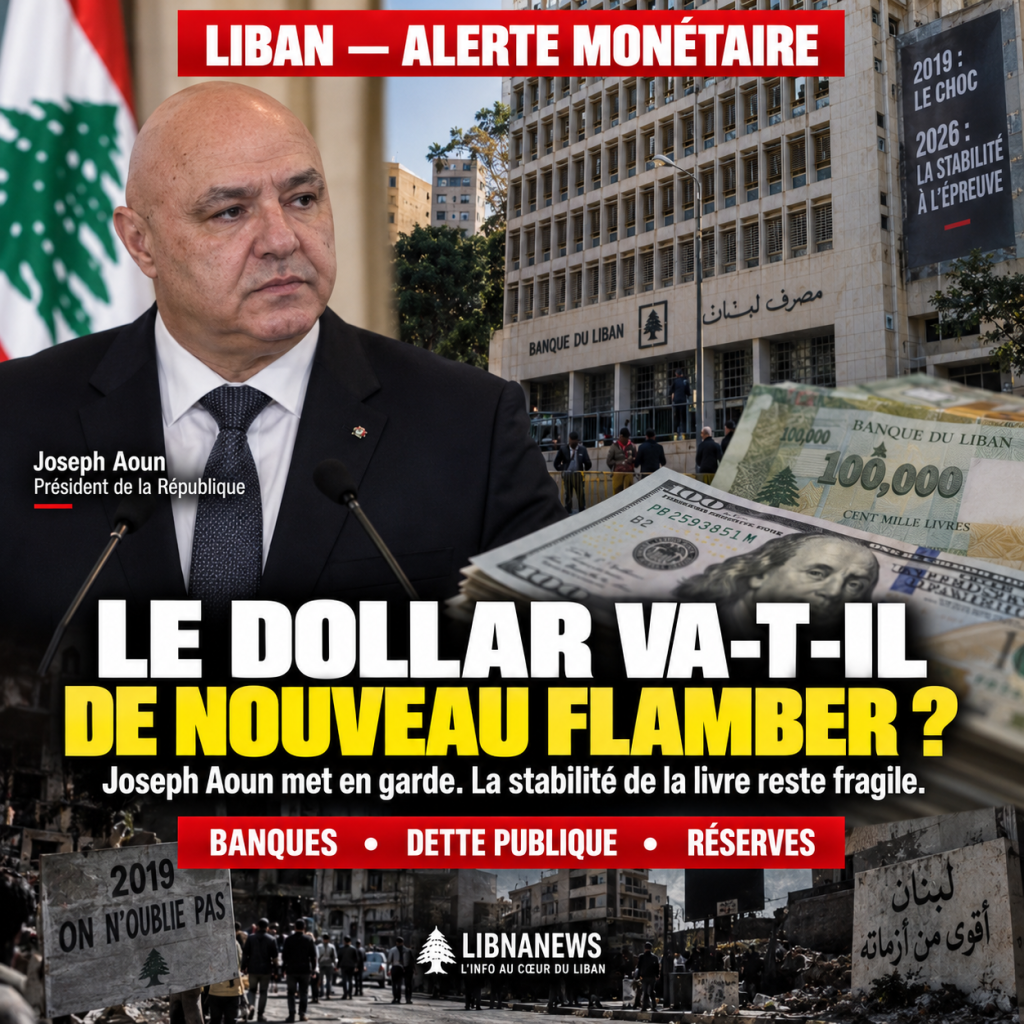
Joseph Aoun denounces the announcements of a return to 2019
President Joseph Aoun has chosen to publicly respond to the speeches announcing a further surge in the dollar and a repetition of the 2019 crisis. On 7 October 2026, he warned against attempts to politicize the economic situation, while the government of Nawaf Salam faced several challenges. Its intervention does not guarantee that the exchange rate will remain stable. First, it aims at a well-known mechanics in Lebanon: expectations of depreciation can change behaviour even before a monetary shock occurs. Households seek to protect their savings, traders adjust their prices and liquidity holders favour currencies. The circulation of alarmist forecasts becomes itself a factor of tension, even when their foundations remain uncertain.
The Head of State denounced the statement of a forthcoming increase in the dollar and a return to similar crises in 2019. He linked them to the economic recovery efforts that the authorities say they want to undertake. However, the scope of this position must be precisely defined. The information published on 8 October reports the presidential warning, but does not provide the names of the authors of these forecasts or a demonstration that a coordinated campaign would be at work. The existence of political instrumentalisation cannot therefore be inferred from the presidential discourse alone. To assess the strength of the pound, foreign exchange resources, financing needs, budgetary risks and the ability of institutions to absorb shocks must be examined separately.
Price stability is not enough to establish the health of the economy
A currency can experience a period of apparent stability in an economy that remains deeply weakened. The exchange rate reflects the actual transactions and liquidity conditions of the moment. It alone does not measure the solvency of the State, the ability of banks to return deposits or the evolution of purchasing power. In Lebanon, these distinctions are decisive. Since the failure to pay in 2020 and the collapse of the banking system, the crisis has changed the way households hold and use their income. A significant part of the transactions are made in dollars or dependent on prices indexed to that currency. In such an economy, price stability can reduce a source of uncertainty without resolving accumulated losses.
In order to assess the risk of a further turmoil, several indicators should be examined together: the foreign currency assets effectively mobilized by the Bank of Lebanon, the flow of dollars entering the country, the creation of local currency, the needs of the Treasury and confidence in financial institutions. The newspapers examined do not offer a complete and comparable set of these data by October 8. They therefore do not allow the calculation of a numerical probability of devaluation or the setting of a precise threshold beyond which a crisis would be inevitable. This documentary limit does not cancel the interest of the presidential alert. It simply prohibits turning a political declaration into a definitive monetary diagnosis.
The State budget, the first test of lasting stability
The link between public finances and money remains central. Where government revenue does not cover its commitments, deficit financing can become a source of pressure. It then depends on the modalities chosen: increase in revenue, reduction in expenditure, accumulation of arrears or use of monetary mechanisms. These solutions do not have the same effects. A deferred expenditure may temporarily preserve the treasury cash flow, but it shifts the burden to suppliers, public bodies or households. Conversely, excessive monetary financing may fuel foreign exchange demand and weaken the exchange rate. We must therefore look at the quality of the budget balance, not just its display.
The electrical record provides a concrete example of these interdependencies. The information published on 8 October refers to approximately $300 million in arrears due to electricity from Lebanon by public administrations and institutions. Their settlement would improve the cash flow of the institution, but would move an obligation to debtor budgets. Without breakdown by institution, maturity and nature of debt, it is impossible to assess the realistic rate of payment. The debate on reducing certain fixed charges for subscribers raises a similar question: relieving consumers can be justified, but the corresponding loss of revenue must be financed. Reform that only deals with one side of the account can create tension elsewhere in public finances.
The rise in Lebanese bonds: an ambiguous market signal
One of the most commented financial facts in the October 8 publications concerns the Lebanese State’s international obligations. Their secondary market price would have been close to 31 cents for a dollar of nominal value, which is the highest level in several years. Such an increase indicates that some investors are willing to pay more for securities still associated with the 2020 default. It can reflect the hope of more creditor-friendly restructuring, reform expectations or purchases of funds specialized in debt in difficulty. But it does not constitute an effective repayment or proof that the State has the currency necessary to honour its old obligations.
The mechanism deserves to be distinguished from an immediate improvement in public finances. When an obligation already issued changes ownership, the money paid goes to the seller of the security, not to the Lebanese Treasury. Consequently, the State does not automatically receive new resources solely because of the rise in prices. In addition, a higher price may change the expectations of debt holders as negotiations approach. Some will be less willing to accept a substantial reduction in their claims if they feel that future recovery will be better. The increase in bonds can thus lead to a renewed optimism while complicating discussions on loss sharing. For monetary risk, it is a market sentiment index, not a substitute for the analysis of reserves and foreign exchange flows.
Bank node prevents confounding calm and recovery
The stability of the pound does not regulate the fate of fixed deposits or of losses in the financial system. The banking crisis has broken the bond of trust between a large part of the depositors and the institutions that kept their savings. Until the rules for the recognition and allocation of losses are clarified, the normal functioning of credit remains hampered. Businesses need predictable financing to invest, import equipment and expand their operations. Households must be able to distinguish the money actually available from bank claims whose recovery conditions remain uncertain. Without a credible solution, monetary stabilisation can coexist with a private economy of part of its financial mechanisms.
Bank of Lebanon Governor Karim Suaid intervenes in an environment where banking reform and debt restructuring are closely linked. Parliamentary discussions on 8 October include the fight against money laundering and terrorist financing. They also raise issues of financial regulation. This work concerns the credibility of the system and its relationship with international partners, but it does not replace a decision on accumulated losses. Compliance legislation can improve the monitoring of operations. It alone does not create the assets necessary to repay the depositors. The distinction between regulatory consolidation and financial resolution is essential to understand why exchange rate stability remains vulnerable to a crisis of confidence.
The International Monetary Fund and the conditions for a credible agreement
Discussions with the International Monetary Fund are another aspect of the issue. A mission to Lebanon from 15 to 18 September 2026 is mentioned in the economic information examined. The discussions focus on the continuation of reforms and prospects for the resumption of negotiations. No final financial agreement can be deducted from this single sequence. The presence of a mission and the possibility of new meetings signal diplomatic and technical activity. They do not guarantee any forthcoming disbursement or adoption of the necessary texts. For markets, the difference is fundamental: an announcement of negotiations can improve expectations, but only commitments that have been implemented will make lasting changes in the resources and obligations of the State.
The issue of an agreement is not limited to the amount of any financing. It also concerns the coherence of the programme chosen: debt treatment, banking reform, public finances, governance and protection of the most exposed groups. Poorly distributed reform could increase social tensions and weaken its own implementation. Conversely, a credible programme could reduce uncertainty about future rules, facilitate some funding and improve confidence. However, the information available does not detail a firm disbursement schedule or a final agreement on the distribution of losses. It would therefore be premature to present the discussions as a guarantee of monetary stability. Rather, they are one of the possible conditions for stronger stabilization.
Channels through which a crisis may reappear
A new monetary crisis could result from several distinct mechanisms. The first would be a shock on the supply of foreign exchange, for example if a worsening security situation reduced revenue from travel, tourism or economic activity. The second would be a sharp increase in the demand for dollars, caused by the fear of depreciation. The third would be a deterioration in public finances if payment obligations increased faster than respendable revenues. Finally, a banking or institutional confidence crisis could encourage the preventive conversion of assets into foreign currencies. These mechanisms can be mutually reinforcing, but their presence does not mean that a collapse is already underway.
The regional context gives a special focus to these risks. The 8 October publications describe continuing tensions in South Lebanon and uncertain negotiations with Israel. A deterioration in security could affect businesses, the movement of people and public expenditure on reconstruction. However, the information does not allow the monetary impact of such a scenario to be quantified. Two symmetrical excesses must be avoided: announcing a new disaster on the basis of political assumptions, or presenting current stability as absolute protection. A useful analysis should identify the transmission channels and follow indicators that could show that a risk is occurring.
What authorities must demonstrate beyond statements
The answer to monetary concern cannot be based solely on rumours. To be sustainable, the authorities must provide regular, comparable and sufficiently detailed information on public finances and monetary conditions. The publication of indicators on revenue, expenditure, arrears, transferable assets and central bank operations would make it possible to distinguish real tensions from unfounded claims. This transparency is all the more important as households have already experienced a massive loss of confidence in financial institutions. A reassuring word can temporarily calm expectations. It does not replace data to verify its strength.
The authorities must also clarify the sequence of reforms. The processing of Lebanon’s electricity claims, discussions with international creditors and banking reform are not three independent issues. Together, they determine the ability of the economy to function without accumulating new bonds that are difficult to finance. As of October 8, 2026, the newspapers described a stability defended by President Joseph Aoun, an increase in the price of international bonds and financial negotiations still open. These elements are neither sufficient to announce a repetition of 2019 nor to exclude a new crisis. The difference will depend on the decisions implemented, their funding and the ability of institutions to make their results verifiable.





Comments