

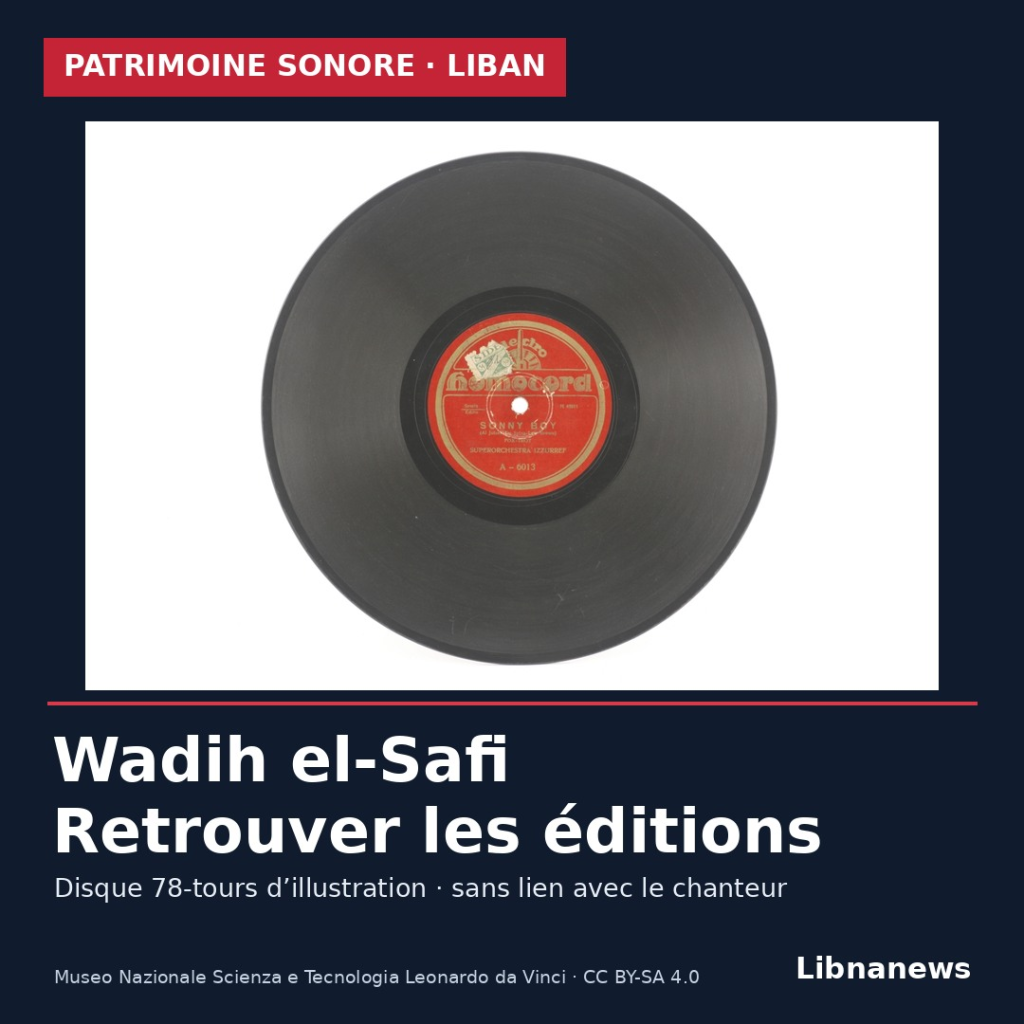
In Paris, a 78-tours by Wadih el-Safi appears in the catalogue of the Bibliothèque nationale de France under a reference Pathé. In North Carolina, an archive of the Lebanese diaspora describes another album, edited by Alamphon. These records show where to start to document the singer’s repertoire: identify the editions that have circulated, without confusing them with the original recordings or assuming who can broadcast them.
On 20 November, the Lebanese Ministry of Information reported on an interview between Paul Morcos and Georges el-Safi, son of the singer. He said he had discussed the retention of recordings, associated rights and public access. The department did not announce in this report any transfer of archives, budget, or online. The searchable catalogues already give a concrete overview of the work that an inventory could do.
Two discs, two references
The BnF describes a 78-round 25 centimetres bearing the reference Pathé PAM1501. Package leafletAllūma Llūma, classified as a dance, mentions Wadih el-Safi singing, accompanied by an orchestra and choirs. The 1956 date refers to the legal deposit indicated in the notice, not to a studio session whose date is known. A copy can be found in the audiovisual department.
At North Carolina State University, the Moise A. Khayrallah Center for Studies on the Lebanese Diaspora documents an Alamphon disc of 10 inches to 78 turns. Its notice says both sidesAllomah Illomahand does not date the edition. The proximity of the titles makes the rapprochement instructive, but the records are not sufficient to establish that it is the same sound recording. Nor do they indicate where the source used to press one or the other disc would be located.
The 38 records related to Wadih el-Safi’s authority star at the BnF include 36 sound recordings and two animated image documents. This count describes the state of a catalogue, not 38 songs or integral of the singer. There are different graphs of his name and credits that change depending on the publication. A work inventory should keep these variants, together with the mark, the record reference, the face and the nature of the date indicated, so that different documents are not mistakenly collected under a single title.
Keeping a copy does not give the right to rebroadcast it
The North American card is accompanied by an MP3. Its reference to fees indicates that the donor retains the rights it controls and that the centre may authorize certain non-commercial uses, including research or teaching. Access to the file is not valid for permission to integrate or reissue a publication. In Lebanon, too, the law distinguishes the rights attached to the work from the neighbouring rights of performers, recording producers and broadcasters. This does not say who currently holds the rights of each version of the song.
The recommendations of the International Association of Audio and Audio-Visual Archives also distinguish the record keeping of a copy that may be processed to facilitate listening. A public catalogue can describe an edition, locate it and report its access conditions without putting the sound online. This is a concrete first step: researchers and listeners know what version is being discussed, while the preservation of the medium and the authorizations for dissemination can be examined separately.





Comments