

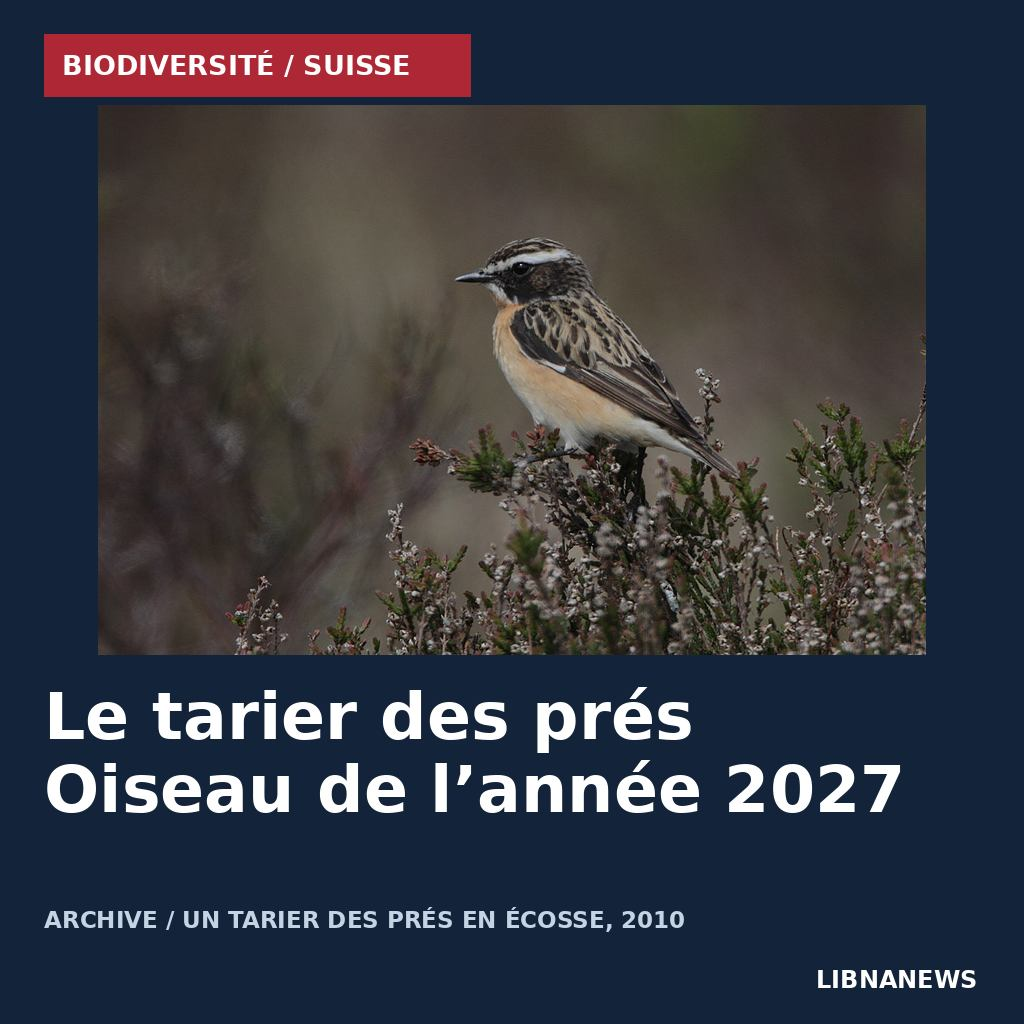
BirdLife Switzerland announced on November 24 the result of its public vote: the tarier of meadows is the bird of the year 2027. This migrant nests on the ground in the prairies. Its retreat shows why, for birds in these environments, the date of the mowing counts as much as the available grass surface.
The public voted from October 1 to 31. Four birds of the flowered prairies were on the run: the tarrier of the meadows, the pipit of the trees, the quail of the wheats, and the rale of the broom. BirdLife Switzerland, which has designated a year-old bird since 2001, thus gives it an awareness role. This distinction does not alter the conservation status of the species.
The tarier of meadows raises his young to the ground
The tarier of meadows (Saxicola rubetra) hunts insects from a high point, such as a stem or fence post. But he’s building his nest down. After leaving the nest, the young still spend a few days hidden in the vegetation before they can fly, according to BirdLife Switzerland. A hatchet at this time can destroy a nest even when the young are no longer in the nest.
BirdLife estimates the Swiss population at 6,000–9,000 couples and says it is still in decline. The tarrier is classified as vulnerable on the Swiss Red List of Breeding Birds. It has almost entirely withdrawn from the Plateau and also declines in the mountains. The Swiss Ornithological Station describes the same shift towards the Jura and the Alps. It notes that irrigation, fertilization and earlier mowing are now changing to the elevation grasslands on which the species depends.
Why protect an entire prairie
Protection of a spotted nest can prevent the machine from passing over it. However, the Swiss Ornithological Station highlights the limits of this solution when grasslands lose their flowers and insects on a lasting basis. Work in the Conches Valley and Lower Engadine combine stable or increasing numbers with large, poorly fertilized, unirrigated and largely late-harvested areas. The threshold of at least 60 % of late mowered areas concerns the sectors studied or targeted by these projects. This is not a uniform timetable for all Swiss prairies.
In several marsh sites in Schwytz Township, BirdLife reports that more than 18 hectares of land were cleared as part of a work undertaken in 2016 with farms, cantonal services and volunteers. The partners have also restored moisture in some areas and concluded late mower agreements. This programme precedes the vote: the title of 2027 highlights measures already experienced, without showing alone a recovery of the national population.





Comments