

On 24 November 1989, two days after the assassination of René Moawad, deputies gathered in Chtaura elected Elias Hraoui. Nine years later, day by day, he passed on the presidency to Émile Lahoud at the Baabda Palace. Émile Lahoud was elected on 15 October. These two scenes tell of the displacement of institutions during and after the war.
President elected in Bekaa
On 24 November 1989, Parliament chose the deputy for Zahlé Elias Hraoui to succeed René Moawad, who had been murdered on 22 November in Beirut. The elected representatives gather in Bekaa, at Park Hotel in Chtaura according to the archives of the Hraoui Presidency. This choice of place is not a ceremony relocated to an already pacified country. The power remains disputed and General Michel Aoun still occupies the Baabda Palace at the head of the military government formed at the end of the term of office of Amine Gemayel.
Hraoui already knows the institutions he addresses. Elected MP in 1972, he chaired the Parliamentary Committee on Agriculture and was appointed Minister of Public Works and Transport in 1980. At the time of his election to the presidency, the issue was not to renegotiate the text agreed in Taif in October. It is to follow up after the death of the first president elected in this framework, while the reconciliation project remains contested.
In the swearing-in speech retained by the Lebanese presidency, Hraoui presents his assumption of office as a continuation of the work of his predecessor. It places the restoration of State authority and the return of displaced persons among the objectives. These are political commitments, not a state of affairs: constitutional reforms inspired by the Taif agreement will take place only in September 1990.
Presidency offices do not return immediately to Baabda
The election does not give Hraoui the keys to the palace. According to the chronology of the Lebanese presidency, he moved first to a barracks in Abdullah, in the Bekaa, and then to a temporary siege in Ramlet al-Baida in Beirut. Even after Michel Aoun’s departure from Baabda on 13 October 1990, he did not move to the palace: the building was heavily damaged and must be rehabilitated. Hraoui did not settle there until July 1993.
It is therefore necessary to distinguish three stages: the election which provides for the presidency, the inclusion of part of Taif’s reforms in the Constitution, and the return to the usual premises. The chronology of the Presidency makes this gap visible. An election may restore the continuity of a function without the institutions immediately returning to their normal place or functioning.
Nine years later, the transfer takes place at the palace
The presidential term was not intended to last nine years. In October 1995, Parliament amended article 49 of the Constitution and extended the current term of office for three years. The Presidency selected 23 November 1998 as its last day. The next day, November 24, Hraoui handed over the palace to his elected successor, Émile Lahoud, and then left Baabda.
Between the two dates, the change is read in the place. In 1989, a president was elected to a hotel in La Bekaa, but he could not take office at the palace. In 1998, he received his successor. The second scene does not erase the controversies of the mandate or the questions left open by the Taif agreement. It shows what the former had not yet allowed: a transmission of power to the Presidency.
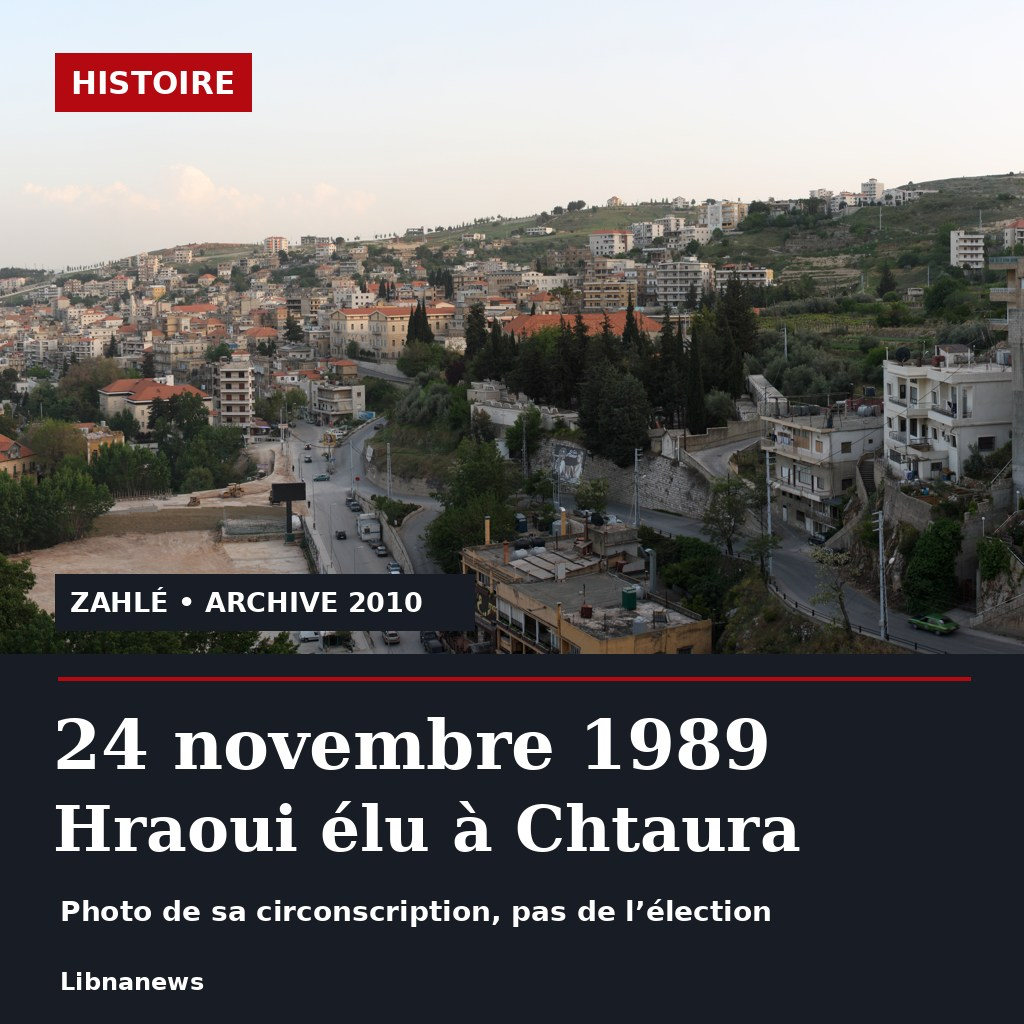
Cover: panorama of Zahlé, where Elias Hraoui was elected MP on 17 April 2010. The photograph shows neither Chtaura nor the 1989 session. Guillaume Piolle (Eusebius) / Wikimedia Commons, CC BY 3.0. Boxing and dressing Libnanews.





Comments