

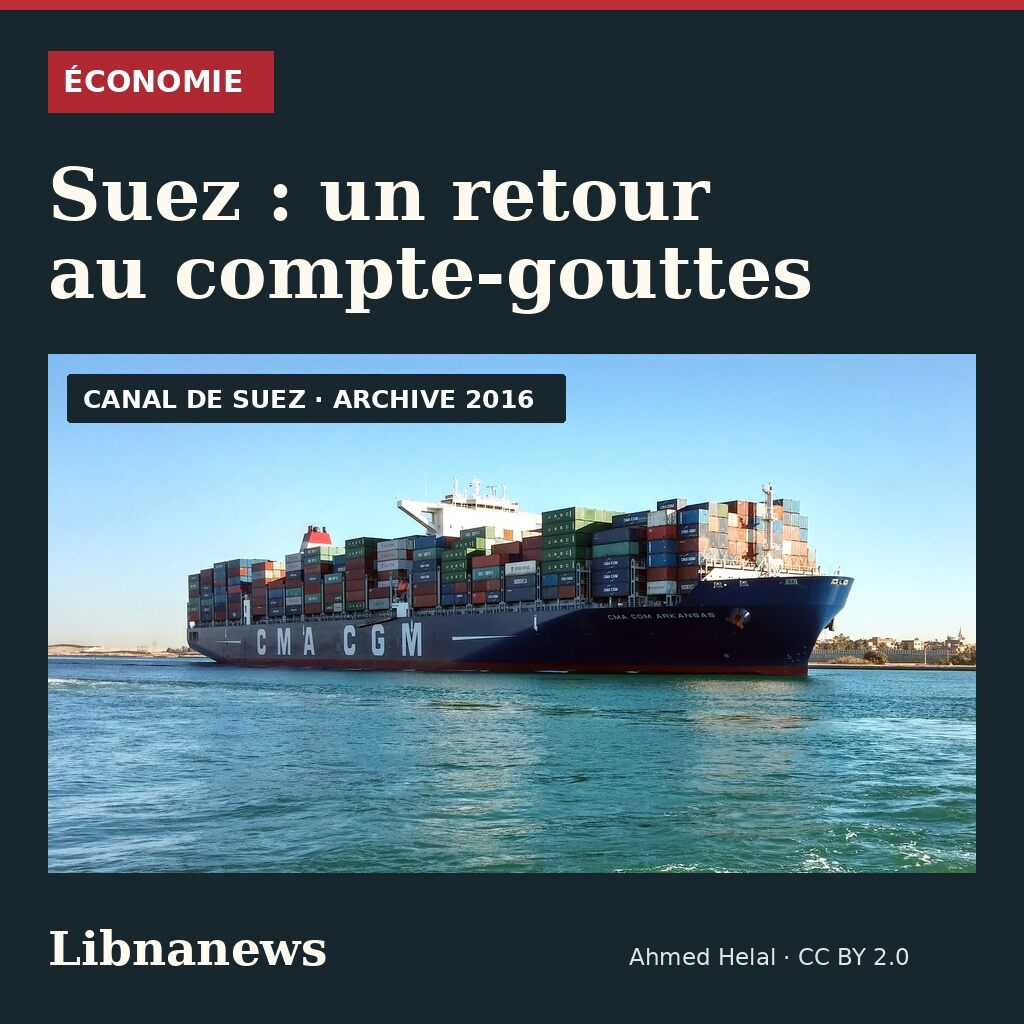
Two container carriers of Evergreen and Ocean Network Express crossed the Suez Canal on November 8 and 15, 2026, according to the Canal Authority. Maersk and Hapag-Lloyd announced that Suez would return to a common service between India and Europe. For Lebanese importers, these decisions do not constitute a change of service or a decrease in freight prices.
The return by Suez decides line by line
A noted passage does not have the same scope as a change of service. The two transits announced by the Egyptian Authority show that container carriers from these companies have again taken the canal. They do not provide information on the regularity of the following passages or on the share of their fleet that passes through Suez.
Maersk and Hapag-Lloyd went further by announcing the replacement of the detour with the Cape of Good Hope for one of their common services. The two shipowners expect a faster delivery, without publishing any measure of the gain already obtained. Maersk points out that changes on other lines are still linked to developments in the Red Sea.
In October, more passages and recipes
The October figures published by the Canal Authority are used to measure a resumption of attendance before these November passages. The number of transits, all types of vessels, increased by around 32 per cent over one year. Revenues almost doubled. These two indicators do not indicate how many containers were on board or which ports received the goods.
| Suez Canal | October 2025 | October 2026 |
|---|---|---|
| Transits, all ships | 1 128 | 1 490 |
| Channel revenue | $373 million | $724 million |
For Lebanon, service and price remain separate
CMA CGM lists a direct link between Asia and the ports of Beirut and Tripoli. This commercial offer does not attest to a recent change of route for the Lebanese service nor to the realization of an announced stopover. The two transits in Egypt therefore do not allow an increase in time to arrive in Lebanon.
The same shipowner announced a high season overload for loadings from 25 November. It targets shipments from Asia’s main ports to the Mediterranean and North African base ports: $800 per 20-foot container, $1,600 per 40-foot container. From China, it can be included in freight. Handling, fuel or local charges may also apply.
These amounts are not a cost estimate for Beirut or Tripoli. The notice does not link this overload to a safety incident. In order to compare two offers, the basic tariff is not sufficient: check the arrival port, the loading date, the charges included and the announced time for the shipment in question.





Comments