

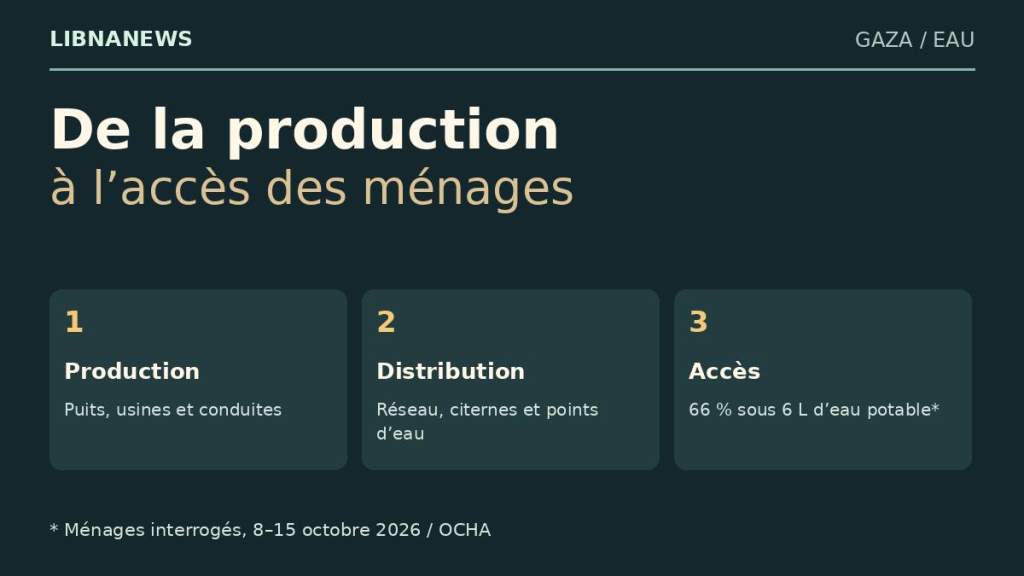
In the Gaza Strip, two out of three households reported having less than six litres of drinking water per person per day during the October humanitarian survey. The figure does not measure the water produced by the facilities: it measures what households say they have obtained. Between the two, the network, the transport and the distribution points are all links likely to give way.
From network to tank: three documented failures
At the end of September, the United Nations Office for Humanitarian Coordination (OCHA) reported that the three lines of the Israeli company Mekorot delivered approximately 40% less than the contractual quantities during the period under review. The United Nations attributed the decline to the difficulties of desalination in Israel, where the presence of algae had affected plants. This is a measure of upstream supply, not the proportion of families without water.
In Dayr al-Balah, another link ceded on 24 August: a strike damaged the reverse d-osmosis unit of the J32 well. The humanitarian partners cleared the rubble and then returned the facility to service. The United Nations estimated that the population served by this facility was approximately 100,000. This number refers to a service population, not a volume produced or evidence that each person received their share.
In Gaza City, the November rains recalled that sanitation also requires access to safe water. In Sheikh Radwan, the level of the basin had risen by nearly a metre and a half according to the humanitarian group responsible for water and sanitation. Rainwater mixed with wastewater from damaged systems; The teams lacked equipment to evacuate them. A water point can remain accessible while becoming unsafe if the vicinity or network is contaminated.
Risk map, samples and distributed volume
A study published by Oxfam on 23 November identified a high risk of contamination of drinking water in northern Gaza, Gaza City and Deir el-Balah: wells or desalination facilities still in use are located in areas where groundwater is vulnerable and debris is high. It’s a risk card, not a potability statement at each tap. The analysis distinguished July samples from this map: fecal coliforms had been detected in 19% of the 79 wells studied. The part concerns the points sampled, not all the wells in the territory.
What the six liters measure
In its report of 18 November, OCHA reports that 66 per cent of households surveyed by telephone between 8 and 15 October were below six litres of drinking water per person per day. 34% reported less than 15 litres of water in total. These two thresholds distinguish water intended for drinking and all domestic uses; the shares do not add up. The responses describe the sample interviewed and do not constitute a measure per neighbourhood or a survey as at 26 November.
In order to follow the return to service, three separate figures are required: the nominal capacity of wells and plants; what they actually produce with energy and available parts; and what affects families, by driving or truck. The UN bulletin issued on 20 November documents the clearance of 121 pipeline sites and evacuation facilities and emergency response in 69 displacement sites. However, it does not publish a uniform reading of the litres of drinking water delivered to each neighbourhood.





Comments