

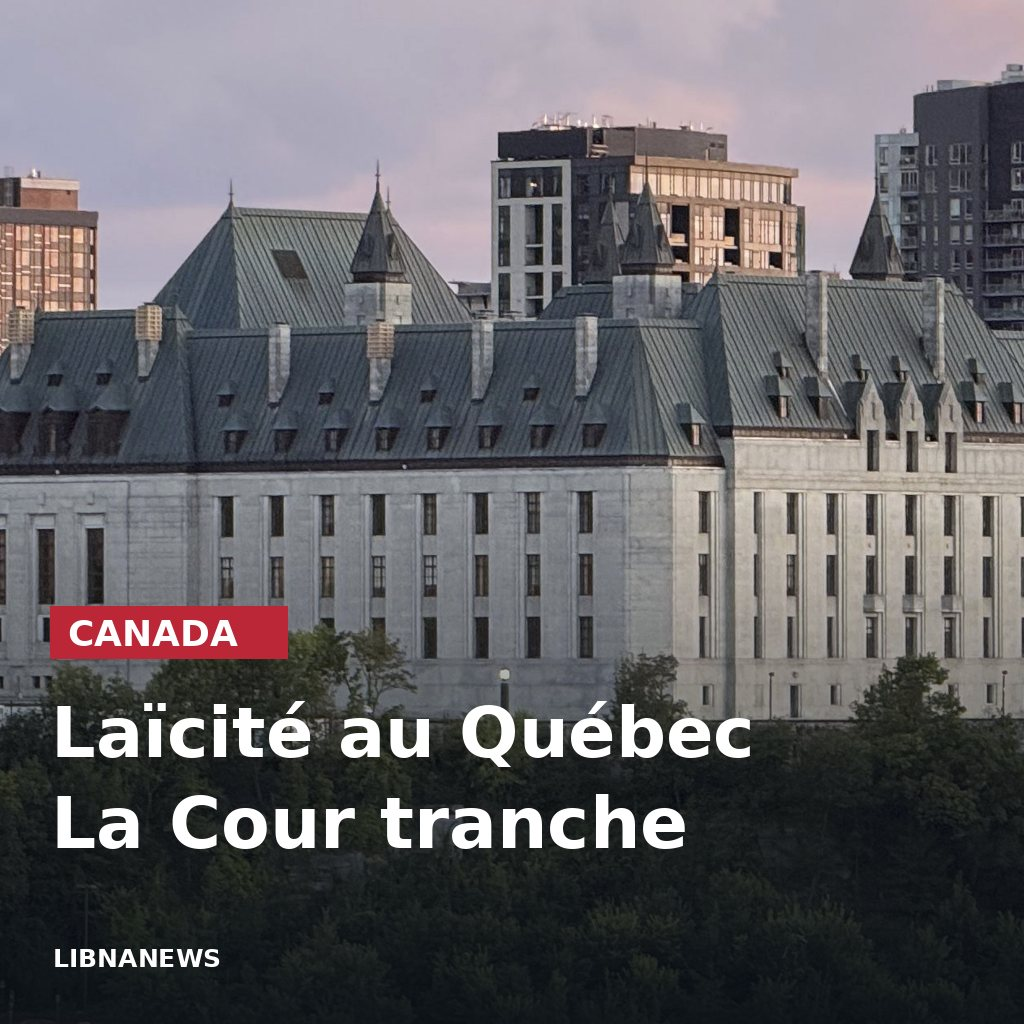
The Supreme Court of Canada confirmed Friday, November 27, most of Quebec’s law on state secularism. The prohibition on wearing religious signs remains applicable to the categories of personnel covered by the text, including teachers in the public network and police officers. On the other hand, the Court ruled out the requirement to sit face-to-face as it applied to members of the Quebec National Assembly.
What remains in force in schools
The law passed in 2019 prohibits the wearing of religious signs in the performance of certain functions listed in the text. This is not a prohibition that applies to the population in public space. The English-Montreal School Board argued that restrictions on the hiring and management of teachers infringed the right of the English-speaking minority to manage its schools.
The Court recognizes that the law may limit the choice of English-speaking school boards when recruiting or wishing to transfer or promote a person. However, it finds that these constraints have not been demonstrated to affect the linguistic or cultural interests of the minority protected by section 23 of the Canadian Charter. English-speaking public schools are therefore not exempted under this article.
The derogation does not exclude any control of the judge
The judges confirmed that Quebec had validly invoked section 33 of the Canadian Charter and the corresponding provision of the Quebec Charter. The federal system allows a legislator to enforce a law despite certain guarantees, including freedom of religion and the right to equality, within the limits set by the law. The declaration must be express and cease to have effect after not more than five years, unless renewed.
The judgment distinguishes between the maintenance of the law and the possibility of a declaratory judgment on its compatibility with protected rights. The clause does not deprive a court of the possibility of making such a declaration. However, the Court chose not to rule in this case. Nor did it hold that section 28, which also guarantees women and men the rights set forth in the Charter, was in itself a ground for invalidation.
Why MEPs are an exception
Section 3 of the Canadian Charter protects democratic rights and is not one of the guarantees that section 33 permits to derogate from. According to the Court, the obligation of the uncovered face prevented an elected person whose religion prescribes a curfew from performing his parliamentary duties. The judgment removes this obligation in its application to deputies, without removing any other restrictions of the law.
The case was heard four days in March 2026. The decision of 27 November referred to 2026 SCC 41. The Court dismissed the appeals of the challengers and the Quebec Attorney General’s incident appeal, so that the MP exception remains.





Comments