

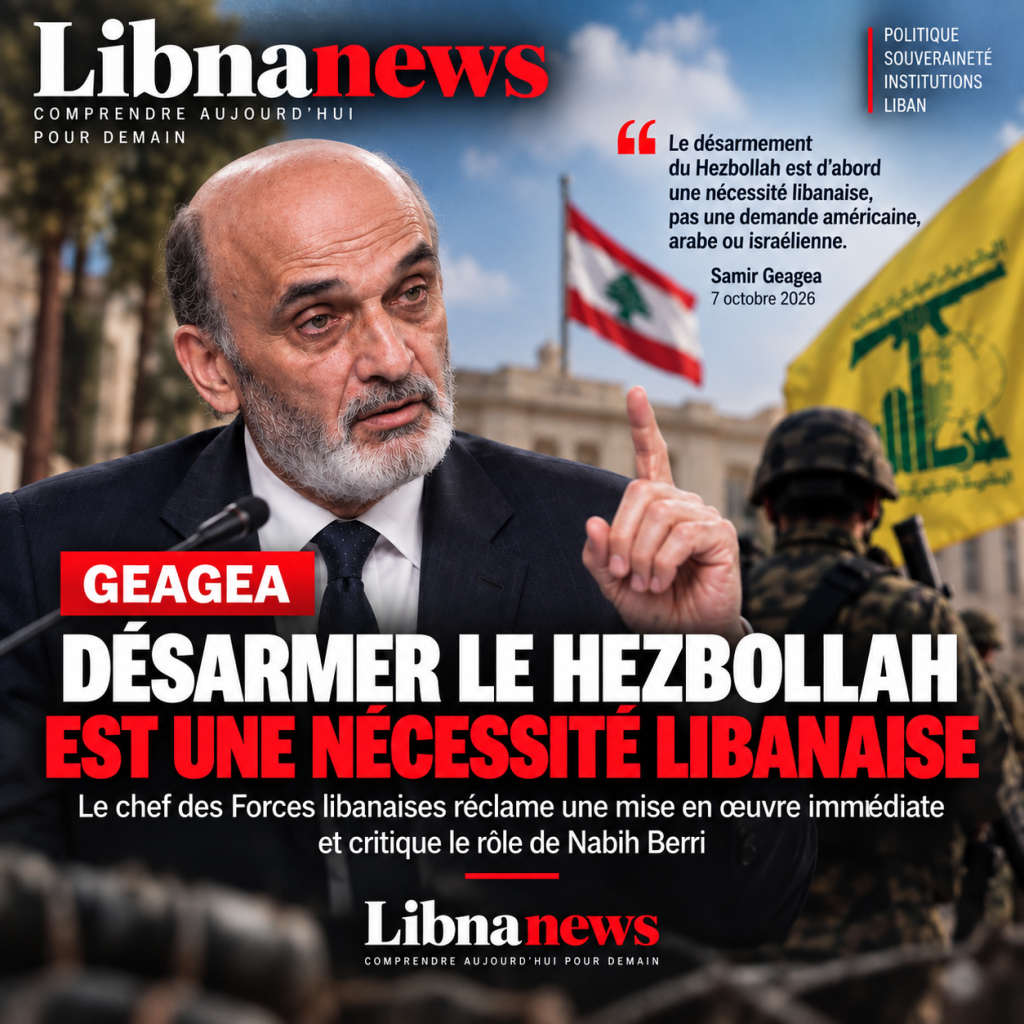
Lebanese Forces leader Samir Geagea called for the immediate disarmament of Hezbollah on Wednesday, 7 October 2026. He claims that this approach responds first to a « Lebanese necessity » and not to the demands of the United States, Arab countries or Israel. This position is taking place at a time when the Lebanese State has already initiated a process to place weapons under its exclusive authority. Geagea also challenged the Speaker of Parliament, Nabih Berri, whom he accused of not playing a constructive role.
The Lebanese Forces Chief Samir Geagea handed over thehezbollah disarmamentcentral to the Lebanese political debate. In statements reported on Wednesday, 7 October, he defended the immediate implementation of this process and rejected the idea that Beirut would act mainly under pressure from foreign powers.
According to Geagea, presenting this issue as an American, Arab or Israeli requirement amounts to reversing priorities. It believes that disarmament is above all an internal necessity to enable the Lebanese State to exercise its full authority.
This position is in line with the long-standing defence of the Lebanese Forces. The party believes that State institutions must have military means and strategic decision on war and peace alone.
Geagea puts Hezbollah disarmament at the forefront
Samir Geagea directly challenged the argument that the Lebanese government would seek to disarm Hezbollah because Washington, some Arab States and Israel requested it.
« That’s not true, » he said. For the Lebanese Forces leader, the dismantling of the Hezbollah military apparatus is a priority for the Lebanese population before responding to requests from foreign powers.
It even considers that this issue should have been resolved earlier. According to him, the process should have started before the last war and before the discussions that led to the current political and security framework.
Geagea therefore believes that Lebanon is acting late. Its reasoning is based on a clear institutional concept: no independent armed organization should be able to maintain a military capacity to influence the country’s strategic decisions.
He also claims that 75 per cent of Lebanese want the dismantling of the Hezbollah military apparatus. This figure is advanced by Geagea himself. No survey or methodological element to confirm this proportion accompanied the reports reported on Wednesday. It should therefore be seen as a political statement by the Lebanese Forces leader and not as an established measure of public opinion.
The issue of weapons now included in State decisions
Geagea’s statement comes in a very different context from the one that prevailed a few years ago. The principle of limiting arms to legal institutions alone is no longer only carried by the political opponents of Hezbollah.
On 5 August 2025, the Council of Ministers decided to move towards a state monopoly on arms. The Lebanese Army then developed a plan to implement this direction on the ground.
On 8 January 2026, the army announced that it had achieved the objectives of the first phase of its plan. This was mainly in the area south of Litani. In particular, the military command had reported an increase in its operational presence and control in areas under its control.
However, the army had highlighted several obstacles. It had cited the Israeli presence at some sites, attacks on Lebanese territory and difficulties related to unexploded ordnance and underground military infrastructure.
The case reached a new stage on March 2, 2026. The Council of Ministers then announced an immediate ban on Hezbollah’s military and security activities outside legal institutions. The Government also called on the movement to hand over its weapons to the State and to limit its activities to the political sphere within the constitutional and legal framework.
That decision gave the disarmament debate an additional institutional dimension. It means that the issue is no longer only about the principle of arms exclusivity, but about the conditions and timing of its application.
For Geagea, sovereignty requires a single military decision
The heart of Samir Geagea’s argument is precisely about state sovereignty.
The Head of the Lebanese Forces affirms that a State cannot function fully when a separate military organization retains an autonomous capacity and intervenes in strategic decisions.
» You cannot have a state, a real state, with a military organization that confiscates strategic decisions and decisions of war and peace, » he said.
This formulation summarizes the Lebanese Forces’ position on Hezbollah. Geagea does not limit the case to the possession of small arms or military structures. He asked the question of the decision-making centre: who in Lebanon has the power to engage the country in a conflict or to decide to cease it?
The Lebanese government has itself taken this principle into account in its decisions of March 2026. He claimed that decisions on war and peace were the sole responsibility of the State. At the same time, it called on the army to continue implementing its arms control plan north of the Litani River.
However, the authorities have linked this approach to the regional security situation. In the same decision, the Government called on the States guarantors of the ceasefire to obtain from Israel a commitment to put an end to the attacks on Lebanese territory.
This dimension remains decisive for the army. By January, his command had warned that Israeli attacks, the occupation of several positions and restrictions on access to certain areas made it difficult to continue his missions.
Geagea also attacks Nabih Berri
In his statements, Samir Geagea also challenged the Speaker of Parliament, Nabih Berri. He blames him for not playing a « constructive » role in the current period.
In particular, the Lebanese Forces leader accuses Berri of obstructing the legislative changes he deemed necessary for the electoral process.
This criticism is part of an earlier political confrontation between the Lebanese Forces and the President of the Chamber over the electoral law. In particular, there was disagreement over the modalities of participation of Lebanese abroad.
The 2017 electoral law provided for six specific seats for the diaspora. However, this provision had not been fully implemented in the 2018 and 2022 elections. Expatriate voters then took part in the elections in their original Lebanese constituencies.
The Lebanese Forces defended the maintenance of a system allowing expatriates to participate in the election of all deputies. Nabih Berri supported a different reading of the law.
Geagea’s criticism of Berri on Wednesday must therefore be understood as a political statement by the Lebanese Forces leader. It does not in itself constitute an institutional observation of the role of the Speaker of the House.
A debate now on enforcement
Samir Geagea’s statements are taking place as the Lebanese debate on Hezbollah’s weapons has changed dramatically. For years, political forces have mainly faced the very principle of disarmament and the legitimacy of maintaining a military apparatus distinct from that of the State.
Since the government’s decisions from August 2025, the question has also focused on their implementation.
The army has been given the task of extending the authority of the State and of implementing an arms control plan. The government then explicitly banned Hizbullah’s military and security activities outside legal institutions in March 2026. These decisions now provide the institutional framework for Geagea’s appeal.
The leader of the Lebanese Forces, for his part, is seeking to speed up the timetable. His intervention on 7 October stressed the interior nature of this requirement. He refused to see disarmament as a concession from Lebanon to the United States, the Arab countries or Israel.
This distinction is politically central. It allows Geagea to present the issue not as the result of a regional relations of forces, but as a choice directly concerning the Lebanese state organisation.
The follow-up, however, will depend on the government’s decisions, the army’s ability to continue its plan and the evolving security situation. The military authorities have already indicated that conditions on the ground can slow down their operations. The gap between Geagea’s request for immediate disarmament and the State-led operational process remains one of the main outstanding issues.





Comments