

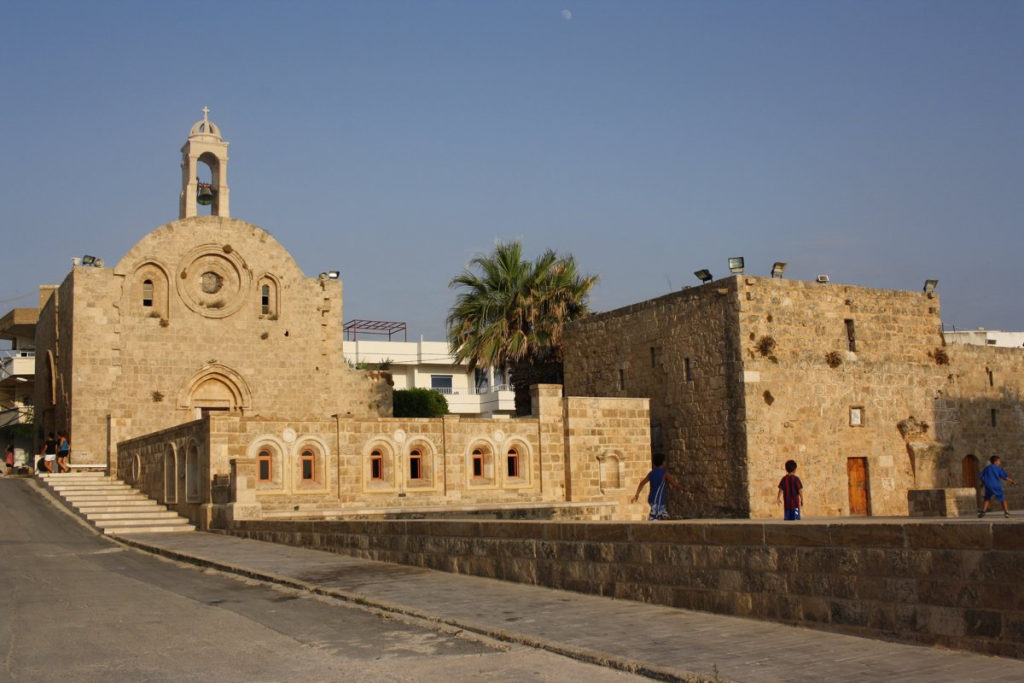
In Anfeh, the Holy Catherine is a patronal feast inscribed in the parish archives: Vespers on November 24, liturgy on the 25th, under the patronage of a martyrdom whose religious narrative has traversed the centuries. In 2026, the Orthodox celebration fell on a Wednesday. The Maronite calendar retained on 24 November.
On the coast of the Kura, the Church of St Catherine gives a concrete place to this memory. The bulletins of the Orthodox Archdiocese of Tripoli and the Kura allow to follow the meetings of the feast over several years. They illuminate a local practice without adding to it the customs of the « Catherinettes » known elsewhere, or turning the old schedules into a program for 2026.
November 25 in Anfeh, the 24th in the Maronite synaxar
The calendar of the Orthodox Patriarchate of Antioch inscribed Catherine on November 25, with the closing of the feast of the entry of the Mother of God into the Temple. The bulletins of the diocese of Zahlé and Baalbek reproduce this date. It places the commemoration in the fasting of the Nativity, beginning on November 15.
The synaxary of the antiochian Maronite rite reproduced by Maronite Heritage, after the edition of Kaslik in 1996, place Catherine, virgin and martyr, on November 24. The difference is also mentioned in Zahlé’s Orthodox synaxar. The Latin calendar published by the information service of the Holy See retains 25. The same saint thus has two related dates in traditions present in Lebanon. This one-day difference should not be confused with the difference between the Julian and Gregorian calendars.
A story transmitted by the stories of saints
Tradition places Catherine in Alexandria, in the context of the persecutions of the early fourth century. She presents her as an educated young Christian who refuses to sacrifice to the deities of the Empire, debates with scholars and remains faithful to her faith until martyrdom. These episodes belong to the hagiography, i.e. the narratives intended to convey the memory and spiritual example of the saints.
Religious sources themselves invite historical prudence. The Italian notice of the Holy See’s information service refers to a Passion written several centuries after the time when the story placed Catherine. Zahlé’s synaxary of November 25, 2024 highlights the absence of contemporary documents preserved and the late transmission of his life.
Not all records give the same chronology of old texts. The exact age of Catherine, the number of her interlocutors or the details of the torture cannot therefore be presented as the verified elements of a trial. Documentary accuracy is stronger when studying the reception of the narrative: liturgical texts, images of the saint and celebrations attested in parishes.
The wheel and the books: read the symbols
The presentation of the patriarchate of Antioche explains two common attributes of Catherine. The wheel refers to the instrument of torture which, according to the story, breaks when one wants to use it against her. The books evoke discussion with philosophers and scholars. Holiness is represented in it through the testimony of faith and the word of argument.
The liturgical title of « the bride of Christ » belongs to the same symbolic language. Tradition tells of a spiritual union represented by a ring; She expresses Catherine’s fidelity to Christ. This is not a historic marriage. In hymns, wisdom, endurance and hope count as much as the objects depicted near the saint. These meanings explain the icon without deducing a domestic rite unique to Lebanese families.
In Anfeh, a documented business party
The diocesan bulletin of 22 November 2009 announces the feast of Catherine as that of the patroness of Anfeh. Metropolitan Ephrem Kyriakos is scheduled to chair the Vespers on November 24 at 4:30 p.m. The following day, the mornings were announced at 8 a.m., followed by the liturgy in the Church of St Catherine. The vocabulary of the newsletter already indicates an annual appointment.
Seven years later, the issue of November 20, 2016 takes up the same succession: Vespers on the 24th, this time at 5 pm, then liturgy on the 25th to 9:30 am. The variation in schedules is instructive. It shows a repeated tradition whose organisation remains fixed locally, year after year.
The archives of the diocesan homilies still record a sermon of Ephrem Kyriakos for the feast, in Sainte-Catherine d’Anfeh on November 25, 2021. This trace complements old ads. Together, these documents attest to the offices, place and participation of the diocesan official. They do not prove a systematic procession, a compulsory popular meal, or a program already agreed for 2026.
A local memory, several Catherines
The Catherine celebrated in Anfeh is Catherine of Alexandria. It must be distinguished from Catherine Labouré, a 19th-century figure linked to the Miraculous Medal. In Lebanon, the calendar of the Vincentian holidays of St. Joseph’s College of Antour placed it on 28 November. The proximity of dates and the common name can blur research, while stories and devotions are different.
In Anfeh, the archives give the Sainte-Catherine its own continuity: to enter the feast from Vespers, to meet for the liturgy of the next day and to take up the texts dedicated to the patroness. The schedules of 2026 must come from a parish announcement. The memory is already legible in the preserved documents, which link a widely shared Christian tradition with a specific community in the Kura.





Comments