

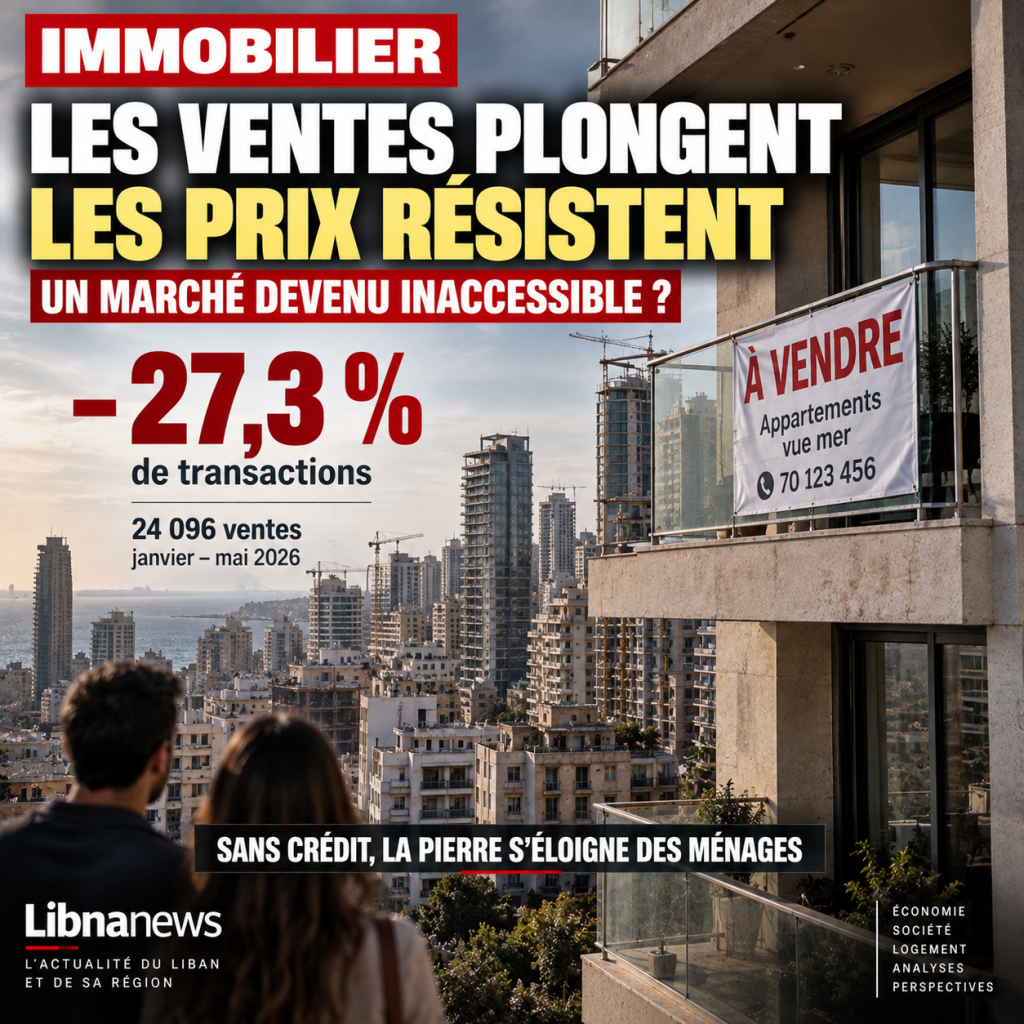
The figure could suggest a real estate market in the middle of stalling. In the first five months of 2026, about24,096 real estate transactionswere registered in Lebanon. Their number declines by27.3%in relation to the same period of the previous year. Almost one in four operations disappeared in 12 months.
Logically, such a contraction should put strong pressure on prices. Yet the available data tells a different story. The cumulative value of transactions still stands at about$2.6 billionand its decline remains much lower than in the number of sales, around8 %. Even more surprising, a professional estimate points to the possibility of rising prices of up to30% by the end of 2026.
This is one of the most interesting paradoxes of the Lebanese economy today:much less goods are sold, without observing a proportional collapse of their value.
It would be tempting to see evidence of extraordinary resistance from real estate. That would be too fast. A market can maintain high prices while becoming less liquid, narrower and much more difficult to access. The drop in transactions can even become a symptom of price resistance: buyers and sellers no longer meet enough to produce the volume of trade observed previously.
The real subject is therefore not only the price per square metre. It is to understand why, in a country still facing a major financial crisis, owners do not seem obliged to slash their property and why buyers are becoming rarer.
24,096 sales: the figure that tells a shrinking market
A 27.3% decrease in the number of transactions in five months is significant enough not to be treated as a mere seasonal change. Real estate activity is slowing down significantly.
But the total value of transactions only declines by around 8%. The gap between these two developments is revealing.
As a guide, if we divide the$2.6 billiontransactions by24 096 operationsa mean value of slightly less than$108,000 per transaction. This calculation does not constitute an average price of housing: transactions may involve apartments, land, shops or other goods of very different sizes and values. However, one thing can be said: the contraction of the volume did not lead to a comparable contraction of the amounts exchanged.
The market therefore further selects its transactions.
Goods still selling appear to be of sufficient value to prevent the overall amount from collapsing at the same rate as the number of transactions. This may reflect a number of phenomena: concentration of purchases in certain areas, maintenance of the prices requested, scarcity of forced sales or market displacement to buyers with significant liquidity.
The available data do not allow for the precise attribution of a part of the phenomenon to each of these factors. However, they are sufficient to rule out a simplistic reading:less sales does not automatically mean less expensive real estate.
Credit, a big absence from the market
The structural problem is obvious: Lebanon no longer has the engine that normally allows a middle class to buy housing.
In a traditional real estate market, a family must not immediately own $150,000 or $200,000 to purchase an apartment. It brings part of the sum and borrows the rest out of fifteen, twenty or twenty-five years. The credit thus turns a monthly income into purchasing capacity.
The Lebanese banking crisis has profoundly disrupted this mechanism.
As long as the financial system is not truly restructured, old deposits are not settled, and banks are not regaining a normal capacity to collect and then lend long-term money, real estate financing remains very different from the one that existed before the collapse.
The consequence is major: the market no longer addresses the same buyer.
A household with a correct income in pounds or even part of its salary in dollars may be unable to raise the amount required for a cash purchase. Conversely, a person with fresh dollars, foreign savings or expatriation income may continue to purchase.
The problem is not only that the apartments are expensive.
It’s thatthe financial stairway to reach their price has disappeared for a considerable part of the population.
This situation can simultaneously reduce the number of buyers and maintain the prices of goods sought by those who still have liquidity.
A market can be expensive without being dynamic
This is an essential distinction.
A high price is often interpreted as a sign of high demand. That’s not always true. In a liquid market, owners can simply refuse to sell at the price offered by buyers.
The result is an absence of a transaction.
Imagine an owner who estimates his apartment at $300,000. A buyer can only offer 220,000. If the owner does not have an urgent need for cash, he can wait. The price posted remains at $300,000, but no sale is made.
Multiply this behavior across the country and you get exactly the type of paradox observed: a significant drop in the number of transactions without equivalent value correction.
Real estate also has a particular feature in Lebanon. After a banking crisis in which access to deposits has been deeply disrupted, a tangible asset can be perceived differently from a financial asset. An owner who owns an apartment, land or commercial premises has something he can see and keep. He is not necessarily willing to trade for cash at any price.
This heritage psychology potentially contributes to rigidizing the offer.
Real estate also served as a refuge after the bank collapse
The crisis has profoundly altered the Lebanese relationship to stone.
When confidence in banks collapsed, real estate represented for some savers an opportunity to turn an uncertain bank debt into a physical asset. The early years of the crisis had therefore produced behaviours that were not solely related to the need for housing.
Buying an apartment could mean saving part of its wealth.
This function of refuge leaves a lasting trace. A family that has turned part of its savings into an apartment doesn’t necessarily want to quickly sell this asset. On the contrary, it can retain it as protection against new financial uncertainties.
The Lebanese market is then presented with a special offer: many owners own an asset they consider to be a reserve of value, while some of the local population no longer has the means to buy it.
The encounter between supply and demand becomes mechanically more difficult.
This is one of the possible explanations for the slowdown in the number of transactions without a comparable drop in value.
Fresh dollars have created an invisible border between buyers
The real estate market now reflects the wider divide in the Lebanese economy.
Not all dollars are economically equivalent in household experience. The old bank money remains associated with the deposit crisis. Foreign currency revenues, foreign transfers and capital held outside the old banking system have a completely different practical value.
This difference divides potential buyers.
On the one hand, households with fresh liquidity can still intervene in the market. On the other hand, those whose assets remain tied to old deposits or whose revenues do not allow enough dollars to accumulate are much more limited.
The result can be a two-speed market.
Quality goods located in sought-after areas continue to find solvent buyers. Others remain proposed for a long time without a transaction. A national average can hardly reflect this fragmentation.
Therefore, the announcement of a possible increase of up to 30% should be handled with caution.
It is a professional anticipation, not an increase already observed throughout the country. Nor does it mean that every Lebanese apartment will gain 30 per cent value. The differences between Beirut, the coast, the mountains, rural areas or war-affected areas are too large to allow a uniform reading.
A 30% increase? What this forecast really says
The estimate attributed to Walid Moussa of a price increase of up to 30% by the end of the year is spectacular. But its informative value may be less in the maximum figure than in the forecast.
It means that some professionals do not expect the drop in the number of transactions to automatically cause price collapse.
Several conditions can support this reasoning. The scarcity of certain goods, the demand for capital in fresh dollars, the purchase of the diaspora and the resistance of the owners to sell at a loss can prevent a strong correction.
But this anticipation must remain an anticipation.
The available data do not make it possible to state today that the national market will actually increase by 30 %. They also do not make it possible to generalize an evolution identical to all regions and categories of goods.
Above all, nominal price increases do not automatically mean market improvements.
If prices rise while transactions continue to decline, accessibility can further deteriorate.
A real estate market is not healthy only because owners see an increase in the theoretical value of their assets. It is when households can buy, sell, borrow, invest and live in sustainable conditions.
This is precisely what is missing today.
For young households, the problem becomes almost generational
The contraction of credit turns access to housing into a social problem.
A generation that bought before the crisis was able to benefit from long-term real estate loans and financing mechanisms now far more difficult to replicate. A portion of young people now enter a market where the price is widely expressed in dollars, while long-term financing remains very limited.
Even a relatively high wage does not automatically solve this equation.
Saving $1,000 per month represents $12,000 per year. It would take more than eight years to accumulate $100,000 without any expense, which is obviously impossible in real life. As soon as housing, food, transport, health and family are added, the provision of sufficient food becomes much longer.
Without credit, family assets and diaspora support are therefore disproportionate.
Access to property may thus depend less on professional income than on the family’s ability to pass on capital.
It is a profound change in the social model.
It benefits those who already possess heritage and further removes those who begin without capital.
Diaspora can sustain prices without reviving the whole market
Lebanese from abroad occupy a special place in this equation.
Their income is usually in foreign currency and their savings capacity may be higher than that of resident households. Lebanese real estate also retains a strong emotional and heritage value: family apartment, village house, land transferred or investment intended to prepare a possible return.
This request may support certain categories of property.
But it does not replace a functioning internal market.
A sustainable real estate sector cannot rely solely on expatriates or a minority with significant liquidity. He needs a middle class that can buy his home, developers who can finance new projects and banks that can support transactions.
If the diaspora supports prices while residents are gradually excluded, the market may look strong while becoming socially more unbalanced.
The paradox of the 2026 figures then makes sense: value holds, but the base of buyers is shrinking.
The South is a completely different market
Any national analysis must also take into account war.
The destruction-affected areas obviously do not respond to the same mechanisms as Beirut or some residential areas of Mount Lebanon. In the South, the real estate issue is confused with reconstruction, return, compensation and security.
The value of a property is not only determined by its size or location. It depends on whether it is possible to live there, rebuild, access infrastructure and believe that the war will not destroy the good again a few months later.
This difference further reinforces the fragmentation of the Lebanese market.
So talking about a single « real estate price in Lebanon » becomes less and less relevant. There are several superimposed markets: high-end, middle-class, land, village, destroyed areas and diaspora goods.
National averages provide direction. They don’t tell the whole story.
The real indicator to be monitored is not only the price
The public debate spontaneously looks at the price per square metre. The figures of 2026 suggest that something else should be observed:market liquidity.
How long is a property left for sale? What difference exists between the price charged and the price actually paid? What proportion of purchases are financed by credit? What part does the diaspora have? In which regions are transactions concentrated? How many households buy to live and how many buy to preserve capital?
The data available in the corpus do not answer all these questions. It would therefore be artificial to invent a single explanation for the decrease of 27.3%.
However, they allow for a stronger conclusion:the decline in sales and the relative strength of their value indicate that the market does not collapse in a conventional way. It tightens.
Less buyers manage to conclude. Remaining transactions remain significant enough to support the overall value. And the owners do not seem to be forced, as a whole, to liquidate their property massively.
It’s less reassuring than a simple price increase could suggest.
The day banks start lending again will change all the equation
The future of real estate is ultimately linked to the financial record.
If Lebanon succeeds in restructuring its banks, gradually settling old deposits and rebuilding a credit system, the real estate market will be able to regain a much wider base of buyers. Households will no longer need the full cash price.
But this return of credit itself could further support demand and hence prices. It will depend on the amount of housing available, the cost of loans and the real capacity of income to follow.
Conversely, if banking paralysis continues, real estate risks remaining a market dominated by cash, diaspora and wealth holders.
This is why the24,096 transactionsrecorded in the first five months of 2026 tell something deeper than a sectoral slowdown.
They show a country where stone retains a value that many Lebanese can no longer attain.
The paradox is there:the real estate market may resist precisely because an increasing part of the population is excluded from it. Owners able to wait do not sufficiently lower their prices, buyers without credit cannot join them, and transactions disappear between the two.
So the real question for 2026 is not whether the prizes will actually win 10, 20 or 30%. The question is whether housing will become a property that a household can finance with its work, or whether it will gradually remain reserved for those who already own capital, receive income from abroad or have immediately available dollars.
In the first case, a market recovery would mean a return to a more normal economy. In the second, price resistance would hide a much less spectacular reality:apartments that are always expensive, but fewer and fewer Lebanese able to buy them.





Comments