





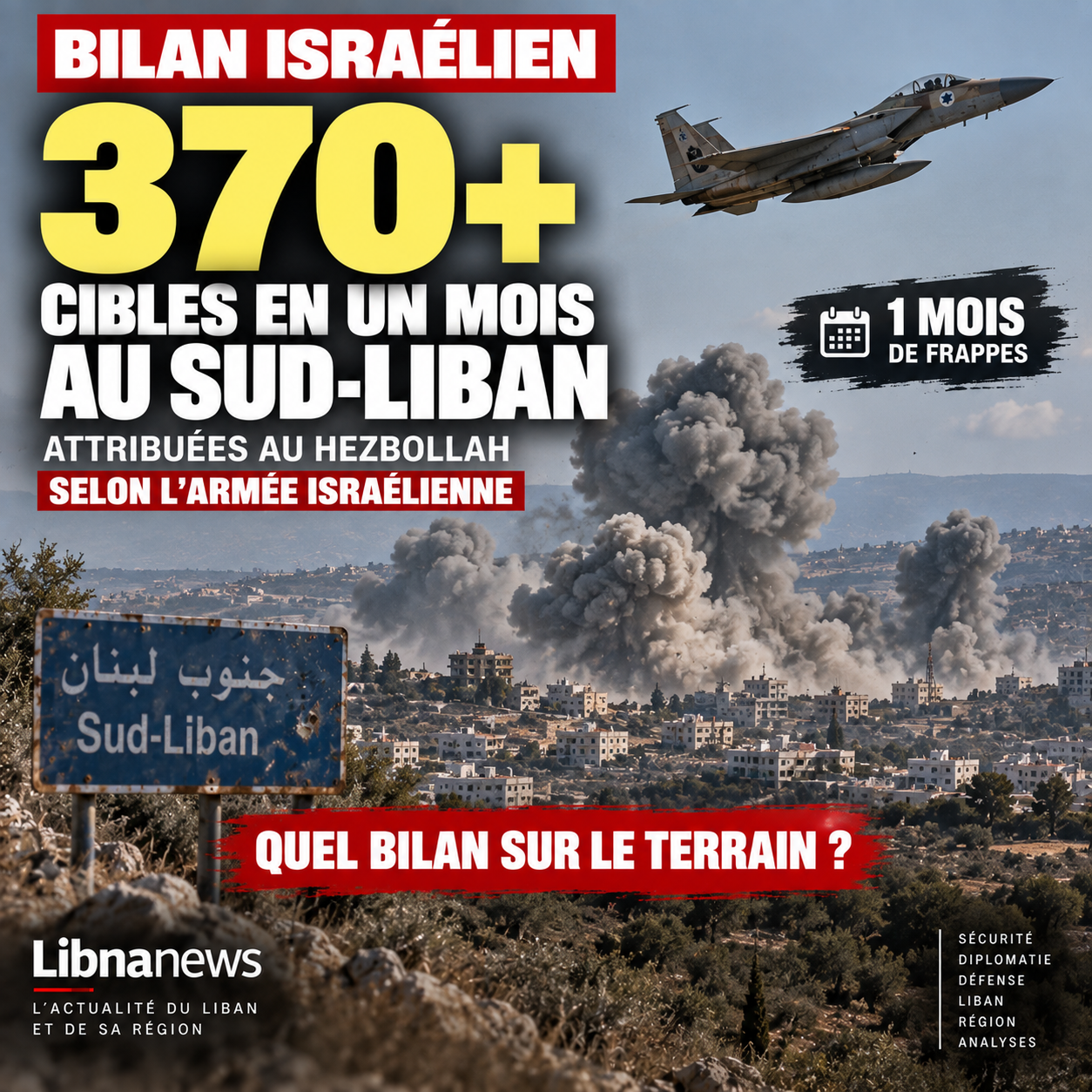
The Israeli army claims to have hit more than 370 targets assigned to Hezbollah in southern Lebanon over the past month. This review, published on Thursday, October 1, 2026, concerns operations conducted by the Israeli Air Force under the direction of the various commands and military intelligence. It has not been independently verified and does not necessarily mean that 370 separate strikes have been carried out, with a single air operation involving several objectives.
According to the Israeli communiqué, these operations in Lebanon are part of a record of over 500 targets hit by Israeli aircraft in Lebanon and the Gaza Strip over the past month. More than 140 targets were reported to have been set in Gaza, while the vast majority of the announced balance sheet therefore concerns the Lebanese front.
The publication of these figures provides an indication of the intensity of air operations in Lebanon in recent weeks. It intervenes as the Israeli army also continues ground operations in the South and maintains military pressure on the infrastructure it attributes to Hezbollah.
More than 370 Hezbollah targets according to Israel
In its statement of 1 October, the Israeli army states that its aircraft continues to operate on several fronts in order to eliminate what it presents as threats and to support forces engaged in offensive and defensive operations.
In Lebanon, more than 370 Hezbollah targets were reportedly hit in the past month. The Israeli army states that these operations were carried out in the south of the country and based on information from, inter alia, the military commands and the Intelligence Directorate.
However, the communiqué does not provide a detailed list of the 370 objectives claimed. It therefore does not allow the precise determination of the number of buildings, positions, weapons depots, underground infrastructure, launchers or persons directly targeted.
The number of « targets » should also be distinguished from the number of attacks. An air strike may target several targets and several munitions may be used against a single target. The figure provided by the Israeli army is therefore primarily its own operational statement.
More than 500 targets between Lebanon and Gaza
The balance sheet announced covers two fronts. Israel claims that its aviation hit more than 500 targets in Lebanon and the Gaza Strip over the past month.
More than 370 are said to be located in southern Lebanon and more than 140 in the Gaza Strip. The figures announced therefore slightly exceed 510 targets in total.
For Gaza, the Israeli army provides more details on the nature of certain targets. In particular, it claims to have killed three Hamas brigade commanders as well as fighters whom it accuses of having prepared attacks or participated in the events of 7 October 2023. Israel also reported targeting persons who allegedly detained hostages, weapons depots and other Hamas infrastructure.
For Lebanon, the communiqué is much less detailed. Most of the information comes from the volume claimed: more than 370 Hezbollah targets hit in the South in a month.
High rate of operations in southern Lebanon
These figures correspond to a period during which Israel continued its air and land operations in several southern regions. In particular, the strikes accompanied the movements of the land forces and the infrastructure destruction operations attributed to Hezbollah by the Israeli army.
For example, on 15 September, the Israeli army announced that it had discovered and destroyed 32 rocket launchers, which it presented as ready for use against Israel. This equipment was reportedly discovered during operations by the 55th Brigade in southern Lebanon.
According to the Israeli version, the rockets had been left behind before the ceasefire agreement entered into force. The army had also announced the destruction of a position and an underground well in the same area.
A few days earlier, Israel had announced the completion of a major operation in the area of Ali al-Taher Ridge. The Israeli army claimed to have dismantled more than two kilometres of underground infrastructure allocated to Hezbollah.
It claimed to have discovered dozens of Iranian-made rockets, missiles, drones, machine guns, dozens of anti-tank missiles and hundreds of mines and explosive devices.
These claims are from the Israeli army and their complete inventory has not been independently verified.
Israeli operations overtake Litani
Military activity has not been limited for several months to areas immediately adjacent to the border. At the end of May, the Israeli army announced that it had taken operational control of the Beaufort Ridge and had engaged forces in the Wadi Saluki area.
Israel reported that its troops had crossed the Litani River and extended their operations against Hezbollah north of the river. The army also said that it was operating near Nabatiyah and was ready to expand its offensive.
Prior to the entry of land forces into these areas, Israeli aviation had conducted preparatory strikes with artillery and tanks. The use of aviation is therefore part of a strategy combining bombing, intelligence and ground operations.
The balance sheet of more than 370 targets announced on Thursday must be placed in this configuration. Airstrikes are only part of Israeli operations in Lebanon, but they can attack positions before ground units advance or intervene on targets identified by intelligence.
Israel claimed 3,500 targets in April
The figure published on 1 October can also be compared with the data reported by Israel in previous phases of the conflict. On 3 April, the Israeli army claimed to have hit more than 3,500 targets in Lebanon since its large-scale operations began.
It reported that its attacks were concentrated on military infrastructure, weapons depots, launching positions and command and control centres attributed to Hezbollah.
Israel also claimed to have hit financial infrastructure linked to Al-Qard al-Hassan and five bridges it accused of being used to transfer arms and fighters from north to south Lebanon.
At that time, the Israeli army also claimed the death of approximately 1,000 Hezbollah members, including commanders and several hundred members of the Radwan force. These figures were derived from the Israeli military record and were not independently confirmed.
The new September review covers a much shorter period: only one month and only air force operations. However, it shows that Israeli aviation is maintaining a steady pace of attacks in southern Lebanon.
A military record without a corresponding human record
The October 1 communiqué does not provide an overall human assessment for the more than 370 targets claimed in Lebanon. It does not specify how many Hizbullah members were killed during these operations or how many civilians were reportedly affected.
This distinction is important. The number of military targets announced by an army does not determine the number of casualties or the extent of civilian destruction. It also does not reveal the proportion of targets actually destroyed.
The figure of 370 indicates, therefore, mainly Israel’s presentation of its operational activity during the past month. A full assessment would require a comparison of this assessment with the Lebanese strike data, the victims identified and the destructions found in the localities concerned.
The announcement was also made in the aftermath of an Israeli attack on a Lebanese Army vehicle in Nabatiyah al-Fawqa. The Lebanese Army command reported that one of its military personnel had been seriously injured and that three civilians had also been affected.
This incident illustrates the direct consequences of the continuation of Israeli operations in areas where the Lebanese army is itself deployed.
Military pressure continues in Lebanon
The publication of this review comes at a time when military and political issues remain closely linked. Israel continues to demand the dismantling of Hezbollah’s capabilities and affirms that its operations are aimed at preventing the movement from rebuilding its infrastructure.
On the Lebanese side, Israeli operations and their territorial extension directly raise the question of the sovereignty of the country and the ability of the Lebanese army to carry out its missions in the areas concerned. The strikes affect areas where Lebanese military personnel, residents and civilian infrastructure remain present.
The Israeli report published on Thursday does not alone measure the human and material consequences of the past month. However, it provides a figure on the claimed intensity of the air campaign: more than 370 targets attributed to Hezbollah were reportedly attacked in one month in southern Lebanon, out of over 500 targets targeted by Israeli aviation by adding together the Lebanese and Gazaoui fronts.
The continuation of ground and air operations now leaves open the question of the pace at which these strikes will continue in October and the areas that will be affected by the possible expansion of Israeli operations.