

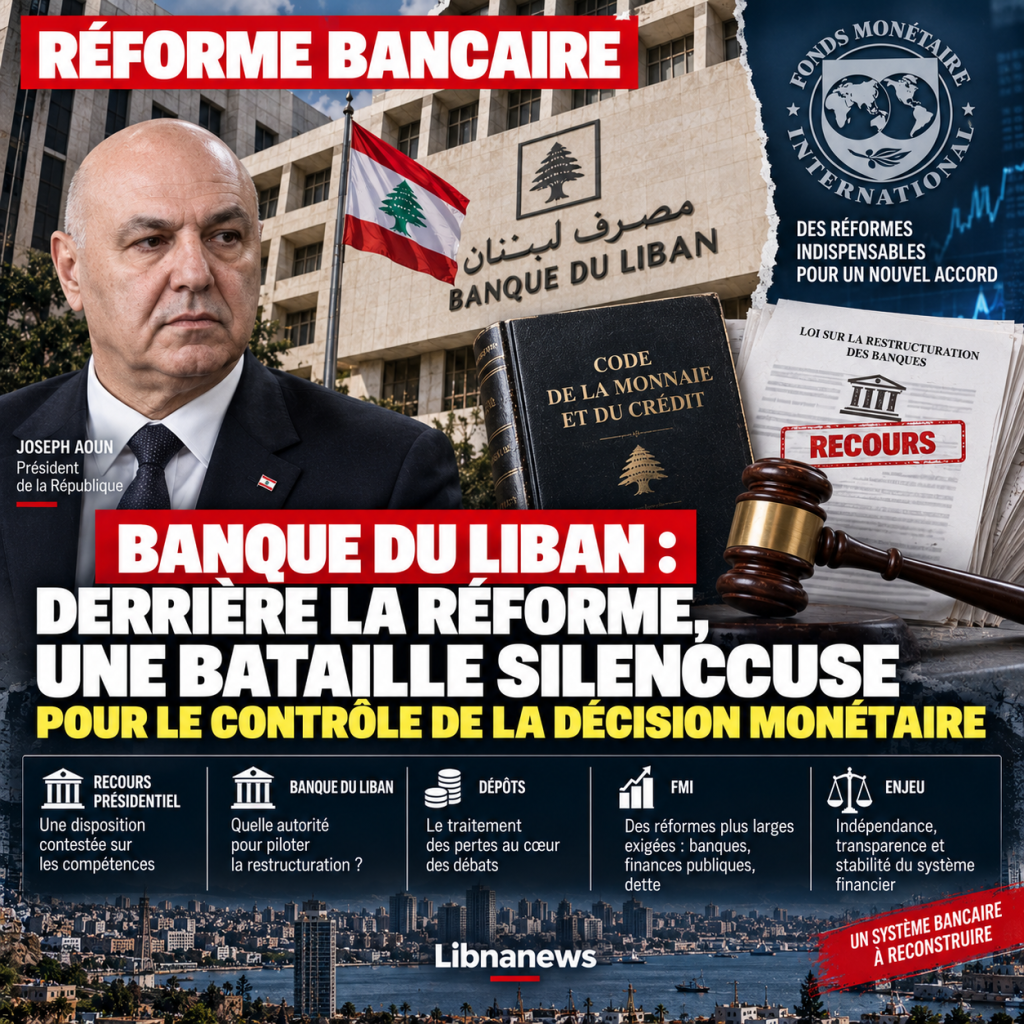
The restructuring of the Lebanese banking sector has opened an institutional battle that far exceeds the fate of the banks in difficulty. At the heart of the debate is the Bank of Lebanon and the extent of the powers that must remain in its hands during the resolution of the crisis. The appeal filed by President Joseph Aoun against a provision of the new banking legislation has made visible a disagreement that has been spreading for several months: should the architecture provided for in the Currency and Credit Code be preserved or should mechanisms be created to restructure institutions with powers that could change the current balance?
The issue has taken on a particular dimension since the arrival of Karim Suaid as head of the Bank of Lebanon. The governor must participate in the resolution of a crisis whose institution is itself one of the central actors. The central bank must maintain monetary stability, supervise the banking system and participate in the treatment of accumulated losses. At the same time, it must regain its credibility after years of crisis. Any change in its powers can therefore have a direct impact on bank restructuring, deposit processing and negotiations with the International Monetary Fund.
A disputed provision directly affecting the balance of powers
The dispute arose when legislation on the treatment and restructuring of banks was adopted. President Joseph Aoun finally chose to challenge a specific provision rather than the entire text. The problem concerns, in particular, the disappearance of a reference to the Currency and Credit Code, which is still one of the legal foundations of the missions and powers of the Bank of Lebanon.
This change may seem secondary to a reader outside the financial discussions. She’s not. The Currency and Credit Code defines the central bank’s monetary and banking responsibilities. Article 70 assigns it tasks relating to the safeguarding of the currency, economic stability and the maintenance of the soundness of the banking system. Therefore, the creation of mechanisms to restructure banks raises a question of competence: how far can these new bodies go without encroaching on the powers already granted to the Bank of Lebanon?
The presidential appeal is based on this question. The aim is to maintain institutional coherence and prevent the emergence of several centres capable of simultaneously intervening in banking decision-making. Restructuring may require exceptional powers. However, it must avoid producing a system in which one authority decides on the future of a bank while another remains legally responsible for the stability of the sector.
The difficulty is therefore to define a clear hierarchy. Without it, the first major restructuring could lead to conflicts of jurisdiction, appeals and further delays. A reform designed to resolve the crisis could then create a new one at institutional level.
Removing the Code reference feeds questions
The parliamentary path of the text has itself become a subject of controversy. The reference to the Currency and Credit Code would have been included in several preparatory versions of the reform. It would have been maintained during part of the technical discussions, before disappearing in the version finally adopted by Parliament. This chronology feeds questions about the reasons for the change and its real consequences.
The debate does not, however, lead to the conclusion that the aim of the abolition was necessarily to weaken the Bank of Lebanon. The available evidence does not demonstrate such an intention. However, there was a clear divergence on the legal effects of the adopted wording. For advocates of the appeal, the lack of sufficient explicit reference to the existing framework may create a parallel authority. For the advocates of the adopted reform, the priority is finally to have the tools to deal with banks in difficulty after several years of immobilization.
These two concerns are not necessarily incompatible. Lebanon needs a banking resolution mechanism that can act quickly. But this mechanism must also function in a stable legal architecture. A very effective paper procedure could lose some of its usefulness if each of its decisions were subsequently challenged on behalf of the Bank of Lebanon’s jurisdiction.
Joseph Aoun’s appeal therefore obliges the institutions to clarify this point before the mechanism is fully implemented. It can cause a delay. But it can also prevent restructuring from beginning on an ambiguity that would become much more difficult to correct once the first decisions are taken.
Karim Suaid facing a Bank of Lebanon with conflicting missions
Karim Souaid’s position is particularly delicate. The Bank of Lebanon must regain its role as regulator while participating in the settlement of a considerable financial liability. It must control banks while its past relations with these same institutions are one of the elements of the crisis. It must also help restore the confidence of depositors, a large part of whom remain deeply suspicious of the entire financial system.
This accumulation of tasks makes the question of the independence of the central bank particularly sensitive. Independence does not mean lack of control. First, it aims to prevent monetary decisions from constantly being subject to immediate political interests. But the Lebanese crisis has also shown the dangers of a system in which the responsibility of the various institutions remains difficult to establish.
The future architecture must therefore reconcile autonomy and responsibility. Karim Suaid must have the necessary powers to carry out the tasks prescribed by law. At the same time, the restructuring of banks must be carried out according to transparent criteria, with rules sufficiently precise to prevent arbitrary decisions. The protection of the independence of the Bank of Lebanon cannot be used to exempt bank resolution from control. Conversely, the need for control should not lead to the central bank being deprived of its basic powers.
This will be crucial when the authorities decide which banks are viable, which need to be recapitalised and which can no longer continue in their current form.
Restructuring banks means allocating considerable power
The institutional debate has a very concrete consequence. The authority responsible for restructuring banks will have immense power. It will be able to participate in determining the viability of an establishment, impose corrective measures, intervene in its recapitalisation and, depending on the framework ultimately chosen, help decide its future.
Behind each of these decisions are shareholders, depositors, employees and creditors. Restructuring is therefore not just about changing balance sheets. It redistributes losses and rights.
A bank deemed viable may continue under certain conditions. Another may have to raise new capital. Shareholders may be called upon to absorb losses. In the most difficult cases, a resolution or liquidation may become necessary. Each decision will have consequences on the deposits and on the system’s ability to recover normal activity.
That is why the question of the competent authority is so sensitive. The regulator of the restructuring mechanism indirectly influences how part of the cost of the crisis will be distributed. The debate on the Bank of Lebanon’s powers is therefore inseparable from the debate on losses.
The financial divide remains the core of the crisis
The bank law cannot solve the crisis alone. The second project concerns the accumulated financial gap between the State, the Bank of Lebanon and the banking sector. As long as this fracture is not addressed, the restructuring may shift losses rather than resolve them.
The Ministry of Finance is continuing work on the corresponding project. Discussions include the Government, the Bank of Lebanon and the International Monetary Fund. Negotiations focus on how to allocate losses while preserving the possibility of putting the financial system back into operation.
This is where the issue becomes politically explosive. Depositors refuse to bear the cost of a crisis they consider not to have caused. The banks also stress the importance of the funds they had placed with the Bank of Lebanon. The State also faces its own financial responsibility and accumulated debt for years.
No solution can fully satisfy all actors. While the state absorbs most of the losses, debt sustainability and public finances are at risk. If banks support them alone, a large part of the sector can become insolvent. If depositors are overly involved, the already destroyed confidence may disappear over time.
The reform must therefore find a distribution capable of being financially credible and socially sustainable.
Depositors at the centre of an impossible reconstruction without confidence
The crisis opened in 2019 has profoundly transformed the Lebanese relationship with banks. For years, many applicants were unable to access their money normally. The restrictions, successive conversion rates and multiple mechanisms applied to withdrawals have established the idea that a bank deposit is no longer necessarily an available claim.
This breach of confidence is one of the most serious problems to be solved. A banking sector cannot function sustainably without deposits. Banks need resources to finance businesses, investments and households. But savers have no reason to put their money back into a system if they are not convinced that their rights will be protected.
The treatment of old deposits therefore has a scope that exceeds the reimbursement of past losses. It will determine the capacity of the new system to attract future deposits. A restructuring that would formally save banks but permanently destroy customer confidence would be an economic failure.
This fact explains the importance of transparency. Depositors must be able to understand how losses have been calculated, what responsibility is incumbent upon each actor, and how the different categories will cope with the effort. Without this clarity, each decision will be suspected of protecting one group at the expense of another.
The Monetary Fund refuses to reduce the agreement to one law
The International Monetary Fund recalled that the road to a new agreement with Lebanon does not depend on a single measure. The entry into force of a credible mechanism for the treatment of banks is an important step, but it must be accompanied by legislation adapted to the financial divide and public finance measures.
Budget 2027 and the debt trajectory are also part of the equation. The Fund calls for a medium-term framework to demonstrate that public finances can return to sustainability. This requirement means that a solution to bank losses cannot simply transfer an unlimited burden to the State. Any formula must take into account the actual capacity of the Consolidated Revenue Fund.
This position makes the debate on the Bank of Lebanon even more complex. The institution must maintain its independence, but it is involved in a negotiation in which its own commitments and balance sheets must be taken into account. The government must restore the deposits as much as possible, but it cannot promise public resources that it does not possess. Banks must be recapitalized, but some may no longer be able to survive.
The future agreement therefore depends on a set of interdependent decisions. Blocking one of them can slow down all the others.
The risk of increasing the number of decision-making centres
One of the main concerns behind the current battle is the possibility of several authorities having overlapping powers. A central bank, a restructuring commission, supervisory authorities and the government can all have a legitimate role. The problem begins when their powers are not clearly defined.
For example, a bank placed in a resolution could challenge a decision by stating that the authority that took it infringed on the powers of another institution. Shareholders could appeal. Applicants could also challenge measures affecting their claims. In a country where judicial proceedings can last, such a proliferation of conflicts could block restructuring for more years.
The clarification sought around the Currency and Credit Code must therefore be sufficiently precise to avoid this scenario. It is not enough to say that the Bank of Lebanon retains its powers. It is necessary to explain how they relate to those of the new structures.
Successful institutional reform is measured less by the number of bodies created than by the clarity of their responsibilities.
The independence of the Bank of Lebanon must no longer mean opacity
The defence of monetary independence also has an obvious political limit. The financial crisis has profoundly damaged confidence in institutions. Part of the population associates the Bank of Lebanon’s past decisions with the mechanisms that preceded the collapse. Restoring its independence without simultaneously restoring transparency is therefore not enough.
The new period must be based on a clear distinction between autonomy of decision and absence of responsibility. The central bank must be able to act without daily political instructions. But its decisions must be documented, monitored and consistent with governance rules.
Karim Souaid thus inherits a mission that exceeds the stabilization of the currency. It must help rebuild the legitimacy of an institution whose role has been deeply challenged. The way in which the Bank of Lebanon will participate in bank restructuring will be one of the first tests of this new phase.
The treatment of banks in difficulty will have to show that decisions are made on the basis of financial criteria and not political protections. Relations between the central bank and institutions will also have to become more transparent. Without this evolution, the defence of institutional independence is likely to be misunderstood by a population that waits first and foremost to recover its rights.
A legal battle that can decide the pace of the whole reform
Joseph Aoun’s appeal finally comes at the worst moment for the financial calendar. The Government is seeking to accelerate discussions with the Monetary Fund. The Ministry of Finance is working on the financial divide. The banks are waiting to know the final rules. Depositors want to know how their assets will be treated.
Any additional uncertainty can therefore cause delays. But the opposite is also true. Moving forward with a legally ambiguous law can create even greater blockages when applied.
The issue is not to choose between speed and right. It consists in obtaining quickly a clarification sufficiently solid to enable restructuring to begin without permanent conflict of competence.
The debate on the Bank of Lebanon thus reveals the real depth of the Lebanese financial crisis. It is no longer just about finding billions to make up for losses. Institutions must be rebuilt to prevent a similar crisis from recurring.
The place of Karim Suaid, the powers of the Bank of Lebanon, those of the new restructuring bodies, the treatment of the financial divide and the fate of depositors are now part of the same whole. The success of the reform will depend on the ability to treat them simultaneously. A weakened central bank cannot guarantee the stability of the new system. A central bank without control cannot restore confidence. Between the two is now an essential part of Lebanon’s financial reconstruction.





Comments