

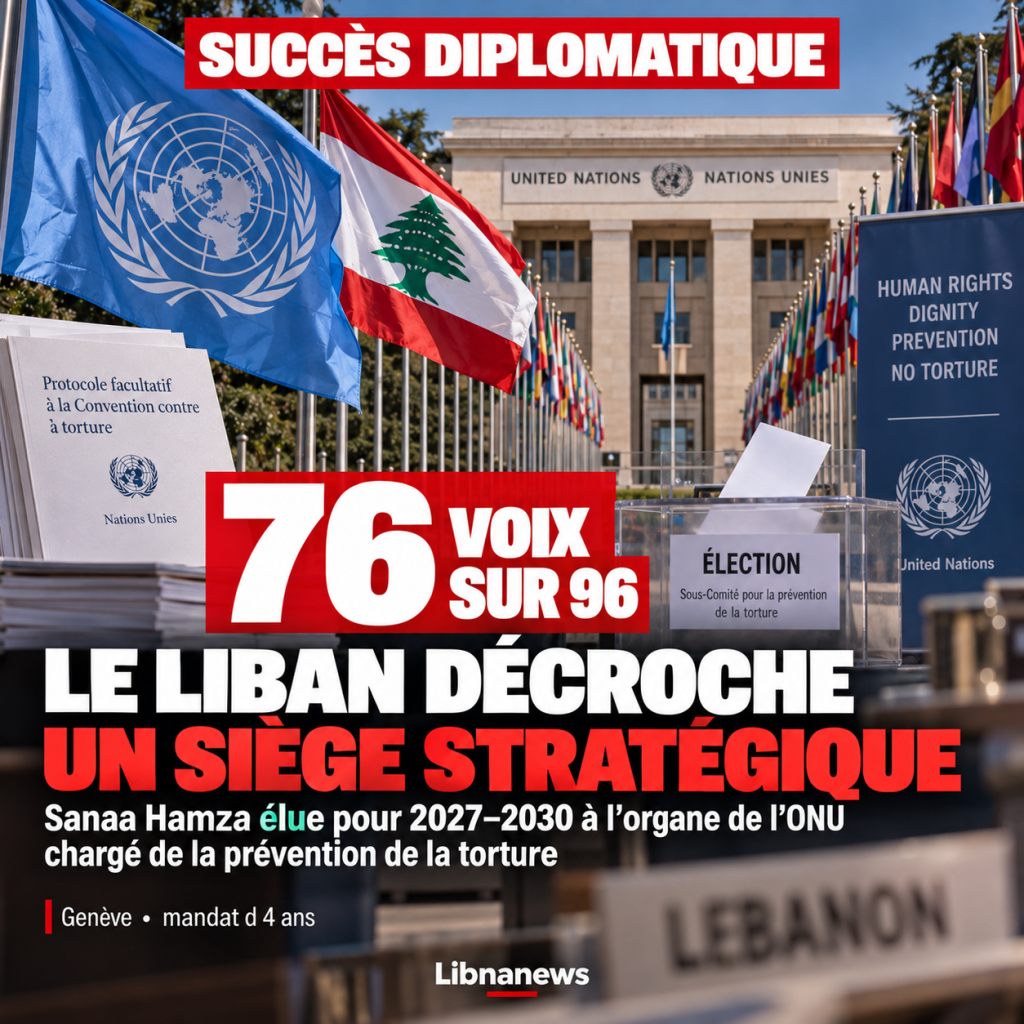
Lebanon had achieved a notable diplomatic result in an international institution directly devoted to the protection of persons deprived of their liberty. The nomination of Dr. Sanaa Hamza received 76 votes from the 96 States Parties that participated in the election of the United Nations Subcommittee on Prevention of Torture. It will serve on this body for the period 2027-2030. The result was one of the candidates who received the widest support in the election, alongside the Greek candidate, who also came in the lead.
The number deserves close attention. With 76 out of 96 supporters, the Lebanese candidacy brought together nearly four out of five voting States. The Ministry of Foreign Affairs and Migrants welcomed the result and thanked the countries that supported Sanaa Hamza. Beyond individual success, the election allows Lebanon to be represented for four years in a specialised UN mechanism dedicated to the prevention of torture and ill-treatment. The mission is not to represent Beirut politically in a traditional diplomatic forum. It directly concerns the conditions under which persons deprived of their liberty are treated.
An election obtained with a particularly broad majority
The vote was held at the United Nations headquarters in Geneva. Sanaa Hamza was the candidate nominated by Lebanon for the period 2027 to 2030. It obtained 76 votes out of 96 States parties to the Optional Protocol to the United Nations Convention against Torture participating in the vote. The available results place her first with the Greek candidate.
The score is the first remarkable element of the election. An international application does not depend solely on the quality of the dossier submitted. It also requires diplomatic work with States with voting rights. The result therefore indicates that the Lebanese candidacy has succeeded in far exceeding the most immediate political or regional alliances. With 76 supporters, it could not rely solely on the usual Beirut partners.
The Ministry of Foreign Affairs has also chosen to focus on this dimension. He thanked the States that had voted for the Lebanese candidate as well as those that had supported his candidacy in the pre-election period. This formulation reveals the diplomatic work needed to build a majority before the election.
However, this result should not be transformed into a general vote on Lebanese human rights policy. States elected members of a specialized body. Support for an individual candidacy does not mean that 76 Governments have validated the situation of Lebanese prisons or national detention practices. Success first concerns the candidate and the diplomatic capacity of Lebanon to elect its representative.
An organization dedicated to prevention rather than reaction to violations
The title of the Subcommittee provides an understanding of the nature of the function. The organization works under the Optional Protocol to the Convention against Torture. Its objective is prevention. Thus, it is not just a matter of reacting when a case of torture is reported or when a case becomes public. The logic is to reduce the conditions for abuse to occur.
This approach places places of deprivation of liberty at the heart of the scheme. Prevention requires attention to conditions of detention, safeguards for persons deprived of their liberty and national mechanisms to prevent abuses. The challenge is to make protections work before a violation is committed, rather than relying exclusively on investigations initiated after the facts.
For Lebanon, this dimension gives the election a special scope. The country does not simply take a seat in a generalist commission. Sanaa Hamza joined a mechanism whose work directly concerned the prevention of torture and ill-treatment. The function therefore requires a technical, legal and institutional approach.
The sources provided do not detail the personal programme that Sanaa Hamza intends to defend during his tenure. Nor can they announce the specific cases on which she will work between 2027 and 2030. It would therefore be incorrect to assign him priorities that are not included in the corpus. What is established is his election, the duration of his term of office and the general mission of the organization that he joins.
The result gives visibility to Lebanese multilateral diplomacy
The election takes place at a time when Lebanese diplomacy is mobilized by much more visible issues: the situation in the South, relations with the United States, reconstruction, relations with Syria and seeking economic support. Elections within UN technical bodies are easier to go into second place. Yet they are another measure of a country’s ability to maintain influence in the multilateral system.
A 76-vote candidacy requires convincing States from different regions and sensitivities. Lebanon can hardly achieve such a result by its political weight alone. He/she must be based on the candidate’s profile, the work of his/her diplomacy, and relations with foreign delegations.
The result is therefore interesting in a context where internal crises can give the impression that the country’s diplomatic capacity is fully absorbed by its emergencies. The Geneva vote shows that a Lebanese candidacy can still build a very broad coalition around a specialised post.
The Ministry of Foreign Affairs chose to present the election as a sign of confidence in Lebanon. This reading is understandable diplomatically. However, it must remain distinct from the exact meaning of the ballot. States elected Sanaa Hamza to an expert body. The scope of the outcome will now depend on its work during the four years of its mandate.
Individual responsibility more than a traditional political seat
This distinction is important because a member of a specialised human rights mechanism does not perform the same function as an ambassador. The mandate is not intended to become a forum for defending the political positions of the Lebanese Government. Its purpose is to prevent torture and ill-treatment.
This difference reinforces rather than diminishes the importance of the election. It means that the candidate must now evolve in a context where expertise and independence of judgment count more than ordinary diplomatic instructions. The prestige of the initial result will therefore not suffice. The credibility of the mandate will be built through the work done between 2027 and 2030.
The Ministry of Foreign Affairs itself stressed this dimension by wishing Sanaa Hamza to contribute effectively to the work of the Subcommittee and to strengthen international efforts to prevent torture, ill-treatment and human rights abuses. The stated objective is therefore not limited to the presence of a Lebanese name in the body.
The mandate also creates an expectation. The higher the electoral score, the greater the Lebanese representative’s initial legitimacy. The 76 votes constitute diplomatic capital. They do not prejudge the balance sheet which will be drawn up four years later.
Prevention of torture is based on sustainable mechanisms
The Sub-Committee’s interest lies in a simple idea: ill-treatment is more difficult to prevent when places of deprivation of liberty operate in an opacity. A prevention policy therefore requires mechanisms to monitor the conditions under which persons are detained and to detect risks before they become serious violations.
This logic goes beyond the existence of legislation prohibiting torture. The legal prohibition is obviously a basis. But its effectiveness depends on how the institutions work in practice. The guarantees offered to a person deprived of liberty, the possibility of control and the existence of reporting procedures also count.
The election of a Lebanese expert to a specialized body in this field therefore provides an opportunity to strengthen the country’s presence in international discussions on prevention methods. It can also enable Lebanon to maintain close contact with practices developed in other States.
However, the available sources do not suggest that a particular national programme will automatically result from this election. An individual international mandate does not replace the decisions to be taken by the Lebanese authorities. It should therefore not be attributed internal consequences which have not yet been announced.
The paradox of an international success in the face of the challenges of detention
The election also takes place while the Lebanese judicial and prison system remains under heavy pressure. National debates include overpopulation, long-term detention and the amnesty law. A joint operating room has even been set up within the gendarmerie command to prepare mechanisms for the speedy implementation of this law if it is to take the necessary constitutional steps.
These files should not be confused with the election of Sanaa Hamza. There is no evidence that her candidacy was built around the amnesty law or that she must intervene in its application. Their coexistence, however, shows that the question of deprivation of liberty remains a concrete subject in Lebanon, not a purely international issue.
The paradox deserves careful attention. Lebanon enjoys significant representation in an international preventive mechanism as it continues to discuss how to deal with its own detention problems. This does not remove anything from the candidate’s success. On the contrary, this situation recalls that international expertise and national reforms can evolve simultaneously without one replacing the other.
The real challenge will be to see whether this international presence contributes over time to enriching the Lebanese debate on prevention. The sources of October 2 do not allow to go further.
An election that comes at a time when Lebanese justice is being sought
The national context also reinforces the symbolic scope of the election. Justice is sought on several fronts: amnesty law, financial cases, administrative disputes and sensitive political cases. In such an environment, the question of safeguards surrounding persons deprived of their liberty is of particular importance.
Prevention of torture is not confined to prisons after conviction. It more broadly affects situations of deprivation of liberty and mechanisms to protect individuals from abuse. Quality of procedures, control and institutional accountability are therefore essential.
The presence of Sanaa Hamza in the Subcommittee may place a Lebanese expert in direct contact with international discussions on these issues. But it will always be up to national institutions to turn principles into concrete practices.
This separation of roles must remain clear. A Lebanese representative in an international body did not have the power to reform the national prison system solely because of her election. It can participate in an international mechanism, contribute to its expertise and strengthen prevention efforts. Domestic implementation depends on the state.
76 votes which also testify to a job as a candidate
Finally, the result makes it possible to focus on an often invisible dimension of diplomacy: campaigns to elect national candidates to international organizations. These elections require exchanges with diplomatic missions, mutual support and a presentation of the candidate’s profile to the voting States.
The Ministry of Foreign Affairs explicitly thanked those countries that had supported the candidacy before the election. This indicates that the election was prepared and defended diplomatically. The score obtained shows that this campaign produced a much higher result than a minimum majority.
For a country with limited diplomatic means, this type of result has particular value. It shows that a specialised application can succeed when it is carried out sufficiently widely. The challenge then is to transform this electoral victory into a real influence within the organization.
The period 2027-2030 will therefore be more important than the vote itself. The 76 voices give Sanaa Hamza a remarkable entry. They do not yet constitute its balance sheet.
A four-year mandate whose scope will be measured by the work accomplished
The Lebanese presence in the Subcommittee will begin in 2027 and continue until 2030. This time allows for work that is not limited to a few meetings. She places the candidate in a long enough cycle to participate in the organization’s activities and contribute to its directions within the framework of her mandate.
For Lebanon, the interest will be double. The country maintains a presence in an important United Nations human rights mechanism. It also has a national in a special capacity in a field directly related to detention and prevention policies.
However, the temptation to turn the election into an abstract national victory must be resisted. The value of an international headquarters depends on its use. The 76 votes out of 96 are a remarkable result because they show the extent of support obtained. But true success will be determined by the contribution of Sanaa Hamza to the work of the Subcommittee.
The Geneva vote therefore opens a period rather than closes it. Lebanon managed to have its candidate elected with one of the highest scores in the election. From 2027 onwards, attention will shift from election results to the substance of the mandate: preventing torture, contributing to international protection mechanisms and participating in work whose credibility depends precisely on its ability to exceed national political considerations.





Comments