

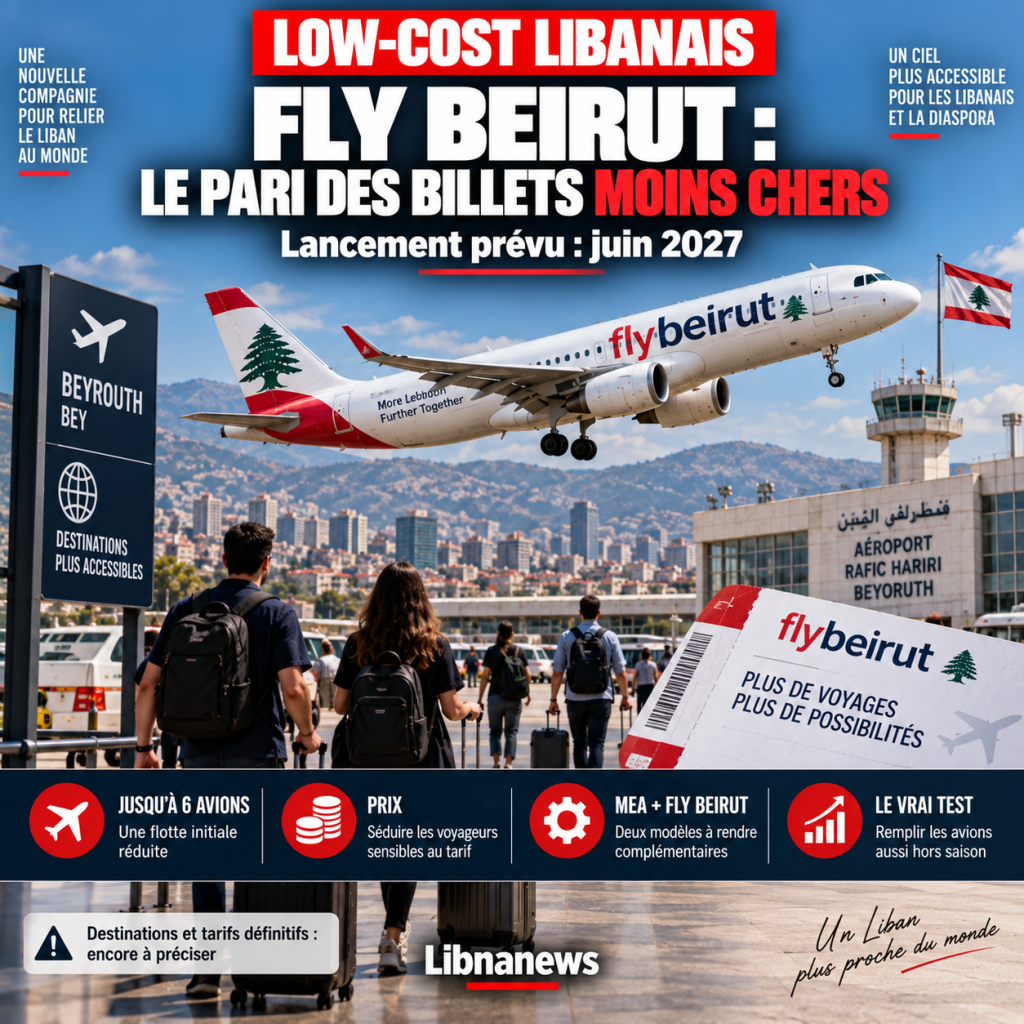
Six planes trying to open a new market
A second airfield is being prepared in Lebanon, alongside the renewal of the Middle East Airlines fleet and the Beirut-New York direct link project. According to information provided to President Joseph Aoun by the President and CEO of the national company, Fly Beirut is to start operations in June 2027. Its positioning is clearly announced: reduced rates. Three aircraft for the new structure have already been moved, while three are in preparation. The project would therefore eventually have an initial fleet of six aircraft. On the other hand, the information available on 30 September 2026 does not yet make it possible to establish the list of destinations, the frequencies, the precise type of each aircraft assigned to the new company, its tariff schedule or its final trading organisation. These strangers are important. They prevent Fly Beirut from being presented as a company whose model would already be completely stopped. They nevertheless help to identify the ambition: to create a separate offer from Lebanon, more oriented towards travellers for whom the price is the first criterion of choice.
The planned launch takes place in a particular market. Lebanon has a limited resident population, but benefits from a very large diaspora and trafficking that is heavily linked to family visits. Lebanese travellers also use the aircraft for much of their international travel because of the lack of simple land alternatives to many markets. This structure creates a natural demand for cheaper tickets. However, it is weak: traffic is very seasonal. Summer periods, holidays and some holidays produce a high demand. Other months are much more difficult. A low-cost company must therefore avoid building its economy on seasonal peaks alone. Its model is normally based on the intensive use of aircraft, rapid rotations and high filling for much of the year. With only six aircraft at start-up, each aircraft immobilized for maintenance or as a result of disturbance accounts for a significant part of the total capacity. The small size of the fleet makes it possible to start carefully. It also increases operational vulnerability. The challenge will therefore not only be to offer cheaper tickets. It will be necessary to maintain a programme that is sufficiently dense and reliable to ensure that lower tariffs do not lead to permanent fragility of operation.
Low cost doesn’t just mean selling cheaper
The term « low cost airline » is often reduced to the idea of a cheaper ticket. However, the economic model is much more precise. To sell at a lower price while remaining profitable, a carrier must reduce its cost per passenger. This usually involves a homogeneous fleet, high daily use of aircraft, short stopover times and a largely digital business organization. The base ticket includes fewer services. Checked baggage, seat choice, meals or other services may be charged separately. Part of the profitability comes from the additional revenues and not from the only price displayed during the first stage of booking. Fly Beirut will have to decide how far she wants to follow this logic. Available information indicates reduced prices, but does not yet detail the content of the product. It would therefore be premature to say that the future company will reproduce exactly the model of the large European or regional carriers specialized in the low cost.
This distinction will be decisive for the Lebanese consumer. A four-person family travelling with several suitcases does not have the same profile as a three-day passenger with a single cabin baggage. The cheapest ticket is not always the cheapest trip when all the additional services are added. Commercial success will therefore depend on the ability to offer legible pricing. The company will also have to strike the right balance between reducing the costs and expectations of the Lebanese market. A significant part of the clientele travels for long periods and carries more luggage than a business traveller doing a quick round trip. An overly restrictive baggage policy could reduce the apparent tariff advantage. Conversely, including too many benefits in the basic price would bring costs closer to those of a traditional company. Fly Beirut will have to build a model adapted to its customers’ habits rather than mechanically copying a foreign formula.
A new company, but a risk of competition with MEA
The main strategic issue concerns the relationship between Fly Beirut and Middle East Airlines. If both structures target exactly the same cities, at the same times and with a comparable clientele, the new company may move passengers from one plane to another rather than create additional demand. A fall in the average price could then occur without a sufficient increase in the total number of travellers. The project would have a real economic interest if it were to expand the market, to recover passengers now transported by competitors or to open destinations which are not profitable in the traditional model of the national company.
A segmentation strategy is therefore likely, even if its details are not yet public in the available documents. The MEA may retain an offer including correspondence, differentiated service classes and more comprehensive services. Fly Beirut could target more price sensitive travellers. Both models may coexist. Several international air groups also use different brands to cover separate segments. But this coexistence requires commercial discipline. A low-cost company should not become a means of selling the same cheaper seat under another name. It must have a truly different cost structure. Otherwise, the group supports two organisations without obtaining the desired economic advantage.
The distribution of destinations will therefore be the first indicator of the strategy. Leisure markets, regional destinations with a strong diaspora and highly price sensitive connections are naturally compatible with a discounted offer. But the corpus does not yet provide a list of which routes will be actually chosen. Any specific destination announcement would therefore be speculative at this stage. What we can already establish, on the other hand, is that the launch of Fly Beirut comes at a time when the MEA itself invests in eight new devices and is preparing a range rise in its long-haul network. The two projects seem to respond to two ends of the market: intercontinental development and renewal of the historic company on one side, more accessible offer on the other. Success will depend on their real complementarity.
Beirut airport will have to absorb two strategies simultaneously
The launch of a new company does not only concern aircraft. It involves the airport, ground crews, slots, security checks, baggage handling and technical services. A low-cost model generally seeks to minimize ground time. A plane that does not fly does not generate revenue. Operations must therefore be organized to allow rapid rotations. This logic can be difficult to apply at an airport where peak periods concentrate many departures and arrivals over a few hours. Fly Beirut will have to have slots compatible with its model while avoiding damaging the operations of MEA and other companies.
The issue of infrastructure becomes even more important if traffic actually increases. A low-cost airline does not succeed when it simply shares existing passengers. It succeeds when it attracts people who travel less often, use another airport or choose a foreign company. If Fly Beirut produces this effect, the number of passengers in Beirut can increase. Control posts, boarding gates, baggage areas and road access will follow. Air development and airport modernization cannot therefore be considered separately.
The low cost model also raises the issue of airport services. Each additional minute of call represents a cost. Procedures for cleaning, refuelling, boarding and handling baggage must be precisely coordinated. A company with six aircraft does not have a large reserve to absorb cascade delays. A delayed first flight can disrupt several rotations in the day. The efficiency of the airport thus becomes a direct component of the ticket price. A company can reduce its internal costs and lose this advantage if its aircraft remain grounded for too long.
The real competitor is already in Istanbul, the Gulf and Europe
Fly Beirut will not arrive in an empty market. Lebanese travellers already have many foreign airlines, sometimes very aggressive on prices. The Istanbul and Gulf platforms allow to reach a large number of destinations with a single connection. European carriers also capture part of the traffic to the West. On some routes, the future company will therefore have to compete with groups with fleets of several tens or hundreds of aircraft.
Size can play against the new entrant. A large company spreads its costs over a huge network. It can move aircraft from one line to another and offer several frequencies. Fly Beirut will start with a reduced fleet. But it also has a potential advantage: Beirut is its natural market. A direct flight is often more attractive than a connecting journey when the price remains comparable. The company can also better adapt its calendar to times of displacement of the diaspora.
However, the price should not be artificially low. A tariff war with much larger carriers would be difficult to sustain. The real advantage must come from an appropriate cost structure. This is where the choice of planes becomes important. Too diverse a fleet increases the need for training, spare parts and maintenance. A homogeneous fleet reduces these expenses. Sources indicate that only three aircraft have been shipped and three are in preparation. They do not provide sufficient information to determine precisely the degree of homogeneity expected. This will be one of the elements to be monitored before launch.
June 2027 leaves less than a year to build a complete company
Between the announcement of 30 September 2026 and the planned start of operations in June 2027, the calendar was tightened. Having aircraft is only part of the job. Crewing, training staff, obtaining authorizations, building reservation systems, negotiating ground services and preparing the commercial network. The first flights must also be sold early enough to ensure proper filling from launch.
However, the calendar has an obvious commercial logic. June corresponds to the beginning of the summer season, during which time demand for Lebanon increases sharply. A new company can thus start operating in an environment conducive to filling. The first months will make the brand known with a more abundant clientele. But this choice simply pushes back the real test. Success will not be measured in July or August 2027. It will appear when the company has to fill its aircraft in the weaker months.
A strong first season can even mask the fragility of the model. If fares are very low to attract travellers and the planes are full thanks to the summer, the impression of success can be fast. The average per passenger income, operating costs and the ability to maintain frequencies in winter will have to be observed. An airline does not become viable because its first flights are complete. It becomes so when it covers its costs throughout the annual cycle.
Cheaper Tickets Could Change Diaspora Report in Lebanon
If the model works, its impact may exceed the air sector. One of the factors determining the frequency of diaspora returns is the price of the ticket. A family living abroad may wish to return each year but reduce travel when four tickets represent a very high expense. A cheaper offer can transform an annual trip into several shorter stays, or allow young people from Lebanese families to come more often.
This increase in frequency would have diffuse economic effects. The traveller spends in restaurants, shops, hotels or rentals. It uses local services and can invest or maintain professional links. In an economy where flows from the diaspora play a significant role, reducing the cost of mobility can therefore have a higher value than the company’s only recipe.
The effect may also concern tourism. Lebanon remains a destination whose potential is severely limited by instability and travel costs from certain markets. A low-cost company cannot remove the security risk. However, it can reduce one of the economic barriers when conditions allow visitors to return. Cheaper tickets can support short stays and trips by young adults, two categories that are particularly price sensitive.
But this logic works in both directions. A low-cost company also facilitates the departure of Lebanese residents. It can therefore increase outgoing mobility as much as arrivals. The economic effect will depend on the profile of passengers and destinations.
The security risk remains the invisible cost of the Lebanese model
Air transport in Lebanon has a constraint that the traditional models of low-cost companies do not easily integrate: regional instability. When military tension increases, insurance, crews and operations can be affected. Foreign companies may suspend their flights. A Beirut-based company does not have the same opportunity to temporarily withdraw from its main market.
This constraint can reduce one of the basic benefits of low cost: predictability. Aircraft must fly a lot. Prolonged immobilization rapidly degrades their economy. With six devices, the risk is even more concentrated. The model should therefore include crisis response capacity and very prudent management of fixed costs.
The relationship with MEA can be an advantage if services, technical skills or some infrastructure are shared. It could reduce the cost of launching. But excessive mutualization may also prevent Fly Beirut from building the light structure necessary to maintain lower tariffs. All the equation is in this border.
The elements available on 30 September 2026 thus confirm an ambition, a timetable and a first fleet. They do not yet make it possible to determine whether Fly Beirut will become a real low-cost company in the economic sense of the term or a low-rate offer integrated with the existing air ecosystem. This difference will be decisive. June 2027 will not only mark the arrival of a new name in the Lebanese sky. It will test whether the country can develop, alongside its historic national company, a model capable of making the journey more accessible without building its competitiveness on prices impossible to maintain.





Comments