


The price of processors increases over several segments, but it does not follow a single curve. Launch price, recommended prices, industrial costs and average sales price tell of different phenomena. Confounding them prevents you from understanding what actually adds to the computer bill.
The problem is first measured in a buyer’s budget. The US starting price for a GeForce 80 range graphics card was $699 in 2020; It reached $999 for the generation launched in 2025. The variance of $300 represents 42.9 per cent in nominal terms. But the same range peaked at $1,199 at the start of the middle generation. A five-year increase can therefore mask a decline between two generations.
On the central processor side, Intel provides another indicator: in the third quarter of 2026, its average selling price for PC chips increased by 9% over a year, while volumes decreased by 14%. The group invoked tariff adjustments and a higher proportion of high-end products. This establishes an increase in the average price for this manufacturer, not a uniform inflation of all CPUs.
Processor prices: three different invoices
The CPU is the general computer processor. A GPU performs many calculations in parallel, especially for images and certain applications of artificial intelligence. In mainstream commerce, its price usually refers to a complete card, with its memory, printed circuit board, power supply and cooling. Comparing this amount to the price of a single CPU already compares two different perimeters.
Accelerators for data centres add another complexity. NVIDIA thus describes Blackwell Ultra as a set of two large computing chips and a dedicated interconnection. Server configurations also associate processors, memory and fast links. The price of a server or rack is therefore not the price of a « processor » comparable to that of a PC component.
This distinction is an economic explanation. The demand for AI can energize certain manufacturing tools, components or assembly capabilities. It does not mean that each consumer CPU is made on the same line or that it uses the same memories as server accelerators.
From 2020 to 2025, launch prices change according to the range
A consistent comparison is to keep the same currency, market and indicator. The U.S. NVIDIA ads provide the following benchmarks for the basic versions of the families concerned, without Ti or Super variants:
| Launch | Range 80 | Starting price | Range 90 | Starting price |
|---|---|---|---|---|
| 2020 | RTX 3080, 10 GB | $699 | RTX 3090 | $1,499 |
| 2022 | RTX 4080, 16 GB | $1,199 | RTX 4090 | $1,599 |
| 2025 | RTX 5080 | $999 | RTX 5090 | $1,999 |
Amounts in US current dollars, excluding local taxes. These are advertised starting prices, not in-store surveys or current prices.
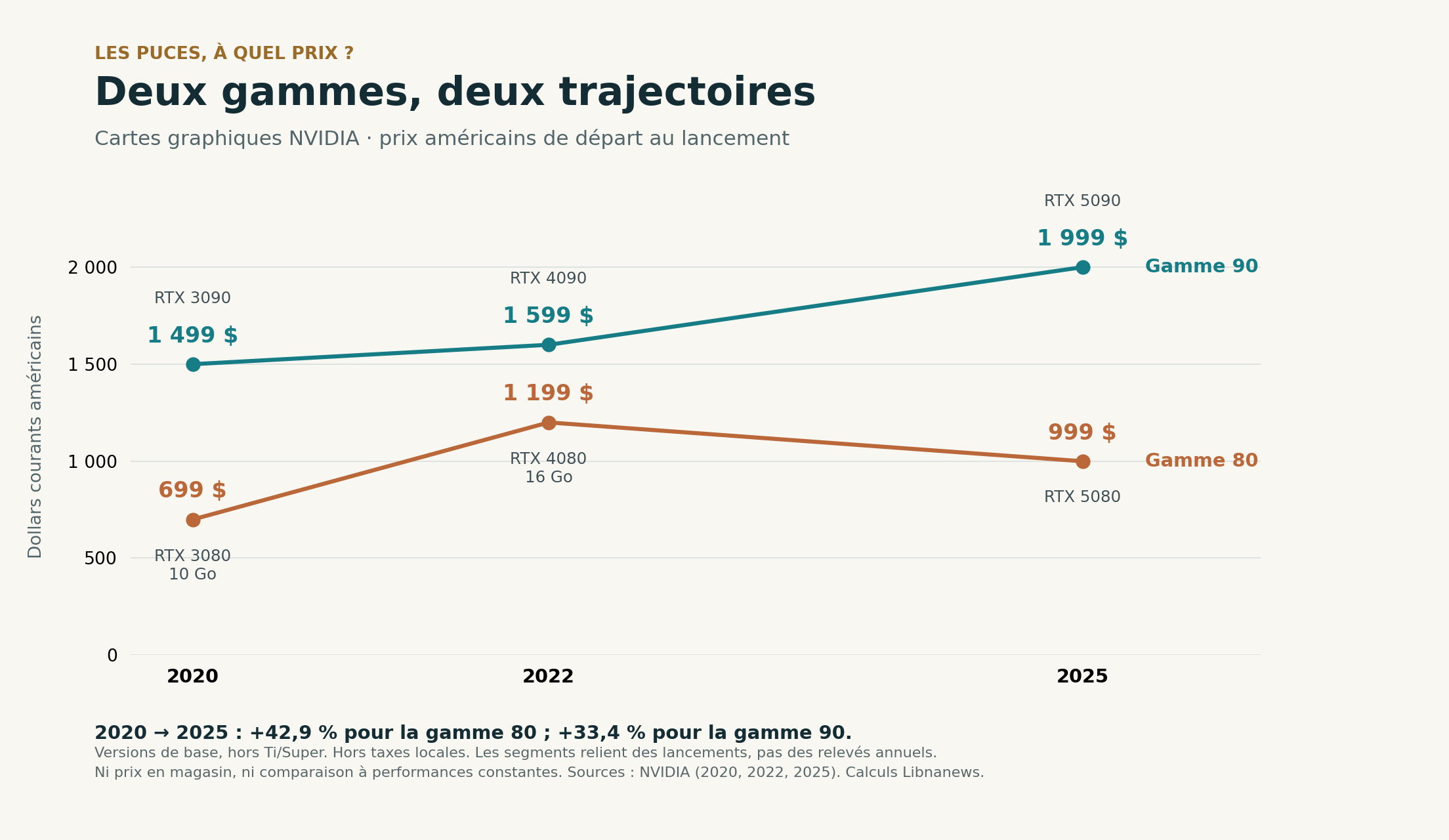
The 90 range thus increased by 33.4% between 2020 and 2025 launches. The 80 range increased by 42.9% over this period, but declined by 16.7% between 2022 and 2025. These calculations measure the evolution of the entry ticket in commercial ranges. Performance, memory and architecture change: they do not measure the price of constant power or quality-adjusted inflation.
The contrast is even clearer between the last two launches. The range of 80 declines by $200, while the range of 90 increases by $400, or 25%. The same manufacturer can therefore reduce the entry ticket of a family and raise the entry ticket of its higher range. Adding these variations without taking into account the quantities sold would not give a representative market index.
At Intel, one-off decreases and an average price up
On May 6, 2025, Intel announced a reduction in the recommended price of its Core Ultra 7,265K in box, from $399 to $299, or about 25%. This precedent shows that competition and repositioning of a range can lower a CPU despite industrial constraints.
On March 11, 2026, Intel announced the Core Ultra 7,270K Plus and Core Ultra 5,250K Plus from 299 and 199 dollars, for availability on March 26. As at 8 November, the official records display « Recommended Customer Price » of $339 to $349 and $219 to $229 respectively.
These benchmarks correspond to separate tariff indicators. Their difference alone is not sufficient to measure an increase in the price paid for an identical product. Intel states that its SPC is indicative and does not constitute a formal offer. The amount actually paid still depends on the seller, version, promotions and local conditions.
Why silicon can cost more
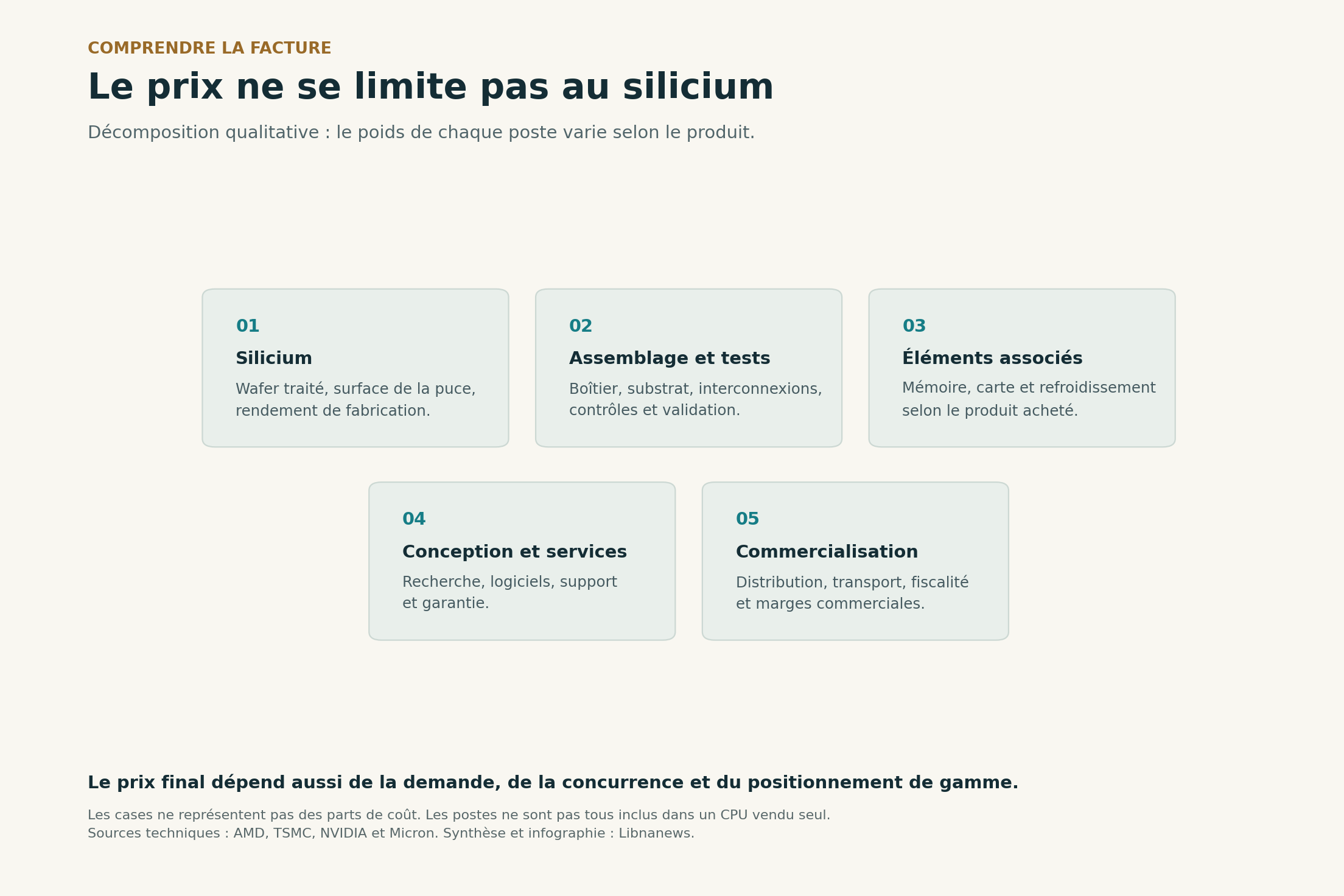
Manufacturing begins on wafers, discs on which are engraved many chips. The cost of the silicon part depends on the price of the processed wafer, the area occupied by each circuit and the number of exploitable circuits. A larger chip or a lower manufacturing efficiency can increase the unit cost. Thus, a more advanced engraving alone does not guarantee a reduction in the price of each component.
AMD identifies the returns, available capacity, timelines and prices of its subcontractors as one of its industrial risks. The company also states that it depends on TSMC for the wafers of its microprocessors and GPUs engraved in 7 nanometers or less. This concentration makes the production conditions of a limited number of suppliers particularly important.
TSMC confirms the magnitude of the industrial effort: on October 15, 2026, the founder maintained an annual investment budget forecast of $60 billion to $64 billion. It also reports higher costs in its foreign plants and an adverse effect on the margin of the 2 nanometers. These factors explain the cost pressures; they do not allow to calculate the exact share of a given CPU.
Packaging and memory become decisive
The engraving is only one step. The packaging connects the different chips between them and the rest of the system. Advanced processes must ensure very dense connections, withstand electrical power and preserve the quality of the final product. In particular, TSMC describes its CoWoS process as a means of integrating logical chips and HBM memory into an interconnection medium.
HBM memory, used in accelerators, should not be confused with the DDR of computers or the GDDR of consumer graphics cards. Markets are linked by manufacturers’ investments, but products and prices remain distinct. On September 30, 2026, Micron reported having concluded agreements covering the vast majority of its HBM volumes in bits for the calendar year 2027, with significant price increases over a year. The group anticipates the first wafer production from its new Idaho plant in mid-2027: an additional capacity is not created instantly.
Demand, range and margin also count
A selling price is not mechanically deduced from the addition of the components. It also finances design, software, testing, warranty and commercial fees. Finally, it depends on the competition and what buyers agree to pay. A shortage can increase price-setting power; an excess stock or a more aggressive competitor can produce the opposite effect.
The average price indicator should be interpreted with the same caution. In the third quarter of 2026, Intel announced an increase of 54% in the average price of its server CPUs, mainly linked to an increased proportion of high-end products. This figure does not mean that each server processor model has increased by 54%.
A company can thus spend more because an identical component becomes more expensive, because it purchases a more powerful configuration or because it has to complete its equipment. These three situations require different comparisons. A cheaper CPU can even accompany a higher total bill if memory, motherboard or storage increase.
Compare the full platform cost
To renew a computer, it is therefore necessary to bring the cost of the CPU closer to that of the complete platform and the work to be done. For an AI server, the comparison must also include memory, network, consumption and operating costs. The right economic question becomes: how much is the useful capacity the buyer needs?
The first production announced for Idaho’s Micron plant is still planned for mid-2027. For buyers, the effect of these investments will then depend on the volumes actually available and their destination: general public memory, servers or accelerators. A advertised capacity is not yet a price drop at the counter.





Comments