

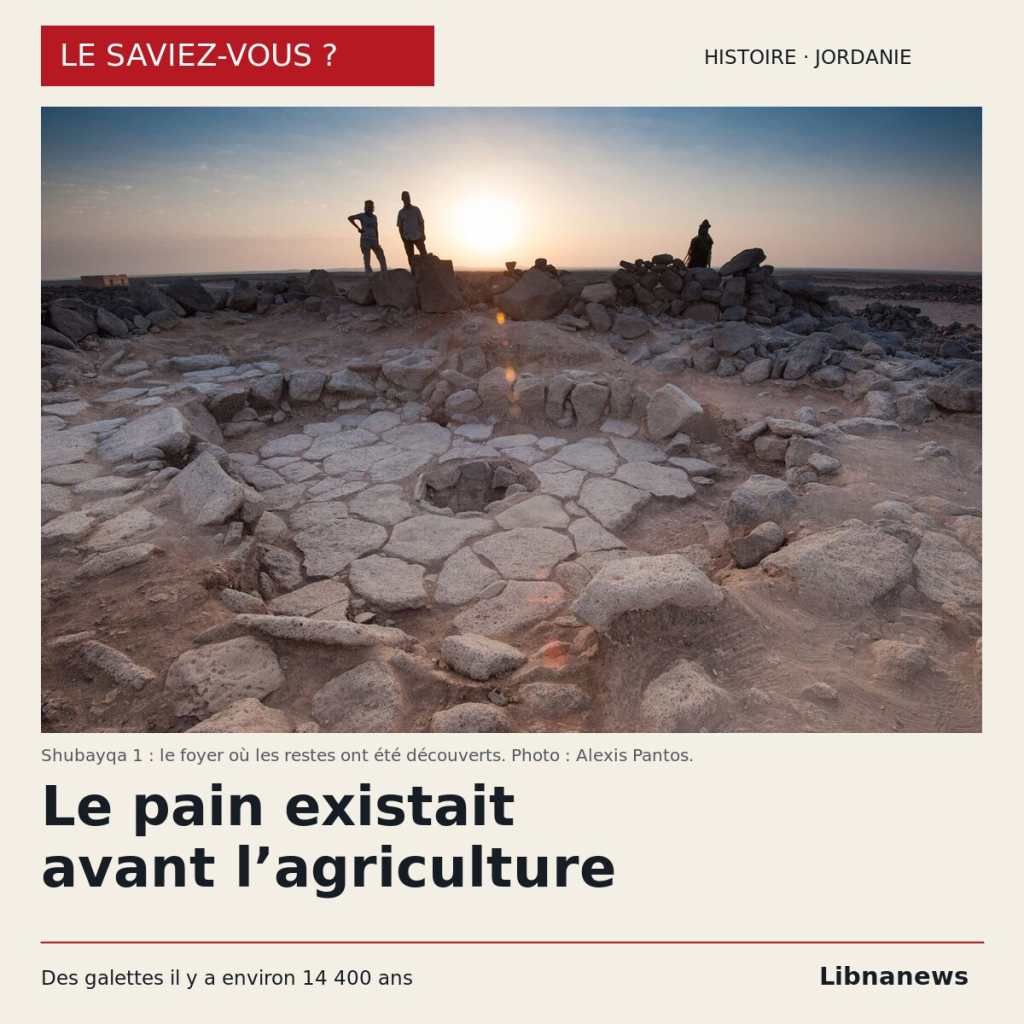
Did you know that? In Jordan, hunter-gatherers were already preparing cakes about 14,400 years ago. In Shubayqa 1, carbonized fragments attest to this cooking well before the development of agricultural societies. This prehistoric bread in Jordan not only tells the story of wheat. It also reveals the role of marsh plants, long less visible in narratives about our diet.
The vestige holds in a few millimetres. Blackened, irregular, it hardly resembles the bread placed today on a table. Yet its structure retains the trace of a human preparation. Ingredients were reduced to small particles, mixed and cooked. Fire turned some remains into archives.
The site is located in the Black Desert, northeast of Jordan. The excavations carried out between 2012 and 2015 delivered fireplaces and stone buildings. Food analysis, published in July 2018, has changed a chain long held to be obvious: agriculture first, bread making then.
A prehistoric bread in Jordan, before the fields
The inhabitants of Shubayqa 1 belonged to the Natoufian communities of the Levant. These hunter-gatherers lived several millennia before the generalization of domesticated crops. Yet they knew edible plants and techniques developed to process them.
Their time is not consistent throughout the region. Communities built sustainable housing, while their mobility and resources varied. The Natoufian concerns territories now divided between several countries, including Lebanon, Syria and Jordan.
A time study published in 2017 had already highlighted the seniority of Shubayqa 1. His first occupation dates back about 14,600 years. They show that these communities were not limited to forested landscapes near the Mediterranean. They also exploited more open environments eastward.
The formula « bread before agriculture » therefore sums up a precise observation. The transformation of wild plants into cooked foods preceded savings based on domesticated cereals. It does not mean that all the inhabitants of the Levant followed the same way of life.
How to recognize a cake in burnt crumbs
The researchers classified 24 Shubayqa fragments as bread-like preparations. They had neither an intact miche nor a recipe. Identification was based on examination of plant tissues, particles and cavities stored in the carbonized material.
The electron microscope makes it possible to study this organization on a very small scale. The size and distribution of the voids help compare a dough, boil or cooked bread. At Shubayqa, the observed characteristics correspond to flat preparations, probably not lifted.
This caution explains the scientific vocabulary: « bread-like » products. The term describes a technical category. It does not allow to reconstitute their exact taste, form or place in each meal.
Research on ancient foods now involves several approaches. They confront archaeological fragments with grinding tools, cooking equipment and controlled experiments. Preparing and carbonizing modern foods helps to understand the traces that each operation can leave.
Work on Çitalhöyük, Turkey, and Jarmo, Iraqi Kurdistan, is continuing this approach. These sites are more recent. They allow us to study the variety of cereal preparations, without assuming that any residue containing grain was necessarily bread.
Wild cereals, but also tubers
Shubayqa’s home was not fed by a cereal bakery in the present sense. Fragments study indicates the use of wild cereals and, in some cases, other plants. Underground tissue probably refers to tubers of scinps, wetland plants.
These organs store nutrient reserves. Their presence expands the spontaneous image of a cake consisting solely of wheat flour. It also recalls an archaeological difficulty: seeds often recognize themselves more easily than transformed roots or tubers.
The research published in 2018 makes it possible to restore a chain of gestures: to prepare the plants, to grind them, to obtain a rather fine material, then to make and to cook a dough. It does not provide the proportions of a reproducible recipe. Presenting an « authentic recipe of 14,400 years » would exceed the evidence available.
These operations required time and expertise. The collection of wild plants therefore did not prevent a complex kitchen. Between a resource found in the landscape and a food served, several transformations could already occur.
What the 2026 study adds to the file
A new botanical analysis, published on July 16, 2026, puts these cakes in a larger diet. It covers 90,890 non-woody plant remains from the Shubayqa 1 occupation sequence.
The results highlight the place of wetland plants. During the old occupations, the tubers of scinps occupy a major position. Later, their proportion decreased, while seeds and grasses became more important.
The current landscape can deceive the visitor. The name Black Desert evokes aridity and basalt. At the end of the Pleistocene, the neighbouring basin received water capable of maintaining a humid, seasonal or more sustainable environment. This resource helped to make repeated stays possible.
This development calls for avoiding a history focused solely on wheat. The first galettes known on site belonged to a diverse food set. The presence of bread does not show that cereals already dominated all subsistence.
The discovery does not date the invention of bread
An ancient vestige gives a documentary limit: this practice existed at least at that time. He does not automatically designate his place of birth. Previous preparations may have disappeared, not carbonize or remain in unknown sites.
The order of discoveries also depends on methods. A search that preserves and examines small organic fragments can reveal long neglected foods. Culinary history becomes clear when attention is focused on previously difficult to identify remains.
The discovery also makes it possible to establish direct filiation with the current Lebanese bread. General similarities, such as a flat form, are not sufficient to demonstrate the continuous transmission of a recipe for millennia.
One question remains: did the desire to produce more of these foods encourage cereal cultivation? This proposal remains a hypothesis. In particular, ongoing research seeks to distinguish collection, resource management and culture, comparing Shubayqa 1 with the nearby Shubayqa 6 site.





Comments