

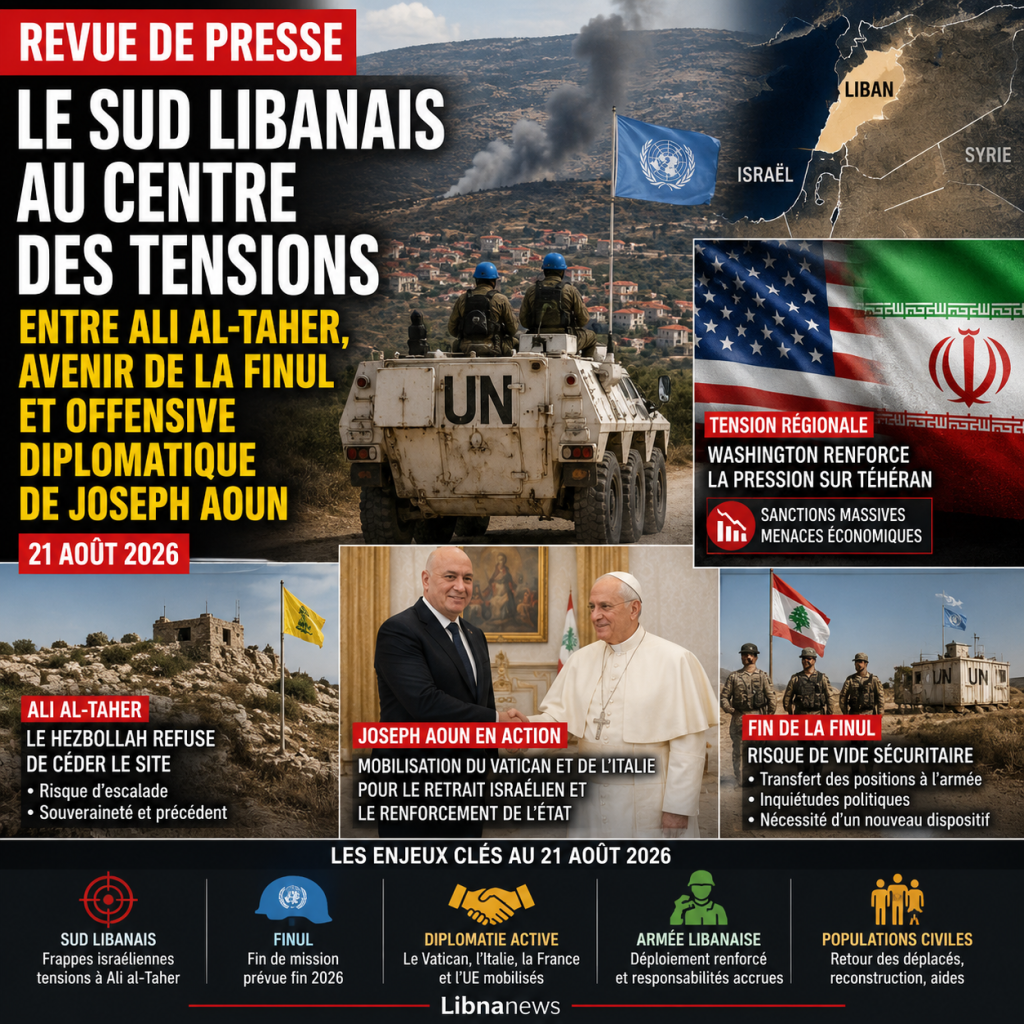
Ali al-Taher becomes the point of crystallization of the crisis in the South
The Lebanese South dominates the first pages of the press of 21 August 2026. The issue is no longer limited to daily Israeli strikes. It now addresses the risk of confrontation around Ali al-Taher, the conditions for Israeli withdrawal and the future of the international machinery in the region.
Annahar, on 21 August 2026, placed the « Battle of Ali al-Taher » at the heart of its edition. The daily describes a situation where diplomatic efforts attempt to pre-empt a possible military escalation. According to French sources quoted by Annahar, the United States is currently exerting pressure on the Israeli government to prevent an expansion of confrontation with Hezbollah.
However, the same sources regard Ali al-Taher as a particularly dangerous point. They believe that its evolution could be linked to the regional power relationship between Washington and Tehran. Relaxation between the two capitals could reduce pressure. A worsening of their confrontation could, on the contrary, increase the risk to Lebanon. The newspaper, however, remains cautious and does not present a new war as certain.
On the ground, the situation remains tense. Al Jumhuriyat, on 21 August 2026, reports that Israeli bombings and operations continue in several areas of the South. The newspaper places particular emphasis on Ali al-Taher and cites an important source of Hezbollah. She claims that the movement is not considering handing over the site to the Lebanese Army, Israel or another party.
The argument put forward goes beyond the military value of the place. According to this position, an Israeli-pressurized site would create a precedent. It could lead Israel to demand the evacuation of other positions. The location of Ali al-Taher north of Litani is also invoked. Hezbollah considers that the territorial provisions relating to resolution 1701 relate primarily to the south of the river.
Annahar, August 21, 2026, reports a comparable reading of the file. The newspaper explains that the movement does not want to create a mechanics in which Israel would designate a location to evacuate, before the Lebanese army comes to occupy it in its place. The question therefore concerns sovereignty as well as military control.
At the same time, the information available does not accurately determine the number of combatants present in the area or the exact nature of the facilities. The press reports structures and fortifications, but several elements remain unverifiable. This caution is important. The case is marked by contradictory information and a strong communication battle.
On 21 August 2026, Al Liwa The daily, however, believes that the continuation of Israeli operations makes the process more difficult. Beirut calls for Israeli withdrawal and cessation of attacks. At the same time, the issue of Hezbollah disarmament remains at the centre of the demands addressed to Lebanon.
The risk is therefore one of blocking. Israel makes certain security developments conditional on Lebanese measures. Lebanon, for its part, calls for the withdrawal and cessation of operations as essential elements for stabilization. Ali al-Taher thus concentrates a disagreement that far exceeds the control of a southern relief.
Joseph Aoun mobilizes Vatican and Italy around Israeli withdrawal
President Joseph Aoun’s diplomatic activity is the second dominant theme. Several newspapers follow his visit to the Vatican and his démarches in Italy. Al Sharq, August 21, 2026, reports that the President asked Pope Leo XIV and the officials of the Holy See to continue their diplomatic efforts in favour of Lebanon.
In particular, Joseph Aoun called for the implementation of the provisions of the framework agreement, the cessation of Israeli attacks and the complete withdrawal of the occupied Lebanese territories. It also links these demands to the return of internally displaced persons and the reconstruction of the affected areas.
However, his speech also includes a commitment to state authority. According to Al Sharq, on 21 August 2026, Joseph Aoun claims that Israeli withdrawal and reconstruction must go hand in hand with the extension of State authority throughout the territory. He also stressed the concentration of the decision on war and peace in the hands of the institutions.
Al Joumhouriyat, on 21 August 2026, reported the same position. The President called for diplomatic intervention by the Vatican in order to ensure compliance with the commitments made. The Holy See expresses its concern at the difficulties encountered in implementing the Framework Agreement. It reiterates its support for efforts to enable its implementation.
However, the presidential process is not limited to the Vatican. Ad Diyar, 21 August 2026, indicates that the meetings in Italy are linked to the search for a solution for the period following the end of the UNIFIL mission. The folder therefore has two dimensions. The first is immediate: prevent further escalation and obtain Israeli withdrawal. The second concerns the security architecture that will have to accompany the deployment of the Lebanese army.
Al Akhbar, on 21 August 2026, claims that Joseph Aoun and Nawaf Salam are working on a cooperation project with the European Union. This could allow the arrival of a European force in the South after UNIFIL. The newspaper attributes an important role to Italy in the discussions. He also stressed that France wished to preserve a presence in the future.
Al Akhbar, however, adopted a critical reading of the relationship between Paris, Washington and Israel. The newspaper considers that France is trying to find a place in a dossier where its influence has been reduced. This analysis must therefore be distinguished from factual information concerning the diplomatic consultations under way.
Annahar, on 21 August 2026, reports a Franco-Italian coordination around the future of the international presence. The daily also indicates that France is preparing a meeting to support the Lebanese army, with the announced participation of several countries.
This mobilization shows that the question of the South is no longer confined to the face-to-face between Lebanon and Israel. It involves the Vatican, Italy, France, the United States and several military partners. Joseph Aoun thus tried to place the Israeli withdrawal, the authority of the State and the international presence within a political framework.
The end of UNIFIL raises the risk of a security vacuum
Another major issue of 21 August 2026 is the planned end of the UNIFIL mission. Several publications emphasize the possible consequences of his departure. Al Sharq, on 21 August 2026, reports that UNIFIL began to hand over some of its sites to the Lebanese army.
A position near Khardali, in the Litani sector, was transferred to the seventh army regiment. This operation is part of a preparatory process at the end of the international mission at the end of the year. The transmission of positions gives a concrete dimension to a debate hitherto essentially diplomatic.
Lebanon must now determine how the army can assume additional responsibilities. He must also know what external presence could accompany him. Speaker Nabih Berri expressed serious concern. According to Al Sharq, on 21 August 2026, he considered the end of the mission to be a very serious decision for the South. It stresses the role of UNIFIL in the implementation of resolution 1701 and in the support of the Lebanese army.
Al Joumhouriyat, on 21 August 2026, also reported the calls of the international force for compliance with this resolution. UNIFIL calls on the various parties to avoid acts that could increase tensions. It stresses that civilians bear much of the consequences of current instability.
At the same time, the government is trying to strengthen the state’s civilian presence. Al Bina, on 21 August 2026, reports that Nawaf Salam chaired a meeting on the return and rehabilitation of several villages in the South. Discussions included Frun, Qallawiyah, Srifa, Borj Qallawiyah, Zawtar al-Gharbiyah and Ghandouriyah.
The Prime Minister is calling for the accelerated acquisition of prefabricated housing and the repair of homes that are not completely destroyed. He also wanted housing aid to be coordinated with the Ministry of Social Affairs.
This dimension is essential for understanding the situation. The debate on southern security is not just about military positions. It directly affects the possibility for residents to return to their villages and stay there. The Government must simultaneously restore housing, guarantee services and strengthen the presence of institutions.
Al Sharq Al Awsat, 21 August 2026, brings another element. According to the daily newspaper, Washington is working on the selection of localities that could enter into the extension of « experimental zones » to the South. The proposed mechanism would be combined with an Israeli withdrawal and a military deployment verification mechanism.
This information shows that several options are being explored. However, none of the publications in the corpus can state that a definitive system has been accepted. The only certainty is that the transition has begun even though the military situation remains unstable.
Confrontation between Washington and Tehran increases pressure on Lebanon
The crisis in the South is finally taking place in a regional context marked by a further worsening of the confrontation between the United States and Iran. Al Arabi Al Jadid, August 21, 2026, dedicates its one to Donald Trump’s announcement of an economic offensive of exceptional magnitude against Tehran.
The US President also threatens the economic consequences of countries, companies and institutions that continue to provide essential support to Iran. US Treasury Secretary Scott Bessent says sanctions must be among the most severe ever imposed. He explicitly mentions their ability to cause the collapse of Iranian power.
Iranian Foreign Minister Abbas Araghchi responds by denouncing what he calls economic terrorism. He believes that American measures also threaten state sovereignty and the global economy.
Al Quds Al Arabi, on 21 August 2026, developed the same confrontation largely. The daily reports that Tehran is preparing for a prolonged confrontation while maintaining the possibility of dialogue. Iranian officials claim that sanctions and military pressure will not lead to surrender.
Al Sharq Al Awsat, on 21 August 2026, also states that the Iranian authorities recognize the difficulties that affect oil exports. Washington is also seeking to further close the financial and commercial channels available for Tehran.
This confrontation has a direct impact on Lebanon. Annahar, August 21, 2026, reports that some French sources link the evolution of the American-Iranian confrontation to the level of risk around Ali al-Taher. Lebanon thus becomes one of the areas likely to be affected by a regional power ratio that it does not control.
At the same time, tensions between Israel and Turkey in Syria add another source of instability. Al-Quds Al-Arabi, on 21 August 2026, reported Ankara’s reaction after the Israeli bombing of Abu al-Duhur’s base. Turkey affirms its desire to continue to support Syria while avoiding direct confrontation with Israel.
Al Jumhouriyat, on 21 August 2026, also analyses this issue as an extension of the Israeli will to prevent the emergence of new military capabilities near its borders. For Lebanon, this accumulation of crises increases the importance of diplomatic action.
The South is at the crossroads of the Israeli-Lebanese confrontation, the Washington-Theran conflict and the new Israeli-Turkish tensions in Syria. On 21 August 2026, the press did not describe a general war already decided. Rather, it shows several crises that are approaching. Ali al-Taher, the departure of UNIFIL and the steps taken by Joseph Aoun are the most immediate demonstrations for Lebanon.
Local politics: the South puts the state in the face of the double challenge of sovereignty and arms monopoly
Joseph Aoun links Israeli withdrawal and state authority
The situation in South Lebanon forms a major part of the domestic political news of 21 August 2026. The positions of Joseph Aoun, Nawaf Salam, Nabih Berri and Hezbollah, however, show significant differences in how to get out of the crisis. The debate covers both Israeli withdrawal, Ali al-Taher, Hezbollah weapons, the future of UNIFIL and the return of the State to the affected areas.
Al Sharq, August 21, 2026, reports that Joseph Aoun took advantage of his meetings in the Vatican to set out the Presidency’s line. It calls for the cessation of Israeli attacks and the complete withdrawal of the occupied Lebanese territories. He also called for the implementation of the framework agreement concluded under American mediation on 26 June.
However, the President does not dissociate these requests from the question of public authority. According to Al Sharq, he claims that the Israeli withdrawal, reconstruction and return of internally displaced persons must go hand in hand with the extension of State authority to the entire territory. He added that the decision on war and peace must be made by the State.
Al Joumhouriyat, August 21, 2026, resumes this joint. The newspaper presents the presidential position around two parallel demands: to secure Israeli withdrawal and to move towards the state monopoly of arms. For Joseph Aoun, the stabilization of the border therefore requires Israeli commitments, but also changes in the Lebanese internal situation.
This line comes as the pressures around Hezbollah disarmament are increasing. Al Liwa, August 21, 2026, reports the words attributed to American Ambassador Michel Issa after a meeting with Nabih Berri. Asked about the end of the war in the South, the diplomat linked it to the handing over of Hezbollah’s weapons. The newspaper believes that this position reflects Washington’s priority in disarmament.
However, Al Liwa A requirement for disarmament without a parallel Israeli withdrawal could, according to daily analysis, provide Hizbullah with an argument to maintain its weapons. The government must thus evolve between American demands, Israeli demands, continued occupation and internal political balances.
This tension is now going through the whole debate. Part of the political forces believe that the State cannot fully exercise its sovereignty as long as the weapons remain outside its control. Hezbollah responded that Israeli withdrawal and the end of attacks were central conditions before any major transformation of the defence system.
Ali al-Taher opposes the logic of the state to the fear of a precedent
Ali al-Taher’s case gives a concrete translation of this political confrontation. Al Jumhuriyat, on 21 August 2026, cites an important source of Hezbollah claiming that the movement is not prepared to return the heights to the Lebanese army, Israel or any other party. This position places the issue of territorial control directly at the centre of the internal debate.
According to the source cited by the newspaper, Hezbollah fears that a re-establishment of the site under Israeli pressure would create a precedent. Israel could then request the evacuation of other positions. The movement also invokes the location of the site north of the Litani and its reading of resolution 1701.
Annahar, August 21, 2026, further develops this logic. According to daily reports, Hizbullah’s refusal is not based solely on the military importance of Ali al-Taher. The movement wants to avoid Israel being able to determine which positions should be evacuated within Lebanese territory.
This question also places the army in a difficult situation. If Israel demands that a position be returned to the army before any evolution on the ground, the military institution may find itself at the centre of a political confrontation that goes beyond its operational mission. Annahar notes this difficulty by referring to the risk that Israeli pressure will gradually shift from Hezbollah to the army.
In this context, the army commander, General Rodolphe Haykal, continues his institutional activities. On 21 August 2026, Al Binas reported that he had received a delegation from the editorial union and several military attachés. Discussions focused on the army’s efforts, particularly in the South, and its role in preserving stability and internal unity.
The debate therefore goes beyond the control of a height. It concerns the definition of the respective responsibilities of the army and Hezbollah. It also deals with a broader question: should the State gradually resume the positions held by the movement, or should this be conditioned by a prior Israeli withdrawal?
Hezbollah maintains a hard line. Annahar, on 21 August 2026, reports that the movement’s parliamentary bloc accuses the authorities of adopting a policy of concessions in the negotiations. He called for the abandonment of the framework agreement and criticized the continuation of discussions as Israeli operations continued.
The divergence with the Presidency is therefore clear on the method. Joseph Aoun defends the continuation of diplomatic efforts and the extension of state authority. Hezbollah believes that the negotiations have not achieved the announced results and that their continuation may encourage new Israeli demands.
Nawaf Salam focuses on the return of the state to the villages of the South
At the same time, the government is trying to move part of the debate towards reconstruction and public services. Al Bina, on 21 August 2026, reports that Nawaf Salam chaired a meeting on the return and rehabilitation of several villages in the South. The South Council and the High Relief Commission were represented.
The work involves Frun, Qallawiyah, Srifa, Borj Qallawiyah, Zawtar al-Gharbiyah and Ghandouriyah. Nawaf Salam asks to speed up the purchase of prefabricated housing for residents. It also orders the launching of repairs in houses that are not completely destroyed.
The Prime Minister also wants the Ministry of Social Affairs to help finance rents for the families concerned. Government policy is thus aimed at creating the material conditions for return. It gives the concept of sovereignty a daily dimension: housing, roads, schools, energy and public services.
Al Sharq, on 21 August 2026, also reported on the meetings of Nawaf Salam with the municipal officials of Rmeich and Debel. They presented the needs of the residents who remained in the border villages. In particular, they stressed fuel supply, the operation of schools, essential services and financial support to municipalities.
Nawaf Salam asserts that maintaining populations in border localities is a national priority. This position complements the Presidency’s security line. The return of the State does not only involve the deployment of soldiers. It also requires the restoration of administrations and normal living conditions.
Interior Minister Ahmad al-Hajjar adopts a similar speech. Al Sharq, on 21 August 2026, reports that he received several Southern municipal delegations. He claims that the towns and villages will be rebuilt thanks to the will of their inhabitants and the work of the municipalities.
These meetings, however, show the magnitude of the needs. Municipalities must manage the consequences of destruction while maintaining services. Some must also prepare return plans while the security situation remains unstable. Reconstruction thus becomes a major political issue, not a mere technical one.
Nabih Berri defends UNIFIL and calls for the implementation of resolution 1701
Nabih Berri occupies a particular place in this sequence. Al Sharq, on 21 August 2026, reports that the President of Parliament considers the termination of the UNIFIL mission to be an extremely serious decision. In his view, the international force remains essential to support the army and contribute to the implementation of resolution 1701.
This position is taking place as UNIFIL begins to transfer some of its sites to the Lebanese Army. A position near Khardali has already been handed over to the seventh regiment. The planned withdrawal of international force thus becomes an immediate subject of domestic politics.
For Nabih Berri, the departure of UNIFIL may remove an instrument of stabilization as violations continue. His concern is in line with that expressed by other officials on the military’s ability to take over all responsibilities alone in an environment that is always in conflict.
At the same time, the issue causes intense diplomatic activity around a possible replacement mechanism. However, as of 21 August 2026, no definitive formula appears in the sources. The Lebanese authorities are exploring several avenues, including European ones.
The file reveals another political difficulty. Strengthening the army is widely presented as a common priority. On the other hand, the various forces do not agree on the conditions that must accompany its deployment. Hezbollah insists on the Israeli withdrawal. Its political opponents place more emphasis on the state monopoly of arms.
US sanctions increase pressure on Hezbollah
This internal confrontation adds new financial pressure. Al Joumhouriyat, on 21 August 2026, reports the announcement of new US sanctions against individuals and companies associated with Iran. Part of the scheme directly targets networks accused of transferring money to Hezbollah.
According to the daily newspaper, the US authorities claim that ten people belong to a network responsible for transferring funds to the movement. Intermediaries reportedly used commercial flights between Lebanon, Turkey, the United Arab Emirates and Iran to move large sums.
On 21 August 2026, Al Liwa Washington presents these measures in the broader context of its confrontation with Iran and its objective of weakening the financial structures associated with Tehran.
These sanctions come at a time when Donald Trump announces a considerable tightening of economic pressure on Iran. Their Lebanese reach is therefore important. They show that Washington is simultaneously dealing with the arms issue, financial channels and political negotiations in the South.
Hezbollah is thus subjected to several forms of pressure. Israel acts militarily. Washington is strengthening economic measures. Inside, the debate on the arms monopoly continues. The movement responded by tightening its criticism of the negotiating policy pursued by the authorities.
Other internal issues remain active despite the crisis in the South
However, local political news is not limited to the border. Al Sharq, on 21 August 2026, reports a new controversy over the presence of Iranian ambassador Mohammad Reza Sheibani in Lebanon. Minister of Foreign Affairs Youssef Rajji claims that his continued presence is incompatible with a sovereign decision which he believes must be implemented.
Rajji states that the return to normal relations with the Iranian mission requires respect for the Lebanese decision by Tehran. This position adds a new element to the tensions surrounding relations between Lebanon and Iran.
On the other hand, Annahar, on 21 August 2026, highlighted the banking reform and the tensions it caused. The debate on the new framework for banks remains directly linked to the exit from the financial crisis. Discussions included constitutional compliance and the role of the International Monetary Fund in the reform process.
Al Sharq also reports on criticism of the responsibility of the former Governor of the Bank of Lebanon, Riad Salameh. Antoine Menassa, president of a gathering of Lebanese businessmen in France, wondered about the fact that the former governor alone bore a responsibility which, according to him, should also concern the governments and institutions that had participated in economic decisions for several decades.
The local policy of 21 August thus appears dominated by the same question in several forms: how to restore the authority of the institutions after years of crisis? In the South, the issue concerns weapons, territory and the army. In border villages, it concerns reconstruction and services. In external relations, it affects diplomatic sovereignty. In the banking sector, it focuses on the responsibility and reform of financial institutions.
However, the Southern dossier remains the one that orders all the others. The Presidency favours an approach combining Israeli withdrawal, negotiation and state authority. The government seeks to make this state presence concrete in the villages. Nabih Berri defends the maintenance of an international framework. Hezbollah refuses that Ali al-Taher should become the first element of a series of withdrawals imposed under Israeli pressure. These positions define, on 21 August 2026, the main lines of fracture of Lebanese policy.
Quotes and speeches by political figures: sovereignty, arms and South at the heart of positions
Joseph Aoun places Israeli withdrawal and state authority on the same plane
The statements of President Joseph Aoun occupy a central place in the Lebanese press of 21 August 2026. His visit to the Vatican enabled him to clarify the doctrine he defended in the face of the southern crisis. It is based on two parallel requirements: to secure Israeli withdrawal and to fully restore State authority in Lebanese territory.
Ad Diyar, August 21, 2026, reports that Joseph Aoun thanks Pope Leo XIV for his efforts in favour of Lebanon. It calls on the State party to continue to support Lebanese claims. The President gave priority to halting Israeli attacks and implementing the provisions of the Framework Agreement.
The Head of State also calls for the « full Israeli withdrawal » from the occupied Lebanese territories. In his view, this stage should enable the reconstruction of the destroyed areas and the return of the inhabitants to their villages. His speech thus gave an important place to the civilian consequences of confrontation.
However, Joseph Aoun accompanies this request for an internal commitment. Al Jumhouriyat, on 21 August 2026, reports that he considers the extension of State authority to be indispensable. He states that the decision on war and peace must be concentrated in the hands of the State in order to achieve security and stability at the borders.
On 21 August 2026, Al Bina The President considers that the Israeli withdrawal, the return of internally displaced persons and the reconstruction must « concur » with the extension of public authority. This formulation is important. It avoids presenting one of the two processes as necessarily after the other.
Joseph Aoun, therefore, does not publicly repeat a formula requiring disarmament as a prerequisite for Israeli withdrawal. Nor does it condition the restoration of State authority at the end of the occupation alone. It presents both movements as elements of the same process.
This position allows it to respond to two different political pressures. The first is from foreign partners who demand a state monopoly on arms. The second comes from Lebanese actors who refuse any concession as long as Israel occupies territories and continues its operations.
Nawaf Salam makes the concrete presence of the State a priority in the South
Prime Minister Nawaf Salam is developing a less focused discourse on military power relations. His statements of 21 August focused on the return of the inhabitants and the capacity of the State to restore normal living conditions in the villages of the South.
On 21 August 2026, Al Bina, reported that Nawaf Salam was asking to accelerate the purchase of prefabricated housing for several localities. It also orders the Southern Council to initiate repairs to houses that are not completely destroyed.
The Prime Minister also calls for coordination with the Ministry of Social Affairs. The aim is to provide financial assistance covering the rents of the inhabitants concerned. His statements thus give a social dimension to the debate on sovereignty.
Al Sharq, on 21 August 2026, also reported the statements made by Nawaf Salam to the municipal officials of Rumeich and Debel. The Prime Minister states that « supporting the resistance of the inhabitants of border villages is a national priority ». It also stresses the need to maintain a permanent and secure liaison with these localities.
His speech contained a clear political message. The State must not only be represented by the army. It must also provide fuel, schools, social assistance, infrastructure and services. Nawaf Salam states that « the Lebanese State will remain present alongside its inhabitants ».
This approach complements that of Joseph Aoun. The President spoke of the monopoly of the decision on war and peace. The Prime Minister insists on the ability of the administration to support the people. In both cases, the return of the State is the driving thread.
Nabih Berri warns about the consequences of the departure of UNIFIL
Speaker Nabih Berri focuses on the future of UNIFIL and the consequences of its departure. Al Sharq, on 21 August 2026, reports that he attaches « extreme importance » to maintaining an international presence in the South.
Nabih Berri believes that UNIFIL plays a key role in preserving security and accompanying the army to international borders. It directly links this mission to resolution 1701.
His vocabulary is particularly severe when he refers to the decision to terminate the mission. According to Al Sharq, Nabih Berri considers the arrest of the UNIFIL mandate to be one of the most serious mistakes made towards the South. The Security Council considers that this development could undermine the mechanism provided for in resolution 1701.
The President of Parliament also warns about Israeli operations against villages. It refers to the destruction of homes and explosions in certain localities. For him, these operations not only destroy buildings. They also undermine the possibility of a sustainable return of the population.
Nabih Berri’s speech is therefore distinguished from that of other officials by his insistence on international protection. He does not dispute the strengthening of the army. It considers, however, that it should continue to benefit from an international framework in an area where occupation and attacks have not ceased.
Hezbollah calls for a break with the negotiating strategy
In the face of presidential and government statements, Hezbollah is taking a much more critical tone. The meeting of the Al Wafaa lil-Muqawama bloc resulted in one of the harshest political positions reported in the newspapers of 21 August 2026.
Ad Diyar, August 21, 2026, reports that the bloc accuses Israel of using the framework agreement as a cover to continue its operations against the South. The movement denounces the deaths, destruction, explosions in residential areas and operations affecting villages and roads.
The criticism then directly targets the Lebanese authorities. The bloc considers that the method of negotiation followed so far has not achieved any of the announced objectives. He cites in particular the cessation of attacks and the Israeli withdrawal.
Hezbollah therefore calls on the authorities to declare the « death » of the framework agreement and to withdraw from the negotiations. This formula marks a clear break with the strategy defended by Joseph Aoun. The Presidency continues to regard negotiation and diplomatic action as indispensable instruments.
The dispute becomes even clearer around Ali al-Taher. Al Joumhouriyat, on 21 August 2026, reports from an important source of Hezbollah claiming that the movement is not planning to return the site. The source states that it will not be handed over « to the Lebanese army, the enemy, or any party ».
The advanced justification is based on the risk of precedent. According to this position, a voluntary discount could « open Israel’s appetite » for other positions. The source adds that a possible Israeli takeover of the site should then result from a battle and not from a voluntary surrender.
This statement shows the gap between the logic of Hezbollah and that of institutions. For the movement, avoiding a concession under pressure is a strategic issue. For the State, the priority is to prevent a new battle from causing an extension of the war.
Ahmad al-Hajjar defends the reconstruction and maintenance of the inhabitants
Interior Minister Ahmad al-Hajjar also spoke on the situation in the South. His statements are mainly focused on municipalities and reconstruction.
Ad Diyar, August 21, 2026, reports that Ahmad al-Hajjar claims that Lebanon « will rise stronger ». He also assures that the cities and villages of the South will be rebuilt thanks to the will of their inhabitants and the efforts of the municipalities.
The Minister adds that the Lebanese people deserve to live in security and stability. These statements are made in meetings with several municipal delegations. In particular, Bint Jbeil’s officials explain the extent of the destruction and the difficulties associated with the displacement and return of the inhabitants.
Al Sharq, on 21 August 2026, also reported his meetings with the leaders of Rmeich and Debel. Ahmad al-Hajjar is discussing with them ways of supporting municipalities so that they can maintain essential services.
His speech joins that of Nawaf Salam on an essential point. The people of the South must be able to stay on or return to their lands. The role of the State is to make this presence materially possible.
Youssef Rajji hardens the speech towards Iran
Sovereignty also appears in the statements of Foreign Minister Youssef Rajji. Al Sharq, on 21 August 2026, reported his position regarding Iranian Ambassador Mohammad Reza Sheibani.
Youssef Rajji asserts that the continuation of the Ambassador in Lebanese territory is incompatible with a sovereign decision to be executed. He refuses the idea of an exception or compromise on this issue.
The Minister adds that normalization of relations with the Iranian diplomatic mission requires compliance with the Lebanese State’s decision. This statement comes in a context where relations with Tehran are closely linked to the internal debate on Hezbollah and its weapons.
It is therefore broader than just a diplomatic dispute. It reflects a willingness to affirm that the decisions taken by the institutions must be respected by foreign partners, including when they have significant political influence in Lebanon.
Sami Gemayel focuses on Saudi support and sovereignty
Kataeb President Sami Gemayel spoke on relations with Saudi Arabia. Al Sharq, on 21 August 2026, reported his meeting with the new Saudi Ambassador Fahd bin Abdulrahman Al-Dosari.
Sami Gemayel stresses the importance of Saudi Arabia’s role in supporting Lebanon. He stressed the depth of historical relations between the two countries and hoped that they would be strengthened.
The Kataeb leader links this cooperation with Lebanon’s stability and sovereignty. His intervention is part of the broader movement of rapprochement with Riyadh, while the resumption of Lebanese exports to the Saudi market is also an important topic of the day.
Another Kataeb official, MP Fadi Karam, takes a position more directly related to the security issue. Al Sharq, August 21, 2026, reports that he supports Joseph Aoun’s efforts regarding experimental areas and verification mechanisms.
Fadi Karam believes that the country faces a confrontation between « the state and the non-state ». It considers the withdrawal of Iranian influence and the resolution of the issue of arms as essential elements of the process. However, it warns against the risk of an extension of occupation if Lebanon does not take into account the existing balance of power.
Naim Kassem and the prospect of mobilization of the Hezbollah base
The statements attributed to Hezbollah’s secretary-general, Naim Kassem, also arouse reaction. On 21 August 2026, Al Liwa.
The daily reports that this perspective is causing concern in some political circles. The wording is interpreted by its critics as a sign of a possible rise in inner tension if pressure on Hezbollah weapons increases.
This dimension is important because it moves the debate from the military front to the Lebanese political and social scene. The dispute over arms is no longer confined to negotiations with Israel or relations with Washington. It can also become a question of internal mobilization.
The political declarations of 21 August 2026 thus reveal clearly differentiated lines. Joseph Aoun defends a simultaneous progression of Israeli withdrawal and state authority. Nawaf Salam gives priority to the concrete return of institutions and services to the South. Nabih Berri warns about the potential vacuum caused by the departure of UNIFIL.
Hezbollah, for its part, refuses to allow negotiations to continue without results on withdrawal and attacks. It also rejects any surrender of Ali al-Taher that could be interpreted as an imposed concession. Ahmad al-Hajjar insists on reconstruction, while Youssef Rajji places sovereignty at the heart of relations with Iran.
These speeches therefore do not only describe individual positions. They set out the different concepts of sovereignty that confront Lebanon: sovereignty through the state monopoly of arms, sovereignty through resistance to occupation, sovereignty through the presence of institutions in the affected territories and sovereignty through the autonomy of diplomatic decision-making.
Diplomacy: Joseph Aoun seeks international protection for the South and prepares the post-FINUL
Vatican mobilized around Israeli withdrawal
Joseph Aoun’s visit to the Vatican is the main Lebanese diplomatic event reported by the press on 21 August 2026. The President seeks to strengthen external support as Israeli attacks continue in the South and the future of the international presence becomes uncertain.
Ad Diyar, August 21, 2026, reports that Joseph Aoun met Pope Leo XIV for about thirty minutes. He then met with the Secretary of State of the Vatican Pietro Parolin and the Head of Relations with the States Richard Gallagher. Discussions focused on Israeli attacks, destroyed infrastructure and the situation of civilians.
Joseph Aoun thanked the Holy See for its support for Lebanon. Most importantly, it asked the Government to continue its work in international forums. Beirut wishes to see the implementation of the framework agreement concluded under American mediation on 26 June, the cessation of the attacks and the Israeli withdrawal from the occupied Lebanese territories.
On 21 August 2026, Al Bina These two dossiers depend directly, in the position defended by Beirut, on an Israeli withdrawal allowing the inhabitants to return to their villages.
However, the Lebanese approach is not limited to calling for international pressure on Israel. Joseph Aoun states that the restoration of sovereignty must also involve the extension of state authority. It reiterates its objective of concentrating the decision on war and peace in the hands of the institutions.
The Vatican, for its part, shows its concern. Al Joumhouriyat, on 21 August 2026, reports that the Holy See expresses its deep concern at the difficulties encountered in implementing the framework agreement. It confirms its support for efforts to enable its implementation.
The Vatican language remains diplomatic. It does not repeat all Lebanese accusations against Israel. It nevertheless allows Joseph Aoun to obtain a public expression of concern about the blocking of the process.
This visit therefore meets a specific objective. Beirut seeks to broaden the number of international actors that can influence the South. The Vatican does not have a military lever, but its diplomatic weight can help maintain the Lebanese question in international discussions.
Rome at the post-FINUL research centre
Italy is the second part of the presidential process. The issue here goes beyond political support. It relates directly to the future security architecture in the South after the planned end of the UNIFIL mission.
Ad Diyar, August 21, 2026, explains that Joseph Aoun seeks to preserve an international presence, even if it must take a different form. The newspaper recalls that Italy and France have already been involved in discussions on a possible alternative.
The problem is getting urgent. The mission of UNIFIL is scheduled to end at the end of the year. His first transfer of positions to the Lebanese Army began. Lebanon therefore had a few months to determine whether a new international presence was possible.
Al Akhbar, on 21 August 2026, claims that Joseph Aoun and Nawaf Salam are working on a military cooperation project between Lebanon and the European Union. It would aim to allow the arrival of a European force after the departure of UNIFIL.
According to Al Akhbar, the president is trying to convince Italy to play a major role in this formula. The daily presents Rome as a privileged interlocutor of the United States and Israel among European capitals. It also stresses the logistical role already played by Italy in the contacts between the different parties.
However, this information is presented by Al Akhbar in the context of a very critical analysis of Western politics in Lebanon. They do not make it clear that an agreement on a European force has already been reached. Rather, they show that such an option is part of the scenarios discussed.
On 21 August 2026, Al Liwas confirmed that the replacement of UNIFIL was one of the topics addressed by Joseph Aoun with his Italian interlocutors. The newspaper refers to Rome’s contacts with the States concerned to seek a solution.
Italian choice is also an operational reality. Italy has a long experience with UNIFIL. It knows the ground and maintains relations with Lebanese institutions. Any involvement in a new arrangement could therefore be based on existing structures.
Paris tries to preserve its role in the Lebanese case
France also appears in the discussions on the future of the South. Annahar, on 21 August 2026, reports that Franco-Italian coordination exists at the highest level around the question of an international presence after UNIFIL.
According to the French sources quoted by the daily newspaper, Lebanese officials want French soldiers to remain alongside the Italians in a possible new formula. However, the Israeli position would be unfavourable to French participation.
France is also seeking to consolidate its role through support for the Lebanese army. Annahar reports on preparations for a meeting in Paris on 17 September. Chiefs of staff from several countries must participate in preparing international support for the Lebanese Armed Forces.
Al Akhbar, on 21 August 2026, interpreted this initiative as an attempt by France to regain influence in the case. According to the newspaper, Paris has lost part of its ability to act for Washington and is now looking for an area in which it can remain indispensable.
The army is this field. Its deployment must increase as UNIFIL reduces its presence. Its financial, logistical and material needs should therefore increase. France can offer training, equipment, financing and military cooperation.
This strategy also helps to avoid direct confrontation with the United States. Paris can support the strengthening of the Lebanese State while participating in the preparation of the future security arrangements.
However, the sources differ on the real influence of France. Some present Paris as an ever-central actor. Al Akhbar insists on his marginalization in the most sensitive negotiations. The September meeting will therefore also be used to measure the French capacity to mobilize Lebanon’s partners.
Washington remains the indispensable player in the negotiations
Despite European approaches, the United States remains at the centre of the diplomatic arrangements. The US mediation is the framework for discussions with Israel and the framework agreement of 26 June. Washington also maintains a decisive influence on security and disarmament issues.
Al Sharq Al Awsat, August 21, 2026, reports that the United States is working on the selection of localities that could be integrated into the extension of « experimental zones » in the South. These sectors should test a mechanism combining Israeli withdrawal, military deployment and verification of new arrangements.
The aim would be to overcome the deadlock between Lebanese and Israeli demands. Lebanon is calling for withdrawal. Israel demands guarantees regarding the absence of Hezbollah weapons in the areas concerned. Washington is looking for a formula for gradual progress.
However, on 21 August 2026, Al Liwa Israel does not, according to the newspaper, demonstrate an immediate willingness to make a general withdrawal. Ali al-Taher’s case further complicates the discussions.
The newspaper also reports US pressure on the issue of Hezbollah weapons. The words attributed to Ambassador Michel Issa establish a direct link between the end of the war and the handing over of the movement’s weapons.
This position creates a difficulty for Lebanese diplomacy. Beirut seeks to convince Washington that an Israeli withdrawal is necessary to facilitate the extension of state authority. Part of the American approach places disarmament at the forefront.
Joseph Aoun therefore tries to obtain a logic of reciprocity. Lebanon must fulfil its commitments, but Israel must also cease its attacks and withdraw. This approach goes through its efforts in the Vatican, Italy and other Western partners.
The departure of UNIFIL also mobilizes Parliament
Diplomacy around the South is not just the responsibility of the Presidency and the Government. Nabih Berri also seeks to maintain an international presence after the end of the current mission.
Ad Diyar, August 21, 2026, reports that a parliamentary initiative brought together dozens of deputies around a document supporting the efforts of Joseph Aoun and Nawaf Salam to preserve an international force in the South.
MP Melhem Khalaf explains to the newspaper that this presence remains necessary because of the Israeli occupation and continued attacks. It also recalls the functions performed by UNIFIL for several decades.
The parliamentary document was forwarded to the United Nations. According to Ad Diyar, the Lebanese delegation to the organization is also working with the members of the Security Council to explore the possibilities of a new formula.
The preference expressed is to maintain a force under the flag of the United Nations. A multinational force independent of the organization raises more reservations. The historical experience feeds these concerns, especially because of the risk that such a device can be removed quickly.
This mobilization shows that a significant part of the political class considers the departure of UNIFIL as a national issue beyond traditional divisions. However, there is still considerable disagreement about Hezbollah’s weapons and the conditions for stabilization.
Riyadh gradually returns to the Lebanese equation
Saudi Arabia also occupies a growing place in the diplomatic news of 21 August. The presence of new Ambassador Fahd bin Abdulrahman Al-Dosari accompanies several signs of renewed bilateral relations.
Al Sharq, on 21 August 2026, reported his meeting with Sami Gemayel. The President of the Kataeb stressed the importance of the Saudi role in supporting Lebanon and stressed the historical relations between the two countries.
The economic dimension accompanies this rapprochement. The launch of the new customs control mechanism at the Masnaa post is taking place in the context of the resumption of Lebanese exports to Saudi Arabia.
Annahar, on 21 August 2026, highlights the presence of the Saudi ambassador when the modern scanner was commissioned at the border post. This equipment must strengthen the control of goods and combat smuggling.
The file has an obvious diplomatic dimension. Saudi restrictions on Lebanese products had been closely linked to concerns about trafficking. Strengthening controls therefore helps to rebuild confidence between the two States.
Riyadh’s gradual return is not just about trade. It intervenes as Lebanon seeks Arab support for its stabilization and reconstruction. Saudi Arabia can also play a role in future support mechanisms for the army and the economy.
At the same time, relations with Tehran are experiencing a new tension
As Beirut seeks to consolidate its relations with several Arab and Western partners, relations with Iran are going through a more difficult phase. Al Sharq, on 21 August 2026, reported the statements of Foreign Minister Youssef Rajji concerning Iranian Ambassador Mohammad Reza Sheibani.
The Minister considers that the retention of the diplomat in Lebanon is incompatible with a sovereign decision that must be implemented. He believes that the normalization of relations with the Iranian mission requires respect for the decisions of the Lebanese State.
This position gives the dispute an institutional dimension. It is not just a personal disagreement with an ambassador. Beirut wants to affirm its right to define the conditions for foreign diplomatic representation in its territory.
This tension comes at a time when the United States is stepping up its sanctions against Iran and Hezbollah-related networks. It may therefore be interpreted in a wider regional context.
However, the sources of 21 August do not permit a diplomatic break between Beirut and Tehran. Rather, they show the Foreign Ministry’s willingness to enforce a Lebanese decision despite Iran’s political weight.
Lebanon tries to prevent regional crises from dictate its timetable
Lebanese diplomatic activity is finally taking place in a particularly unstable regional environment. The economic confrontation between Washington and Tehran is worsening, while tensions between Israel and Turkey are increasing in Syria.
Most of the 21 August newspapers link these crises to the situation in Lebanon. A deterioration in the relationship between the United States and Iran could reduce the margins available for a solution in the South. Conversely, a resumption of discussions could facilitate some compromises.
Lebanese diplomacy is therefore trying to keep several channels open simultaneously. The Vatican must provide political support. Rome is being asked for the future of the international machinery. Paris prepares support for the army. Washington remains the indispensable mediator. Riyadh regains a more visible political and economic presence.
This multiplication of interlocutors also reflects a weakness. No single partner can guarantee Israeli withdrawal, prevent attacks, ensure the replacement of UNIFIL and resolve the issue of arms.
Joseph Aoun’s strategy is therefore to build international convergence around a number of principles: Israeli withdrawal, cessation of attacks, return of inhabitants, reconstruction, deployment of the army and extension of state authority.
As of August 21, 2026, this architecture remains under construction. There are many consultations, but no final agreement on post-FINUL is still reported by the sources. Lebanese diplomacy therefore leads a race against time, as the timetable for the withdrawal of international force advances and the military situation in the South remains fragile.
International Policy: Washington opens economic war against Tehran while Gaza and Syria maintain regional tensions
Donald Trump moves confrontation with Iran to economic ground
The confrontation between the United States and Iran largely dominates international news of 21 August 2026. Several publications describe a new stage of confrontation. Washington now favours massive economic pressure, without completely closing the possibility of a subsequent resumption of negotiations.
Al Arabi Al Jadid, August 21, 2026, reports that Donald Trump announced what he described as the strongest economic offensive ever against a state. The US President no longer targets only Iranian institutions. It also threatens countries, businesses, banks, airports and government agencies that continue to provide essential support to Tehran.
Trump is calling for a halt to the channels used for oil exports, financial exchanges, cash transfers and intermediary companies. He also called on the US allies to participate in Iran’s economic isolation.
US Treasury Secretary Scott Bessent gives an explicit political focus to this strategy. Al Arabi Al Jadid, on 21 August 2026, reports that he describes sanctions as the most severe in history and claims that they must lead to the collapse of Iranian power.
Al Quds Al Arabi, August 21, 2026, reports the same hardening. Donald Trump announces an unprecedented « economic war » and threatens with grave consequences the states or agencies that would provide a path of survival for the Iranian economy.
Tehran’s response is immediate. Iranian Foreign Minister Abbas Araghchi denounces a form of « economic terrorism ». According to Al Quds Al Arabi, he believes that American policy threatens not only Iran, but also the global economy and the sovereignty of other states.
Araghchi also considers that Washington repeats a policy already implemented without achieving its objectives. Tehran thus states that it wants to resist the new campaign while maintaining the possibility of a diplomatic solution.
Ormuz Strait remains at the heart of the balance of power
Economic confrontation is closely linked to maritime road control and energy exports. The Strait of Ormuz therefore retains a central place in American, Iranian and Arab calculations.
Al Arabi Al Jadid, August 21, 2026, reports that Donald Trump claims that the United States now has a very important control over the sea crossing. US officials quoted in the newspaper report that a corridor was organized to allow oil tankers to pass through.
The US Navy is accompanying a strategy that combines economic pressure and secure energy flows. The objective is to limit Tehran’s ability to use Ormuz as a pressure instrument while preventing uncontrolled oil prices.
Washington also strengthens its military apparatus. Al Arabi Al Jadid reports the arrival of the aircraft carrier George Washington in the Middle East to replace Abraham Lincoln. This report shows that economic pressure does not mean an American military withdrawal from the region.
However, the Gulf States are seeking to prevent further escalation. Qatar’s Prime Minister and Minister for Foreign Affairs, Mohammed bin Abdulrahman Al Thani, insists on the need to guarantee freedom of navigation in the Straits of Ormuz and Bab al-Mandab.
According to Al Arabi Al Jadid, on 21 August 2026, Doha refused to allow international maritime traffic to become a means of political blackmail. Qatar continued to mediate with Pakistan in order to promote a diplomatic solution.
Oman takes a similar position. Its Foreign Minister Badr Al Busaidi defends freedom of navigation and calls for a political solution. The proliferation of these declarations shows that the Gulf States fear the economic consequences of prolonged confrontation.
Tehran is also preparing the hypothesis of a new war
The US economic pressure does not remove the military dimension. Several Iranian officials claim that their country is preparing for a possible resumption of fighting.
Al Quds Al Arabi, on 21 August 2026, reported the statements of the spokesman for the Revolutionary Guards, Hossein Mohbi. He claims that the weapons used in a possible new war would be different from those used previously.
He referred to improvements in military charges, accuracy and range of missiles. The message clearly seeks to show that Iranian capabilities continue to evolve despite attacks and sanctions.
Al Sharq Al Awsat, on 21 August 2026, also observed a reorganization of Iran’s main security posts. The daily interprets these appointments as a sign of preparation for a confrontation that may last.
However, the publication stresses that this development does not necessarily mean that Tehran is planning a preventive war. It can also reflect the conviction that confrontation with the United States and its allies will continue in various forms.
Diplomacy is therefore not completely abandoned. The Iranian authorities distinguish between negotiation and surrender. They claim to be able to return to dialogue if political conditions permit.
This combination of military readiness and conditional opening to negotiation helps to maintain an intermediate situation. Neither Washington nor Tehran present a general war as their only option. However, neither side shows a willingness to yield to its main demands.
Gaza continues to face attacks despite the ceasefire
The situation in the Gaza Strip is the second major international issue of the day. Al Quds Al Arabi, on 21 August 2026, reported the funeral of fifty Palestinians whose bodies and remains had been removed from the rubble. Among them are 19 children.
The remains come in particular from buildings destroyed during previous bombings. Rescue teams continue extraction operations despite the lack of heavy equipment and the extent of destruction.
The newspaper also reports further violations of the ceasefire. Israeli fire and bombardment affect several areas of the enclave. The Gaza Ministry of Health has reported new victims since the truce came into effect.
Al Arabi Al Jadid, on 21 August 2026, reports at the same time that Israeli Prime Minister Benjamin Netanyahu’s office denied having accepted the entry of an international force into Gaza. Israel also claims that there will be no complete reconstruction before the disarmament of Hamas.
This position comes as Washington envisages substantial funding for an international stabilization force. The disagreement therefore concerns the timing and conditions of its deployment.
Qatar, Egypt and Turkey jointly condemn the latest Israeli attacks. According to Al Arabi Al Jadid, the three mediators believe that escalation threatens efforts to implement the peace plan.
Mohammed bin Abdulrahman Al Thani believes that the Palestinian factions have agreed to move forward on a number of provisions, including those concerning arms. He believes that the responsibility for further progress lies with the Israeli government.
Settlement and violence in the West Bank aggravate the Palestinian crisis
The West Bank also occupies an important place in Al Quds Al Arabi of 21 August 2026. The daily reports several settler attacks on Palestinians and their property.
At least 12 Palestinians were injured in an attack in the area between Al Mughayyir and Abu Falah, northeast of Ramallah. Other incidents are reported in several areas of the West Bank.
In the Hebron area, settlers set fire to a Palestinian home while a mother and daughter were there. In the north, Israeli families began to settle in a settlement evacuated in 2005 and then reactivated by the authorities.
The controversy mainly concerns the settlement project in the E1 area. The Israeli decision to launch a bid for more than a thousand housing units is causing new international reactions.
Al Quds Al Arabi reports that France, Italy, the United Kingdom and Germany are calling on Israel to stop the expansion of settlements and withdraw the relevant tenders. These States believe that the policy is further threatening the possibility of a viable Palestinian State.
At the same time, the Palestinian issue is undergoing internal political developments. The same newspaper reports an increase in the number of voters registered for the Palestinian legislative elections scheduled for November. The West Bank enrolment rate exceeds 87 per cent.
These elections would be the first Palestinian legislative elections in nearly 20 years. However, doubts persist as to their actual performance. Political restrictions, Palestinian divisions and security conditions can still jeopardize the process.
Israel and Turkey face verbally after strikes in Syria
Syria is becoming another major source of tension. Israel struck the Abu al-Duhur air base in the Idlib area. The Israeli authorities justify the operation by their desire to prevent the installation of Turkish military capabilities that could threaten their security.
Ad Diyar, August 21, 2026, points out that this strike is part of a series of Israeli operations against Syrian military infrastructure. The newspaper believes that Israel wants to prevent Turkey from becoming a dominant military power in Syria.
Ankara denies, however, that a Turkish force was present on the base at the time of the bombing. Al Quds Al Arabi, on 21 August 2026, reports that the Turkish Ministry of Defence condemns the attacks and claims that Turkey will continue to support Syria in developing its capabilities.
Turkish President Burhanettin Duran said that Ankara would not fall into what he described as a trap set by Benjamin Netanyahu. He believes that Israeli rhetoric also meets the Prime Minister’s domestic political needs.
Israeli Defense Minister Israel Katz warns Recep Tayyip Erdogan about what he calls dangerous adventures in Syria. He claims that Israel will not allow any party to threaten his security.
Al Joumhouriyat, August 21, 2026, places this confrontation in a wider regional rivalry. The newspaper believes that the strikes reflect Israel’s desire to maintain freedom of military action in Syria and to prevent the emergence of new capabilities near its areas of interest.
Despite the virulence of the statements, the sources of 21 August do not describe direct military confrontation as imminent. On the contrary, the United States is seeking to prevent a collision between two of its important partners in the region.
Baghdad tries to resolve the issue of arms without internal confrontation
Iraq is experiencing a debate that has some similarities with other regional crises: the state monopoly on arms. Al Arabi Al Jadid, on 21 August 2026, reported that the Coordinating Framework had initiated contacts with several armed factions that were still refusing to surrender their weapons.
Hadi Al Amiri and Ammar Al Hakim participate in mediation aimed at avoiding confrontation with the security forces. The aim is to find a mechanism for gradually transferring military decision-making to official institutions.
The Government maintains the principle of a state monopoly on arms. However, some factions are calling for guarantees regarding their future, their combatants and possible integration into official structures.
The debate is therefore not just about the physical surrender of weapons. It also concerns the political and institutional transformation of groups which have had an important military role for several years.
President of the Iranian Parliament Mohammad Bagher Ghalibaf, visiting Baghdad, said that Tehran supported the creation of a legal framework to place weapons under the authority of the commander-in-chief of the Iraqi armed forces.
However, this statement comes in a context of persistent sensitivity to Iranian influence. Iraqi officials seek to preserve their policy space while avoiding a break with Tehran.
Yemen is experiencing a new surge in military operations
Yemen is another hotbed of escalation. Al Quds Al Arabi, on 21 August 2026, reports that the Houthis announced that they had targeted Najran airport and an Aramco facility in Saudi Arabia with drones.
The military spokesman Houthi Yahya Saree describes these attacks as a response to Saudi air activities over Saada province. The Saudi authorities are thus again facing the risk of a direct extension of hostilities in their territory.
At the same time, Yemeni government forces announce numerous operations against the Houthis on several fronts. Fighting continues, particularly in the western coastal areas.
Al Sharq Al Awsat, on 21 August 2026, describes a willingness of government forces to strengthen their deterrent capabilities. Military officials point to the increasing use of drones and the possibility of deeper operations against launch sites, command centres and supply lines.
The newspaper also highlights the regional dimension of this confrontation. The evolution of the war in Yemen remains linked to the relationship between Iran, the United States and the Gulf powers.
Maritime safety adds additional difficulty. Al Quds Al Arabi reports the seizure of a tanker off Yemen by pirates. The incident reinforces concerns about the security of shipping routes between the Arabian Sea, Bab al-Mandab and the Red Sea.
From Libya to North Korea, other balances remain fragile
Al Sharq Al Awsat, on 21 August 2026, finally reports several international developments that reflect an unstable global environment. In Libya, a dialogue commission signs a draft agreement on elections and the unification of executive power.
This move is aimed at bringing rival camps closer together. However, the process remains fragile and still depends on the implementation of negotiated provisions. The rivalry between foreign influences also continues to weigh on Libyan actors.
In Asia, North Korea is again demonstrating force. Al Sharq Al Awsat reports the launch of approximately ten short-range ballistic missiles from the Pyongyang region.
These shots occur while South Korea and the United States conduct military exercises. Donald Trump also mentioned the possibility of a new meeting with Kim Jong-un before the end of the year.
The sequence illustrates a diplomacy combining military pressure and political openness. Pyongyang continues to develop and expose its capabilities, while Washington maintains the possibility of direct dialogue.
The international policy of 21 August 2026 is thus dominated by several crises that communicate with each other. The confrontation between Washington and Tehran is affecting the balances of the Gulf and Yemen. Israeli tensions extend from Gaza and the West Bank to Syria. At the same time, the regional powers seek to contain these confrontations and preserve their own interests.
The common feature remains the absence of a definitive settlement. Sanctions temporarily replace the military offensive against Iran without eliminating the risk of war. The ceasefire in Gaza does not prevent attacks. The discussions on Syria do not erase the Israeli-Turkish rivalry. In Iraq and Yemen, the issue of arms control continues to determine much of the political and security future.
Economy: banking reform, return of exports to Saudi Arabia and reconstruction of confidence
Banking reform puts the deposit crisis at the centre of the debate
The banking situation returns to the forefront of Lebanese economic news of 21 August 2026. Several publications address the restructuring of the sector, the liability for accumulated losses and the conditions for restoring confidence. The debate remains closely linked to the fate of depositors, while the consequences of the crisis triggered in 2019 remain visible.
On 21 August 2026, Al Liwa The daily reports that banks have long been one of the main instruments for attracting capital. This function was largely based on the confidence of Lebanese and foreign applicants.
The crisis of 2019 has deeply broken this relationship. According to the analysis published by Al Liwa This will depend primarily on the behaviour of the institutions and their ability to demonstrate more rigorous management over a sustainable period.
The newspaper stresses the need for a renewal of bank governance. He believes that banks and financial institutions must adapt their branches to the new period. The aim is to create teams capable of restoring a credible relationship with depositors and companies.
However, the key issue remains loss. It identifies three main parties involved: the Ministry of Finance, the Bank of Lebanon and commercial banks. However, the newspaper believes that responsibilities should not be distributed mechanically identically among all banks.
The Bank of Lebanon would have the information to distinguish the behaviour of each institution. This approach could become important in determining the allocation of losses and restructuring mechanisms.
The fate of deposits remains the main concern. The daily considers it necessary to maintain the monthly repayments organized by the circulars of the Bank of Lebanon, while gradually increasing the ceilings. These payments are not a definitive solution, but they address some of the immediate needs of households.
Annahar highlights the constitutional dimension of financial reforms
Annahar, on 21 August 2026, also devoted an important place to the new banking framework. In particular, the newspaper highlights the debate on the constitutional conformity of certain provisions and the role of the International Monetary Fund in the reform process.
The question therefore goes beyond the technical management of the banks. It concerns relations between Lebanese institutions, respect for constitutional rules and conditions for the restoration of international financial relations.
The International Monetary Fund remains an important player in this sequence. Banking reforms are seen as one of the necessary conditions for financial stabilization and restoration of Lebanon’s credibility with its partners.
However, the political debate remains lively on how these reforms should be designed. The protection of depositors, the allocation of losses and the responsibility of the various actors are still the main points of tension.
The situation is all the more sensitive as households continue to suffer the consequences of blocking part of their savings. The needs relate to current expenditure, health costs, education and insurance. Financial reform cannot therefore be reduced to an accounting operation.
The central problem is who will bear the accumulated losses. Banks, the State, the Bank of Lebanon and depositors do not have the same responsibilities or financial capacity. Any solution therefore directly alters the distribution of the cost of the crisis.
This question explains the political and constitutional dimension of banking legislation. Reform considered unfair or legally fragile could prolong litigation rather than restore confidence.
Riad Salameh’s responsibility continues to fuel questions
The debate on the banking crisis is accompanied by a discussion on individual and institutional responsibilities. Al Sharq, on 21 August 2026, reports the statements of Antoine Menassa, president of a gathering of Lebanese businessmen in France, concerning the former governor of the Bank of Lebanon Riad Salameh.
Menassa questions the fact that the former governor is being presented as the main responsible for the financial crisis. He also asked what part of the responsibility lay with successive governments and other institutions that had participated in economic decisions for several decades.
This position does not constitute an established exemption from the former Governor. Rather, it highlights the debate on the systemic nature of the crisis. Fiscal policies, Bank of Lebanon choices and commercial banking practices have developed in the same environment.
Al Liwa The daily opinion is that it would be insufficient to seek a single explanation for a crisis built over a long period of time.
This discussion should take on additional importance when determining losses. Identifying responsibilities is not solely a matter of political judgement. This may have consequences for repayment mechanisms, recapitalisation of banks and legal proceedings.
The new governor of the Bank of Lebanon, Karim Suaid, is thus faced with a dual mission. It must manage the current repayment mechanisms and participate in the construction of a new financial framework that can restore confidence.
Exports to Saudi Arabia offer a positive signal to Lebanese trade
In addition to the banking difficulties, several newspapers point to a more favourable development: the gradual resumption of Lebanese exports to Saudi Arabia.
Al Sharq, August 21, 2026, presents the resumption of this commercial stream as a sign of a return of confidence. The file is closely linked to the strengthening of land border controls with Syria.
Annahar, on 21 August 2026, reports the commissioning of a new scanner at Masnaa. Equipment must improve the control of trucks, vehicles and goods crossing the border.
The device works continuously and has a greater capacity than the old equipment. It should speed up inspections while increasing the capacity of customs to detect hidden or non-compliant goods.
The presence of Saudi Ambassador Fahd bin Abdulrahman Al-Dosari during the commissioning gives the event a dimension that goes beyond customs modernization. The issue of controls has long been an important element in trade relations between Beirut and Riyadh.
Strengthening surveillance should help reduce traffic risks. It also allows Lebanon to present its partners with a more credible export control mechanism.
The recovery of the Saudi market is of particular importance to Lebanese producers. Saudi Arabia has historically been a major market for several categories of agricultural and industrial products.
The re-establishment of trade can therefore bring additional revenue to companies facing a limited internal market. It can also promote employment in export-dependent sectors.
Masnaa’s post becomes an economic and security tool
The new scanner also illustrates the relationship between security and economy. The fight against smuggling is not limited to security services. It determines the ability of legal companies to access foreign markets.
Insufficient control may lead to restrictions that affect all exporters. Conversely, improved customs procedures can reduce the risk of legal cargo being penalized by illegal trafficking.
Annahar, August 21, 2026, stresses that the new equipment must also accelerate the passage of goods. This function is important for agricultural and food products, the value of which may decrease as transport times increase.
The ongoing operation of the system can therefore reduce part of the logistical costs. However, equipment is only one element of the necessary reform of border crossings.
The credibility of the system also depends on procedures, human controls and cooperation between administrations. Relations with the Syrian authorities are also an important factor for land exchanges.
The recovery of exports to Saudi Arabia will therefore be an indicator to follow. A sustained increase in volumes would show that improving controls produces concrete economic effects.
The South imposes a new bill on the Lebanese economy
At the same time, the security situation in the South is a major economic cost. Destruction affects housing, roads, infrastructure and agricultural activity. They also prevent part of the population from returning to normal activity.
On 21 August 2026, Al Bina The government wants to buy prefabricated housing units and repair houses that can still be restored.
These expenditures illustrate the gradual transition from military emergency to reconstruction. They mobilise the Southern Council, the High Relief Commission and the Ministry of Social Affairs.
Aid for the payment of rent is also a public charge. Many families cannot return immediately to their villages. The State must therefore support their temporary housing while financing the work necessary for their return.
The problem goes beyond the real estate sector. Municipalities demand fuel, public services, functional schools and safe communication channels. Each element requires funding in an already constrained budgetary context.
Continued attacks further complicate planning. Reparations may be initiated in an area that remains exposed to further destruction. This uncertainty also reduces private investment.
However, the return of residents is an important condition for local economic recovery. Without a stable population, businesses, farms and small businesses cannot return to normal activity.
Electricity remains a weak point in public finances
Al Jumhouriyat, August 21, 2026, devotes part of his edition to the difficulties of electricity in Lebanon. The public institution highlights the problems of recovering its claims, particularly from public administrations and institutions.
The dossier illustrates a long-standing difficulty of the Lebanese economy: the financing of an electricity sector which remains heavy for public finances while providing insufficient service.
The issue of recovery is central. A public undertaking cannot improve its financial position on a sustainable basis if a significant part of the energy produced is not properly billed or paid.
However, the criticisms reported by Al Jumhouriyat challenged some of the submissions made by the institution. In particular, they ask for a distinction to be made between the different categories of tax paid.
This controversy shows that the reform of the electricity sector requires more transparency on costs, revenues and responsibilities. It remains one of the structural issues accompanying the general financial reform.
Electricity directly influences the competitiveness of enterprises. Where the public network is insufficient, economic actors must bear additional energy costs. The reform of the sector therefore has a far wider impact than the accounts of the public institution.
Aviation activity and airport safety are among government priorities
The air sector is also one of the economic issues monitored by the government. Al Sharq, August 21, 2026, reports a meeting between Nawaf Salam and Middle East Airlines President Mohammad El Hout.
Both officials examine the company’s activity and the movement at Beirut airport. They also address aviation safety measures.
Nawaf Salam claims that the government places high priority on airport and navigation security. He referred in particular to the risks associated with bird gatherings, certain activities in the vicinity and the state of the Ghadir River area.
These questions may seem technical, but they are of direct economic importance. The airport is one of Lebanon’s main external connection infrastructures.
Any deterioration in its security or operational capacity would have consequences for tourism, business travel, exports and the diaspora. The stability of air transport is therefore an important element of economic confidence.
Reconstruction of confidence remains the driving force of the economy
The various economic dossiers of 21 August 2026 finally present a common point. Whether banks, exports, electricity, the airport or the reconstruction of the South, the central question remains that of trust in institutions.
In the banking sector, this confidence depends on the ability to define losses and gradually return deposits. In external trade, it depends on the ability of customs to prevent traffic and ensure the conformity of goods.
In the South, it depends on the capacity of the State to rebuild and provide services. In electricity, it requires better management of revenue and expenditure. In air transport, it is based on compliance with safety standards.
Thus, 21 August 2026 did not mark an end to the economic crisis. Rather, the sources describe several parallel attempts at institutional reconstruction.
The resumption of exports to Saudi Arabia provides a positive signal. Banking reform opens up the possibility of reorganising the sector. The new customs procedures show an improvement in control capacity.
However, the difficulties remain considerable. Deposits are not fully returned. The distribution of losses remains contested. The reconstruction of the South requires significant resources and the security situation continues to affect investment.
The Lebanese economy of 21 August is thus situated between two movements. The first is the legacy of the financial crisis and conflict-related destruction. The second is an attempt to gradually restore institutions, exchanges and confidence which are essential for a sustainable recovery.
Justice: amnesty, returns from Israel and financial responsibilities place procedures at the centre of the debate
Amnesty Law Opens Complex Judicial Case on Israel’s Returns
The Amnesty Act adopted by Parliament on 12 August is the main judicial file dealt with by the press on 21 August 2026. Ad Diyar devotes significant development to the plight of the Lebanese who left for Israel after the Israeli withdrawal from the South in 2000. The central question now is who will be able to return, who will continue to be prosecuted, and what guarantees will be available to candidates for return.
Ad Diyar, August 21, 2026, insists first on a fundamental distinction. Amnesty does not mean that all possible crimes committed are eliminated. According to the political and legal sources cited by the daily newspaper, some serious offences remain excluded from the scheme.
Intentional murder, espionage, treason, and some illegal relations with Israel are among the acts likely to continue to be prosecuted. The files must therefore be reviewed individually.
This distinction prevents all Lebanese who left in Israel from being treated as a single legal category. Ad Diyar estimates between 3,000 and 4,000 people potentially affected with their families. However, the newspaper points out that situations differ considerably.
Some were just civilians. Others belonged to the former South Lebanon Army. Still others were members of families of combatants without themselves participating in military or security operations.
The text therefore opens up a possibility of settlement, but does not create general immunity. The return to Lebanese territory can be followed by an examination of each individual’s personal situation. Justice remains at the centre of the practical application of the amnesty.
Three categories of persons affected by possible return
Ad Diyar, August 21, 2026, distinguishes three major categories among the Lebanese who left for Israel. The first includes those who left Lebanon in 2000 or after that date without having belonged to the South Lebanon Army and without any established military or security activity.
Such persons could benefit from the mechanism provided they meet the legal conditions. However, the issue of Israeli nationality is a further difficulty for those who acquired it during their stay.
After more than 25 years, some families had children born in Israel. Part of this new generation is not recorded in Lebanese records. The administrative and legal treatment of return therefore goes beyond the criminal case.
The second category concerns families of former members of the South Lebanon Army. According to the sources cited by Ad Diyar, relatives could benefit from return arrangements even when the judicial situation of the veteran remains more complex.
The third category is formed by persons who had initially won Israel before leaving for a third country. Some now live in Sweden, Germany, Canada, the United States or other countries.
These persons should not be counted among the Lebanese still present in Israel. However, they may remain affected by the return rules if they decide to return to Lebanon.
This diversity explains why no precise figures can yet be given on actual returns. Being legally admissible does not necessarily mean wanting to come back. Some people have rebuilt their lives abroad and may not wish to settle back in Lebanon.
The case of former members of the South Lebanon Army remains the most sensitive
The most sensitive issue concerns those who belonged to the South Lebanon Army or associated security structures. Ad Diyar, on 21 August 2026, stresses that their situation cannot be equated with that of civilians who left with their families.
Persons accused of participating in military, espionage or collaboration activities remain subject to trial. The nature of the charges then becomes decisive.
The challenge is to avoid two confusions. The first is that anyone who has lived in Israel is automatically guilty of the same acts. The second would be to consider that amnesty removes criminal responsibility.
On the contrary, the sources cited by the daily newspaper argue for a case-by-case assessment. This method must make it possible to distinguish the departure motivated by fear or the circumstances of the time of active participation in activities that could constitute offences.
The dossier also has a political and Community dimension. Bkerké has been interested in the situation of these families for several years. Maronite Patriarch Bechara Boutros Al-Rahi has repeatedly called for a legal solution to put an end to their indefinite situation.
This intervention does not remove jurisdiction. Rather, it seeks to establish a procedure for persons not involved in serious crimes to return without remaining exposed to permanent uncertainty.
Security guarantees become a practical condition for return
The law alone does not solve all difficulties. Ad Diyar, on 21 August 2026, points out that some potential candidates for return seek guarantees regarding their safety and treatment after their arrival.
Concerns include the possibility of arrests, reprisals or pressure in villages of origin. Some families therefore wish to know what protections can be provided by the State.
The issue must be distinguished from judicial immunity. Ensuring a person’s safety does not mean preventing justice from examining his or her case. Conversely, a person who is not the subject of a serious charge must be entitled to the normal protection afforded by the State.
This distinction is essential for the application of the text. Without a clear mechanism, the number of returns could remain low even among legally eligible individuals.
The State must therefore reconcile several imperatives: to enforce judicial decisions, to prevent reprisals and to apply uniformly the conditions laid down by law.
Implementation will probably be more important than the text’s vote alone. It will measure whether the amnesty actually leads to a settlement of a dossier that has remained open for more than a quarter of a century.
The 2011 precedent shows the limits of a law without enforcement mechanism
Ad Diyar also recalls the existence of Law 194 of 2011. She had already tried to create a framework to deal with the situation of the Lebanese who had left in Israel.
According to the daily newspaper, this mechanism had remained incomplete for several years, in particular because of the lack of completion of the procedures and measures necessary to implement it.
This precedent explains some of the current questions. The adoption of a new law does not automatically guarantee rapid settlement. Administrations, security services and justice must have specific procedures for reviewing applications.
The issue of identity documents should also be addressed for children born abroad. The possible waiver of Israeli nationality for those who possess it may also constitute a significant legal and personal difficulty.
Therefore, files will probably have to involve several jurisdictions. The Department of Justice will not be the only one concerned. The internal services, judicial authorities and civil registration bodies will also have a role.
The 2011 experience shows that the actual scope of the amnesty will depend less on its announcement than on the state’s ability to build an applicable and sustainable procedure.
Charges of corruption put justice under surveillance
The functioning of justice is also reflected in the political positions taken on 21 August. Ad Diyar reports that the Al Wafaa lil-Muqawama bloc expresses concern at what it describes as an extension of corruption and benefit-sharing mechanisms in several sectors.
The bloc is also critical of the role of government and the judiciary. He believes that the judiciary does not sufficiently fulfil the tasks assigned to him and points to a decline in confidence in certain procedures.
This is a political position, not an established judicial finding. The distinction is important. The charges of the block must be attributed to the perpetrator and cannot be presented as evidence.
However, they show a wider problem. The credibility of judicial procedures remains a subject of confrontation between political forces. Each sensitive dossier is likely to be interpreted through the power relations between parties.
This situation increases the need for justice capable of demonstrating its independence. Proceedings related to corruption, public finances and politicians are particularly vulnerable to accusations of selective treatment.
The question, therefore, is not just to increase the number of surveys. It also concerns the ability to complete proceedings and explain decisions taken.
Unpaid telephones open a case on fraud and public revenue
Annahar, on 21 August 2026, also referred to the issue of non-customs mobile phones. The case concerns the control mechanisms for aircraft entering the Lebanese market and the payment of the corresponding duties.
The file is located at the border of justice, customs and public finances. Imports outside official procedures deprive the State of revenue and create unfavourable competition for operators complying with the rules.
The issue is of particular importance as the authorities seek to strengthen border controls. The commissioning of the new scanner in Masnaa shows that the fight against trafficking has also become an economic objective.
Telephone procedures should identify the circuits used and any responsibilities. However, the available sources do not permit criminal liability to be attributed to a specified person without a judicial decision.
This caution is required in a section on justice. The existence of an investigation or suspicion does not constitute a conviction.
However, the file illustrates the losses that the informal economy can cause for a state facing a serious financial crisis. Customs fraud cases are therefore not marginal in the current context.
Riad Salameh and the question of wider responsibility in the financial crisis
The case of the former Governor of the Bank of Lebanon Riad Salameh also continues to raise questions. Al Sharq, on August 21, 2026, reported the statements of Antoine Menassa on the investigations against him.
Menassa states that foreign proceedings have not yet, according to his assessment, produced the expected results. He asked why the responsibility for the financial crisis should be concentrated on the former governor.
He recalled that successive governments and other institutions had participated in financial decisions in the decades preceding the collapse. This statement constitutes a position and does not make it possible to draw a conclusion on Riad Salameh’s criminal responsibility.
However, it raises an essential question for future procedures: how can political, administrative, financial and possibly criminal responsibility be distinguished from the various actors?
The Bank of Lebanon’s choices were part of a system involving the State and commercial banks. A judicial investigation must therefore focus on specific acts and on the individual responsibilities that can be demonstrated.
The search for systemic responsibility cannot be used to erase any individual responsibility. The opposite is also true: prosecuting a person responsible is not enough to explain all the mechanisms that produced the crisis.
Banking reform can generate new litigation
Finally, the new financial laws are another potential area of litigation. Annahar, on 21 August 2026, reported on the discussions surrounding the new framework applicable to banks and questions about its compliance with the Constitution.
Officials and lawyers are considering the possibility of appeals to the Constitutional Council. The discussion includes protection of depositor rights and allocation of losses.
The issue is particularly sensitive since decisions taken can directly affect the value of claims held by hundreds of thousands of applicants.
Banking reform must meet economic imperatives. It must also comply with the constitutional rules concerning the property, equality and competence of the various institutions.
Possible remedies should therefore not be seen solely as a political obstacle to reform. They can also be used to verify the compliance of the new system with the constitutional framework.
At the same time, Lebanon’s international partners are calling for rapid reforms. This pressure creates a tension between economic urgency and legal certainty.
Justice is thus directly involved in the exit from the financial crisis. The ordinary courts, the Constitutional Council and the supervisory authorities may have to consider different dimensions of the legislation and its application.
Justice faced simultaneously with the past of war and the financial crisis
The files recorded in the August 21 press show two main categories of challenges. The first refers to Lebanon’s conflicting past. The amnesty for persons parties in Israel obliges the State to distinguish between civilians, families and persons suspected of serious crimes.
The second category concerns the consequences of the institutional and financial crisis. Investigations into fraud, liability in bank collapse, suspicions of corruption and appeals against reforms require lengthy and technically complex procedures.
In both cases, the central issue is the individualization of responsibilities. Family or community membership is not enough to establish guilt in Israel’s return file. Similarly, a public or banking function alone is not sufficient to determine criminal liability in the financial crisis.
The sources of 21 August do not allow to announce the outcome of these procedures. However, they show that the role of justice becomes more important as the State tries to resolve cases that have been left open for years.
Amnesty will be judged on its ability to allow returns without erasing serious crimes. Financial reform will be judged on its ability to protect rights while allowing restructuring of the sector. Investigations into corruption will be judged on their independence and outcome.
Lebanese justice is thus faced with a common requirement in all these cases: to transform highly political conflicts into evidence-based procedures, individual responsibilities and applicable decisions.
Society: return of internally displaced persons, reconstruction of the South and essential services at the heart of concerns
Returning to villages in the South becomes a social emergency
The human consequences of the situation in South Lebanon dominate the press society section of 21 August 2026. Behind the discussions on Israeli withdrawal, weapons and security is an immediate question: under what conditions can the inhabitants return to their villages and resume normal life there?
Al Bina The Council of the South, the High Relief Commission and the central operations cell of the Presidency of the Council participated.
Six localities are among the priorities: Frun, Qallawiyah, Srifa, Borj Qallawiyah, Zawtar al-Gharbiyah and Ghandouriyah. The government wants to speed up the return of residents and restore essential services.
Housing is the first challenge. Nawaf Salam asked to speed up the purchase of prefabricated housing by the Southern Council and the High Rescue Commission. These units must provide a temporary response to families whose homes do not permit immediate return.
The Prime Minister also calls for the start of repairs in houses that are not completely destroyed. This distinction is important. Some families can return quickly if the damage is repairable. Others will remain displaced much longer.
The Government also provides rent support. Nawaf Salam requested coordination with the Ministry of Social Affairs to provide financial support to the families concerned. Displacement creates a double burden: loss of original housing and payment of temporary accommodation.
Reconstruction thus becomes a social problem as well as an infrastructure problem. Repairing a village does not only mean rebuilding the walls. Families must be allowed to recover their income, schools, businesses and services.
Rmeich and Debel ask for ways to keep their inhabitants there
Al Sharq, on 21 August 2026, reports the meetings of Nawaf Salam with the presidents of the municipalities of Rmeich and Debel. Both officials describe the difficulties encountered by the inhabitants who continue to live in the border localities.
One of their main requests is to maintain liaison with the rest of the country. Road safety and continuity of travel are essential for supply, care, education and economic activities.
Municipalities are also calling for a regular supply of fuel. In border villages, it is not only used for vehicles. It is necessary to operate several services and equipment.
Maintaining schools is another priority. A family will be more reluctant to return or stay if the children do not have an establishment that can function normally. Education therefore becomes directly linked to the maintenance of the population.
Municipal officials are also calling for continued payments from the Ministry of Social Affairs and more support for the municipalities. Municipalities are on the front line to meet needs while their own resources are limited.
Nawaf Salam claims that supporting the inhabitants of border villages is a « national priority ». It stresses the need for permanent and secure liaison with these localities.
The Prime Minister also states that the state will remain present with its inhabitants. However, this promise will be measured through very concrete results: practical roads, open schools, available fuel, paid aid and accessible public services.
Bint Jbeil prepares the return despite the magnitude of the destruction
The situation in Bint Jbeil also illustrates the difficulties facing municipalities. Al Sharq, on 21 August 2026, reported the meeting between Interior Minister Ahmad al-Hajjar and a delegation from the municipal council.
The municipality submits a report to the Minister documenting the destruction caused by the Israeli attacks. It also outlines the technical and logistical needs of the city.
The file includes a plan for the displacement of the population and a return project where conditions permit. The municipality must therefore work simultaneously on two scenarios: helping those who cannot return and preparing for the relocation of those who can.
Ahmad al-Hajjar claims that the cities and villages of the South will be rebuilt thanks to the will of their inhabitants and the efforts of the municipalities. He hoped that Lebanon would regain security and stability.
The Minister also received representatives from Rmeich and Debel. The discussions also focused on ways in which municipalities could meet the needs of the inhabitants.
This repetition of the same requests in several locations shows that the difficulties are not isolated. The Southern municipalities face similar problems in housing, energy, transport, education and financing.
The capacity of municipalities therefore becomes an essential element of reconstruction. The central government may decide on the programmes, but the municipalities must identify families, follow the work and maintain community services.
Part of the inhabitants chooses return despite the danger
Another reality is described on 21 August 2026: some residents return to their villages despite security risks. The newspaper presents this decision as an answer to the length of the displacement and the difficulties of life away from home.
Families must arbitrate between two risks. The first is a return to an area still exposed to attacks. The second is that of prolonged displacement, with its economic, social and psychological consequences.
The question of the beginning of the school year increases this pressure. Families need to know where their children will attend school. Uncertainty about housing makes this organization particularly difficult.
Residents who remain displaced must also bear the costs of housing and daily life. State aid therefore becomes essential for low-income households.
Return, however, cannot be considered sustainable if essential services do not follow. A habitable home is not enough when the school is closed, access to care is difficult or roads remain dangerous.
This fact explains the government’s insistence on the simultaneous restoration of housing and services. It also explains why military stabilization has an immediate social impact.
Destruction also threatens the heritage of the South
War also affects historical sites. Al Sharq, August 21, 2026, reports on the actions of MP Michel Moussa after the inclusion of Jabal Amel fortresses on the World Heritage List at Risk.
He welcomed the initiative of the United Nations Educational, Scientific and Cultural Organisation and called for international pressure to prevent sites from being targeted or used in military operations.
The Minister of Culture Ghassan Salamé also follows up on this issue. The visit to Lebanon of the Director General of the international organization, Khaled El-Enany, is intended to examine the situation of several heritage sites.
Heritage protection may seem secondary to housing needs. Yet it is of social and economic importance. Historic sites contribute to the identity of the localities and can also contribute to their tourism activities.
Their destruction would result in irreversible loss. A house can be rebuilt. A seriously damaged archaeological or historical site cannot always be restored to its original state.
The Southern dossier therefore includes several forms of reconstruction: housing, infrastructure, services and heritage. They must be thought together if the aim is to allow a real resumption of local life.
Beirut airport must address very concrete risks to aviation safety
Daily security also appears in the Beirut International Airport file. Al Bina, August 21, 2026, reports Nawaf Salam’s meeting with Mohammad El Hout, President of Middle East Airlines.
The discussions concern air activity, but also several risks in the airport environment. The Prime Minister states that safety of navigation is a government priority.
The gathering of birds is one of the problems mentioned. The authorities want to reduce the sources that draw them around the leads. The holdings and facilities located within the area concerned must also comply with the decisions taken.
The clean-up of the Ghadir River and its surroundings is one of the measures mentioned. The problem illustrates how poor environmental management can become a direct risk to critical infrastructure.
Nawaf Salam states that the government will not compromise safety standards. The relevant ministries and administrations must continue the field controls.
The issue concerns travellers, but also residents of neighbouring areas. The airport lies at the heart of a dense urban space where economic activities, housing and infrastructure overlap.
Water and heat recall the vulnerability of populations in the region
The social pages of non-Lebanese publications also broaden the perspective of everyday difficulties encountered elsewhere in the Arab world. Al Arabi Al Jadid, on 21 August 2026, gave particular attention to the consequences of heat and power cuts in Khartoum.
High temperatures exacerbate the difficulties of the inhabitants already faced with unstable power supply. Heat becomes particularly dangerous when cooling systems cannot function.
This type of situation recalls the interdependence between climate, energy and health. A heat wave does not have the same consequences in a city with a reliable electricity grid and in an area where cuts are prolonged.
In Lebanon, the issue of water also appears in Al Jumhouriyat of 21 August 2026, which questions the possibility of water becoming a health problem.
Water quality, storage and distribution interruptions can pose risks to the population. These difficulties become more sensitive during heat or when infrastructure is weakened.
Health security therefore also depends on public services that are not always considered to be directly relevant to health: water, electricity, sanitation and waste collection.
Heat causes significant overmortality in Germany
Annahar, August 21, 2026, reports another example of the social effects of extreme temperatures. According to estimates from the Robert Koch Institute, about 14,000 people died in Germany during the summer in circumstances related to heat waves.
The figure is well above that recorded in summer 2018. People over 75 are the most affected category.
Heat doesn’t always cause death directly. It often aggravates existing cardiovascular, pulmonary or renal diseases. Health authorities therefore use the concept of heat-related mortality.
The most serious episode focuses on a week in June when temperatures exceeded 40 degrees in some regions.
These data show that the health effects of climate change also concern countries with developed infrastructure. Older and fragile people remain particularly vulnerable.
The subject has relevance for Mediterranean societies, where extreme temperatures also become more frequent. He stressed the need to adapt health systems and urban policies.
Public services now determine the possibility of staying in their territory
The various social subjects of 21 August 2026 converge around the same question: the capacity of institutions to protect the ordinary conditions of daily life.
In the South of Lebanon, this issue takes on a particularly urgent dimension. Residents need housing but also school, road, fuel, electricity, water and access to care.
The maintenance of the population in border villages cannot therefore depend solely on a political call for resistance or attachment to land. It requires material means.
Municipalities play a central role, but their financial capacity is limited. Support from the central government, the Southern Council, the High Relief Commission and the Ministry of Social Affairs remains essential.
Reconstruction must also take into account the differences between villages. Some sectors can quickly accommodate their inhabitants. Others require heavy work or remain too exposed to military operations.
Prolonged displacement also creates new vulnerabilities. Housing expenditure is increasing. Children change their school environment. Families sometimes lose their usual sources of income and support networks.
The 21 August press thus shows that the return to the South cannot be reduced to an individual decision. It depends on a public policy combining security, reconstruction and services.
The challenge for the state is to turn the ads into visible devices in the villages. Institutional presence will be assessed less by statements than by the practical possibility for a family to return, to stay in accommodation, to send its children to school and to return to work in sufficiently safe conditions.
Culture: Southern heritage, memory of Aref El Rayess and Arab creation between war and transmission
Aref El Rayess, fifty years after « The road to peace »
Lebanese creation occupies an important place in the cultural pages of 21 August 2026. Annahar goes back to the work of Aref El Rayess on the occasion of an exhibition organised with the Aref El Rayess Foundation. The project highlights works directly related to the Lebanese war, but also different periods of the artist’s career.
Annahar, on 21 August 2026, recalls that Aref El Rayess had visited Algiers in 1975, a few months after the start of the war in Lebanon. Invited to exhibit in the Algerian capital, he stayed there with his wife until October 1976.
During this period, the artist makes a series of charcoal drawings on the violence observed during the first year of the Lebanese conflict. The experience of war thus becomes an artistic matter, without the work being limited to the documentary representation of the fighting.
Back in Lebanon, Aref El Rayess transformed these drawings into engravings in 1978. He wishes to bring them together in a book entitled « The Way to Peace ». Annahar states that the Lebanese authorities then prevent the publication of the book. The works then remain preserved for years in the artist’s workshop in Aley.
Fifty years after their creation, this series reappears in a context where Lebanon is again experiencing war and displacement. Historical reconciliation is not formulated as equivalence between periods. However, it gives special force to the rediscovery of these works.
The gallery also presents works covering other stages of his career. Gouaches carried out in 1958 represent, among other things, combatants who participated in the clashes of this period in Mount Lebanon.
The exhibition also includes works from the Italian period, abstract or figurative landscapes and the series inspired by the « Petit Prince » by Antoine de Saint-Exupéry. The latter was carried out in the late 1970s.
The journey thus allows to go beyond the image of an artist only associated with war. Annahar highlights a work capable of moving from political violence to landscapes, then to more contemplative compositions.
The historic sites of the South also enter the battle of protection
Lebanese culture on 21 August is also marked by the heritage situation in the South. The destruction caused by military operations is not only a threat to housing and infrastructure. They also exhibit historical sites whose value exceeds the villages where they are located.
Al Sharq, on 21 August 2026, reported that MP Michel Moussa welcomed an initiative of the United Nations Educational, Scientific and Cultural Organization concerning the fortresses of Jabal Amel. He called on the international community to exert pressure to prevent their exposure to military operations.
He stressed the need to protect these sites and avoid their use in clashes. His intervention came at a time when the question of heritage conservation took on a dimension directly linked to war.
The Minister of Culture Ghassan Salamé is also involved in this matter. Al Sharq emphasizes his efforts to preserve monuments and his willingness to raise awareness among international officials of the situation.
The visit of the director general of the international organization, Khaled El-Enany, should allow for a direct examination of several sites. The field presence gives a concrete dimension to an issue that might otherwise remain limited to diplomatic declarations.
Annahar, August 21, 2026, also shows Khaled El-Enany and Ghassan Salamé during a visit to the archaeological site of Tyre. This stage recalls the exceptional wealth of the South’s heritage, where historical remains are now associated with areas affected by military tensions.
The protection of these sites addresses several issues. It first concerns historical memory. It also has an economic dimension, since heritage is one of the resources of Lebanese cultural tourism.
A property destruction is finally very different from a real estate destruction. A modern building can be rebuilt. A lost or deeply damaged archaeological structure cannot always be restored.
The war continues to permeate Arab cultural productions
The relationship between political violence and creation also appears in the cultural pages of Arab publications. Al Quds Al Arabi, August 21, 2026, returns to Algerian cinema with « Chronicle des années de braise ».
The film is placed in the history of colonization and the struggle for Algerian independence. Film creation here becomes a means of preserving and transmitting a collective memory of colonial domination and revolt.
This return to a major work shows the persistence of an Arab cinema that uses political history as an artistic matter. The national narrative is not only dealt with in history books. It is also built through images, characters and the representation of individual experiences.
Al Arabi Al Jadid, on 21 August 2026, was interested in the situation of Russian cinema in the context of the war in Ukraine. The daily describes a sector facing production difficulties and increasing pressure on content.
According to the publication, institutional support tends to favour films that conform to the official narrative. War therefore affects the financing, creation and limits of what can be shown.
This dossier makes it possible to observe a wider phenomenon: when a conflict continues, culture itself becomes a space for confrontation. Public institutions seek to build a narrative, while artists have to deal with production conditions and restrictions.
The cinema is thus divided between creation, memory and politics. This relationship goes through very different contexts, from historical Algeria to contemporary Russia.
Walid Saif revisits the illusions of heroism
Al Arabi Al Jadid, on 21 August 2026, also devoted a place to literature with a reading of Walid Saif’s « Jassas tragedy ».
The proposed treatment is particularly concerned with representations of heroism. The narrative questions how societies build their heroic figures and turn violence into a legend.
This problem takes on a particular resonance in an Arab space where war and conflict occupy an important place in collective memory. The literature here offers a distance that immediate news does not always allow.
The interest of the work lies in the questioning of simplified images of the hero. Individual choices, power relations and the consequences of violence become more important than the mere celebration of exploits.
Walid Saif is known for his work on Arab history and memory. This new reading is part of this continuity by questioning the stories transmitted from one generation to another.
The presence of this subject alongside the works of Aref El Rayess and Algerian cinema reveals a common theme in the corpus: how does creation transform a violent historical experience into a transmissible narrative?
The responses differ from one medium to another. The drawing keeps the visual trace. The cinema reconstructs a historical period. The novel can deconstruct the myths surrounding conflicts.
Naguib Mahfouz reread through his gaze on Egyptian society
Al Sharq Al Awsat, on 21 August 2026, devoted a dossier to Naguib Mahfuz. The publication asks a question about the sometimes harsh look taken by the writer on the inhabitants of his own country.
The subject allows to revisit the relationship between the writer and the society he describes. At Mahfuz, the city, neighbourhoods, families and social relations are not simply a setting. They form the very subject of fiction.
The question of severity therefore refers to the function of the literature. Describe the contradictions of a society can be interpreted as criticism. This criticism can also constitute a form of attachment to a world that the writer knows intimately.
The file indirectly recalls the importance of Mahfouz in Cairo’s literary representation and Egyptian social transformations. His characters give access to different layers of society and their evolution.
This rereading is part of a broader cultural trend: revisiting the great authors not to celebrate them mechanically, but to question their choices and how they represent their time.
It thus complements the other literary subjects of the day. Cultural memory is not frozen. Each generation returns to ancient works with new questions.
Kurdish culture gathers around the Sulaymaniyah festival
Al Arabi Al Jadid, on 21 August 2026, is also interested in the Sulaymaniyah festival and how it fits into the cultural identity of the city.
The festival offers a meeting place between different artistic expressions. The event is therefore not limited to a series of shows. It has a close relationship with the cultural history of Sulaymaniyah.
The city has long been an important part of Kurdish literary and artistic production. A festival organized in this context also becomes a means of strengthening exchanges between artists and the public.
The event recalls the importance of local cultural events in regions often addressed in the press from an exclusively political or security perspective.
Culture here presents another image of Iraqi Kurdistan. The issues of creation, transmission and urban life take precedence over political rivalries.
In a review dominated by regional wars, this presence is not secondary. It shows that societies continue to produce artistic spaces despite the crises surrounding them.
Kinda Alloush returns to the cinema in two productions
The cultural pages of Al Quds Al Arabi, August 21, 2026, also follow the return of actress Kinda Allush to the cinema. She is involved in two projects with important figures in Egyptian cinema, including Yousra and Mohamed Mamdouh.
This return allows to follow the traffics that have long characterized the Arab cultural industry. Actors, directors and producers often work beyond their home countries, especially between the Levant and Egypt.
The presence of Kinda Alloush in two productions also reflects a more sustained resumption of his film activity. The subject concerns both the news of artists and the evolution of the sector.
Egyptian cinema retains its role as a regional hub. It attracts interpreters from several countries and offers visibility beyond the national market.
The proliferation of these collaborations helps to maintain a common Arab cultural space despite the political fragmentation of the region.
Cultural creation remains closely linked to political conditions
The corpus of 21 August finally shows that culture never completely evolves away from crises. In Lebanon, the works of Aref El Rayess are reread through the memory of the war. In the South, heritage sites are directly exposed to the consequences of military operations.
In Algeria, cinema continues to transmit the memory of colonization and revolution. In Russia, war influences financing and freedom of creation. In Arab literature, Walid Saif questions the construction of heroism while Naguib Mahfouz is reread through his critical gaze on society.
This relationship between culture and conflict does not mean that any creation is political. Festivals, artistic careers and film collaborations also show a desire to preserve autonomous creative spaces.
For Lebanon, however, the heritage issue has a particular urgency. The protection of southern monuments takes place while the inhabitants themselves try to return to their villages.
The preservation of heritage and that of local life are then joined. Monuments, landscapes, works and archives help maintain the continuity of a territory despite destruction.
The cultural press of 21 August 2026 thus shows two complementary movements. The first is to preserve what might disappear: historical sites, memory of wars and ancient works. The second is to continue to create in spite of crises.
Aref El Rayess particularly embodies this joint. Drawings born during the Lebanese war reappear fifty years later in a country once again confronted with destruction and displacement. Their presentation recalls that creation can keep track of an era while changing its meaning when viewed by a new generation.
Sport: European football, Turkish club spending and governance issues dominate the news
The corpus offers little news about Lebanese sports
The press of 21 August 2026 provides abundant sports material, but the Lebanese presence remains limited. Unlike the political, economic or cultural sections, there are no major results of a Lebanese athlete or major national competitions that dominate the editions studied. It would therefore be artificial to build this section around a Lebanese event that is not from the sources.
Sports pages focus mainly on international football. Annahar, Al Arabi Al Jadid, Al Quds Al Arabi and Al Sharq Al Awsat place high emphasis on European clubs, transfers, competitions and economic issues that transform professional sport.
This configuration leads to the extension of the heading in accordance with the principle adopted for the press review: priority to Lebanese sport when it exists in the sources, then treatment of the most important international sporting events when the local matter is insufficient.
One of the common themes emerging is the growing weight of money. Real Madrid and the major Turkish clubs are analysed in detail. Global football governance is also under criticism, while several regional and international competitions are preparing for their new season.
José Mourinho launches a profound reorganization of Real Madrid
Annahar, on August 21, 2026, dedicated his sports page to the transformation of Real Madrid under the direction of José Mourinho. The Portuguese technician returns 13 years after his previous visit with a specific mission: to restore the club a collective balance lost after two seasons without a major title.
The daily explains that President Florentino Pérez has chosen a break rather than a simple adjustment of staff. The club recruited several players with different profiles to change its collective functioning.
The amount of operations is high. Annahar accounts for about €225 million of the paid transfers made by Real Madrid. However, player sales brought in nearly 184.5 million euros. The balance of paying transactions is thus around 40.5 million.
This difference allows daily life to improve the image of a policy based solely on massive expenditure. The club also obtained some players without transfer compensation, including Bernardo Silva and Ibrahima Konaté.
Mourinho’s goal would be less to accumulate stars than to assign specific functions. Yann Diomande brings speed. Marc Cucurella offers versatility. Denzel Dumfries strengthens the power on the side. Konate must solidify the defense, while Bernardo Silva provides an additional solution in the construction of the game.
The new balance must also clarify offensive roles. Kylian Mbappé would evolve more in the axis. Vinicius Junior would keep his space on the left side. Jude Bellingham would be placed behind the attackers in a role closer to that of an offensive leader.
Annahar describes a team called to evolve frequently with two backgrounds behind Bellingham. Aurélien Chuameni and Federico Valverde are presented as essential elements of this balance.
Mourinho’s main aim is to impose collective discipline. His goal is not to suppress offensive freedom, but to prevent several major players from occupying the same spaces. The success of his return will therefore be assessed on the consistency of the game as well as on the results.
Turkish clubs spend tens of millions and raise questions
Al Arabi Al Jadid, on 21 August 2026, is interested in another manifestation of financial inflation of football: the expenses incurred by several clubs of the Turkish championship.
The daily stops on Fenerbahçe. Leaders mobilized tens of millions to strengthen their team during the summer market. Among the players cited are Romelu Lukaku and Mason Greenwood.
These operations attract attention because of their cost. They illustrate the ambition of the major Turkish clubs to regain greater sporting visibility on the European stage.
However, Al Arabi Al Jadid does not treat the case as a mere succession of prestigious recruitments. The newspaper questions the economic model for clubs to assume such expenses.
The case of Trabzonspor is also mentioned. The daily is particularly interested in the impact that the salary cost of a star could have on the resources of a club. It also raises the issue of public support and funding conditions.
This problem goes beyond Turkish football. Many European clubs seek to increase their competitiveness quickly by recruiting very expensive players. The risk arises when the growth in wages and transfers exceeds that of sustainable revenues.
The strategy can produce rapid sporting results. It may also create dependence on external financing or unsecured future income.
The Turkish championship thus becomes a case of study of the economic evolution of football. Sport ambitions are now inseparable from the club’s ability to build a financial model that can support their investments.
Real Madrid also remains a global economic power
Al Quds Al Arabi, 21 August 2026, brings another dimension to the Real Madrid file. The club remains at the top of the world’s top football brands.
According to daily data, the value of the Real Madrid brand increases by 25% to €2.4 billion. The club also holds first place among the strongest brands in the sector.
Annual revenues illustrate this power. Real Madrid recorded €1.221 billion in revenue during the 2025-2026 financial year. He reached a new record for a third consecutive season.
The renovation of the Santiago-Bernabéu stadium contributes to this progress. The enclosure can now generate more revenue through meetings, reception areas, museum and tourist activities.
These figures also provide a better understanding of Annahar’s sport strategy. A club capable of producing more than EUR 1 billion in annual revenue has a very different margin of manoeuvre than most of its competitors.
Economic value, however, does not guarantee success on the ground. The previous two seasons have shown precisely that the accumulation of prestigious players is not enough when collective balance is insufficient.
Mourinho’s return therefore comes at the intersection of two logics. Real Madrid has exceptional commercial power. It must now transform this financial capacity into a more coherent team.
Barcelona beats Al Ahly in the Joan Gamper Cup
Al Quds Al Arabi, on 21 August 2026, also returns to the Joan Gamper Cup and the match between Barcelona and Al Ahly. The Catalan club imposes 2-1 at Camp Nou stadium.
The meeting is an important step in the preparation of the Egyptian club. Al Ahly had organized an internship in Spain before facing Barcelona.
The daily highlights the role of Egyptian Abdul Karim in the success of Barcelona. This confrontation also gives Al Ahly the opportunity to measure his level against one of the main European teams.
At the same time, the Egyptian club is undergoing a significant change in its membership. Several players left the team, including Mahmoud Hassan Trezeguet, Aliou Dieng, Mohamed Ali Ben Romdhane and Mohamed Sherif.
Wael Gomaa sets the goal of returning to the national front. He mentioned the need to regain the traditional image of Al Ahly and win the championship after a season deemed disappointing.
The meeting against Barcelona must therefore be put back into a reconstruction phase. The result remains secondary to the team’s assessment prior to the start of official competitions.
For Arab football, however, the poster retains a strong symbolic dimension. It opposes one of the most popular clubs in the Arab world to a major European football institution.
Jordanian Football Opens New Season with Al Faisaly and Al Wehdat duel
Al Quds Al Arabi, on 21 August 2026, is also following the launch of the Jordanian season 2026-2027. Al Faisaly and Al Wehdat must open the competition in a much awaited confrontation in Amman.
The meeting takes place within the framework of the Jordanian Supercute, the format of which has been changed. The competition now brings together the four teams that took the first place in the previous championship.
The other semifinal has to oppose Al Hussein Irbid, who holds the title, to Al Ramtha. This meeting takes the form of a derby from northern Jordan.
The new formula seeks to give more importance to early season competition. It also allows the main clubs to quickly have meetings at stake.
The duel between Al Faisaly and Al Wehdat retains a special place in Jordanian football. Their rivalry often exceeds the only situation in the ranking and mobilizes a large audience.
This recovery therefore offers a first indicator of the condition of the main clubs after the summer preparation and the movements of staff.
Ayoub Bouaddi confirms the emergence of a new Moroccan generation
Al Arabi Al Jadid, 21 August 2026, puts forward Ayoub Bouaddi, 18 years old. The young Moroccan community drew attention at the 2026 World Cup in the United States, Canada and Mexico.
The daily highlights its role in Morocco’s journey to the quarterfinals. Its performance has increased the interest of the media and the European market in it.
The case of Bouaddi is part of the increase in Moroccan football observed for several years. The country now has a large number of players trained in European structures while maintaining a strong link with the national selection.
The youth of the player naturally increases expectations. However, the transition from a successful international tournament to a sustainable career at the highest level remains a difficult step.
Its evolution will depend in particular on its club time, its environment and its ability to maintain its performance when expectations become stronger.
The World Cup nevertheless provided an exceptional showcase. A quarter-final qualification puts players in a selection under a much larger international exhibition.
The governance of the International Football Federation provokes a growing challenge
Al Sharq Al Awsat, on 21 August 2026, devotes part of his sports coverage to the governance crisis around the International Football Federation and its President Gianni Infantino.
The challenge no longer comes only from isolated officials. It also affects clubs and supporters’ organizations.
The European Association of Clubs, chaired by Nasser Al-Khelaifi and representing more than 800 clubs according to daily life, is among the actors calling for changes in the functioning of the international organisation.
Clubs, in particular, express concerns about governance and their relations with the International Federation. The Club World Cup is one of the points of tension.
The possibility of a refusal to participate in future editions is raised if concerns are not addressed. Such a threat would be particularly important, since international competitions depend directly on the presence of the main clubs.
The challenge also affects supporters. A group of European, African and North American organisations called for the departure of Gianni Infantino.
The debate shows a transformation of power relations in global football. The International Federation retains regulatory power, but clubs have considerable economic power. Supporters are also seeking to influence decisions more.
One of the causes of this tension is the increase in competition. Calendars become more busy as each organizer seeks to develop new revenue.
Economy and governance take on a growing role in sports news
The sports coverage of 21 August 2026 is not limited to the results. Financial and institutional issues are particularly important.
Real Madrid illustrates the commercial power of the largest clubs. Its brand is now worth several billion euros and its annual revenues exceed one billion. Yet, he invests in a deep sports reorganization to find titles.
The situation in Turkey is different. Several clubs spend heavily on attracting stars, but the sustainability of their business model raises questions. The level of external support and the ability to finance wages sustainably become decisive.
The crisis around the International Federation shows a third dimension. Clubs no longer only want to be participants in competitions decided by the authorities. They seek to intervene in their governance and threaten to use their economic weight.
The Jordanian, Egyptian and Moroccan examples also show the vitality of football in the Arab world. Al Ahly measures up in Barcelona, Jordan opens its season with a new formula and Morocco sees the emergence of a new generation after its global journey.
For Lebanon, however, the corpus of 21 August remains more modest. The publications provided do not provide sufficient substantial Lebanese sports news to become the centre of the section without adding information outside the sources.
The sports section of this edition is therefore mainly international. It reveals a sport where performance remains essential, but where money, club strategy and institutional governance now occupy a growing part of the news.




