

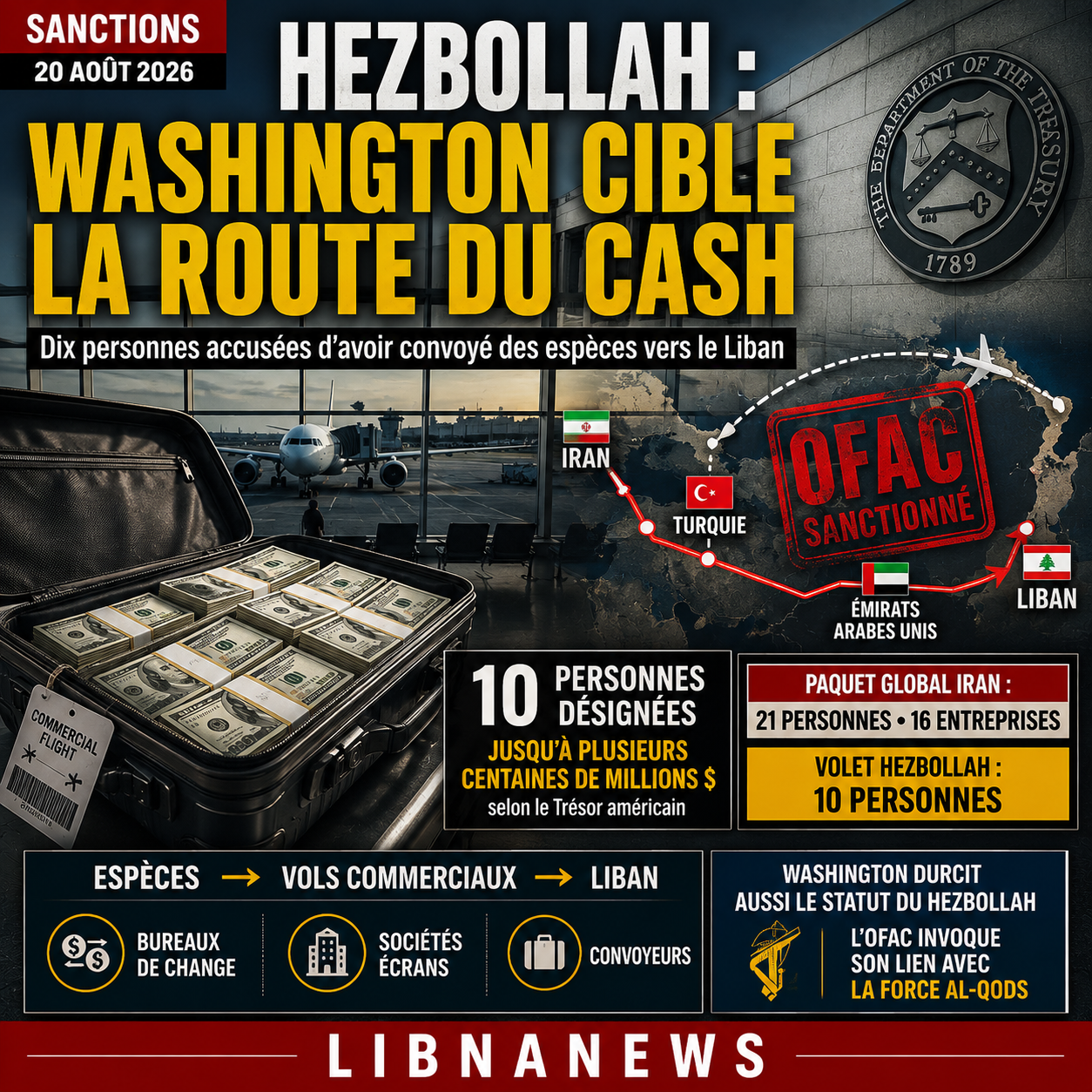
The US Treasury announced on Thursday 20 August a new sanctions offensive against Iran-related networks, targeting a total of 21 people and 16 companies according to the announcement relayed in Beirut. The Hezbollah component identifies ten men and women accused of smuggling cash on commercial flights between Lebanon, Turkey, the United Arab Emirates and Iran. Washington says this network could move up to hundreds of millions of dollars. At the same time, the Office of Foreign Assets Control re-signed Hezbollah as part of its relationship with the Al-Quds Revolutionary Guard Force, claiming that the Iranian organization intervenes directly in its operations and political decisions.
The new U.S. decision applies less to an isolated business or financier than to a money chain. According to the Treasury, foreign exchange offices in Turkey, front companies, bank accounts and especially conveyors travelling on commercial airlines would have allowed cash to be moved between several countries before their arrival in Lebanon.
Washington names ten people in this network:Yunus Alper Yilmaz, Halil Ibrahim Kacmaz, Onder Dede, Vasfi Akyuz, Mehmet Akyuz, Mehmet Acur, Feyyad Karasalih, Masoud Mousafar, Gulay Kaya Savci and Emrah Ayaz.
The mechanism described by the Office of Foreign Assets Control, or OFAC, would allow Hezbollah to obtain currencies outside the formal financial system and circumvent sanctions that limit its access to international banks. The U.S. administration also links this network to a former financial officer of the Al-Quds Force, Behnam Shahriyari, who is now deceased.
This decision comes as Washington seeks to increase financial pressure on Iran and its allied organizations in the region. In the Lebanese case, it puts at the forefront a question that has become central since the banking collapse of 2019: the massive circulation of cash outside the traditional banking system.
Ten suspected conveyors between four countries
The character presented as central in Hezbollah isYunus Alper YilmazA Turkish businessman. The U.S. Treasury accuses it of leading the network of conveyors responsible for transporting cash between several countries in the region and Lebanon.
According to OFAC, Yilmaz used some foreign exchange offices based in Turkey as facades for its operations. It also reportedly provided front companies and bank accounts for transfers related to the Al-Quds Force.
Washington then identifiesHalil Ibrahim KacmazandOnder Dedelike two Yilmaz associates. In particular, they reportedly recovered cash from bureaux de change prior to their transfer.
Vasfi Akyuzwould have been more logistical. The Treasury accuses it of coordinating the movement of conveyors while participating in certain transport operations.
Six more people complete the list:Mehmet Akyuz, Mehmet Acur, Feyyad Karasalih, Masoud Mousafar, Gulay Kaya Savci and Emrah Ayaz. According to American charges, they smuggled money to Hezbollah on commercial flights to Lebanon.
These are charges made by the U.S. administration under administrative sanctions. They should not be presented as court sentences.
Commercial flights to move cash
The procedure described by Washington is one of the most sensitive aspects of the announcement. The network reportedly used conveyors travelling as passengers on commercial flights connectinglebanon, Turkey, the United Arab Emirates and Iran.
OFAC estimates that this organization could move up to hundreds of millions of dollars between these different jurisdictions.
The use of species would respond to a particular constraint. The US sanctions severely complicate the use of the international banking system by persons and structures associated with Hezbollah or the Al-Quds Force. Banks dealing in dollar transactions include exposure to the US financial system and may face sanctions when they facilitate certain transactions with designated persons.
The physical transport of currency makes it possible to circumvent some of these controls. Money does not necessarily pass through an identifiable international bank transfer. It can be physically moved and then reintroduced into different circuits by foreign exchange offices, companies or other intermediaries.
However, this method has a logistical constraint: moving very large sums requires a multiplication of transport, conveyors and collection points.
It’s this human infrastructure Washington says is targeting Thursday.
Why Turkey and the Emirates appear in the network
The geography described by the US Treasury is also significant. The network would not only operate between Iran and Lebanon. It would use stages in Turkey and the United Arab Emirates.
In the Turkish case, Washington directly accuses Yilmaz of using local exchange offices as well as commercial and banking structures. Turkey is an important transport centre between the Middle East and Europe, with a dense air network to Beirut and several regional capitals.
The Emirates has a different function in regional trade channels. Dubai has long been a platform for trade, re-export, exchange and financial services between Iran and the rest of the world. This economic importance explains why Iranian networks seeking to circumvent US sanctions regularly appear in OFAC designations.
However, bringing these countries into a sanctioned network does not mean that their governments are involved in the operations described. U.S. charges target individuals, corporations or intermediaries using their territories and infrastructure.
This distinction is essential, especially at a time when Turkey and the Emirates are playing a growing diplomatic and economic role on Lebanese issues.
The network would go back to Behnam Shahriyari
The Treasury links the sanctioned scheme toBehnam Shahriyari, presented as a former financial officer of the Iranian Revolutionary Guards Al-Quds Force.
Shahriyari, now deceased, had already been identified for several years by Washington as one of the players in the financial mechanisms used to support Tehran’s allied organizations.
According to the U.S. administration, the network targeted on Thursday had previously been associated with him. This connection is important in Washington’s reading of the case: the ten conveyors would not form a mere private cash transport network, but one of the extensions of a financial infrastructure linked to the Al-Quds Force.
The Treasury recalls that the mechanisms used to finance Hezbollah are not based on a single method. Washington cites illegal oil trade, illegal maritime operations, sales of raw materials, front companies and physical transport of cash.
In its national risk assessment published in 2026, the Treasury estimates more broadly that Hizbullah retains several sources of revenue. According to Washington, the movement receives Iranian financial support while relying on commercial activities, donors, international networks and financial intermediaries.
The transport of species is therefore part of a much larger system.
What exactly is the Al-Quds Force?
TheAl-Quds Force, or IRGC-QF according to its English acronym, is the branch of the Guardians of the Islamic Revolution primarily responsible for external operations.
The Revolutionary Guards themselves form a separate military and political-economic institution from the regular Iranian army. Created after the 1979 Islamic Revolution, they gradually gained major weight in the military, security and economic apparatus of the Islamic Republic.
The Al-Quds Force is responsible for operational relations with various partners and armed groups supported by Tehran abroad.
The United States was one of the entities sanctioned for terrorism in 2007, including its support for Hezbollah and other organizations. Washington then added the Revolutionary Guards to its list of foreign terrorist organizations in 2019.
This qualification is subject to US legislation. On the contrary, Iran regards the Revolutionary Guards as an official component of its armed forces.
It is the link between the Al-Quds Force and Hezbollah that Washington legally reinforces with its decision of 20 August.
Why Washington « reigns » Hezbollah
The term can lead to confusion. The United States has not just discovered Hezbollah or put it under sanctions for the first time.
Washington has placed Hezbollah on the US list ofForeign Terrorism Organizationsforeign terrorist organizations, from the8 october 1997. The State Department also designated in 2001 asSpecially Designed Global Terrorism, or SDGT, under Executive Order 13224.
The decision of 20 August adds an additional basis.
It is now re-designating Hezbollah under the modified Executive Order 13224, considering the movement asheld, controlled or directed by or acting on behalf of the Al-Quds Force.
To justify this qualification, the U.S. Treasury advances two elements. He claims that the Al-Quds Force coordinates Hezbollah attacks and intervenes deeply in the direction of its political decisions.
This statement has a scope that goes beyond the financial question alone. Washington legalizes its reading of the relationship between Hezbollah and Tehran: the Lebanese movement is not only regarded as a beneficiary of Iranian support, but as an organization under the direction or control of the Al-Quds Force within the meaning of the American sanctions regime.
This qualification is challenged by Hezbollah, which claims Lebanese identity and decision-making while assuming its strategic alliance with Iran.
OFAC, the administration that can cut access to the dollar
The main actor of this decision isOffice of Foreign Assets Control, better known by its acronym OFAC. This administration depends on the US Treasury Department.
Its power does not lie in the arrest of sanctioned persons. It is based on access to the US financial system.
When a person is designated, his or her property and property interests located in the United States or held by American persons must be blocked. U.S. citizens and businesses may no longer engage in transactions with U.S. citizens or businesses unless authorized or exempted.
The scope is becoming international due to the role of the US dollar and banks in global payments.
A foreign bank that knowingly carries out certain important transactions for a designated person may itself expose itself to secondary sanctions. In particular, OFAC may restrict its access to corresponding accounts in the United States.
This threat pushes international financial institutions to exercise vigilance that is often higher than the US legal prohibitions alone.
For a network seeking dollars or other convertible currencies, the effect can be considerable.
What sanctions change for the ten people
The ten persons appointed on Thursday see their possible assets under US jurisdiction blocked.
The rule also extends to undertakings which they own directly or indirectly up to the level of50 % or moreindividually or collectively with other sanctioned persons.
Transactions involving their property or property interests are generally prohibited for American persons.
However, the most significant effect may appear outside the United States. Banks, foreign exchange companies, transport companies and other foreign partners may decide to cease any relationship with a sanctioned person in order to avoid exposure to the US system.
The Consolidated Revenue Fund also notes that secondary sanctions may affect certain foreign financial institutions that facilitate significant transactions for designated persons.
The aim is therefore to make the operation of the network much more expensive, even when it does not directly use an American bank.
Lebanon facing the problem of the cash economy
The US announcement is particularly sensitive to Lebanon. Since the collapse of the banking sector in 2019, the economy has moved largely towards cash payments.
This facilitates daily transactions in a country where confidence in banks has collapsed. It also complicates the fight against money laundering, illegal financing and cross-border currency transport.
The US Treasury considers that Hezbollah uses this feature to move funds outside of conventional banking.
The issue relates directly to border controls and Rafic Hariri International Airport. The Lebanese authorities had already strengthened the inspections of some travellers following accusations of the use of civilian flights to transfer Iranian money.
By February 2025, direct links between Tehran and Beirut had been suspended in a context of high security pressures. The Israeli charges already involved the transport of Iranian species to Hezbollah by air.
The new American description suggests a more diffuse system: when the direct road is complicated, money can, according to Washington, transit through other countries and be transported by several conveyors.
New pressure on Lebanese financial circuits
For Beirut, the consequences are more than 10 people.
Lebanon was currently trying to restore its relations with international financial institutions, restructure its banking sector and improve mechanisms to combat money-laundering and illicit financing. In this context, any US accusation of hundreds of millions of dollars passing through the country increases the pressure on the supervisory authorities.
Lebanese banks have already severely reduced their relations with sanctioned individuals and companies in order to preserve their access to the dollar and corresponding foreign banks.
The challenge is therefore shifting to non-banking channels: exchange companies, informal transfers, physically transported cash and commercial enterprises that can act as intermediaries.
The US decision of 20 August specifically states that Washington intends to focus its sanctions more on this infrastructure.
It also intervenes as Lebanese authorities discuss the arms monopoly and the future role of Hezbollah. Sanctions add a financial dimension to this political and military pressure.
The next indicator will be less the number of names added to the United States lists than the ability of the authorities in Turkey, the United Arab Emirates and Lebanon to identify the circuits described by Washington. If foreign exchange offices, accounts, front companies and conveyors are effectively neutralized, Hezbollah will have to find other routes to send to Lebanon the currencies that the Treasury claims come from Iranian financial infrastructure.




