

A success that does not lead to an appointment
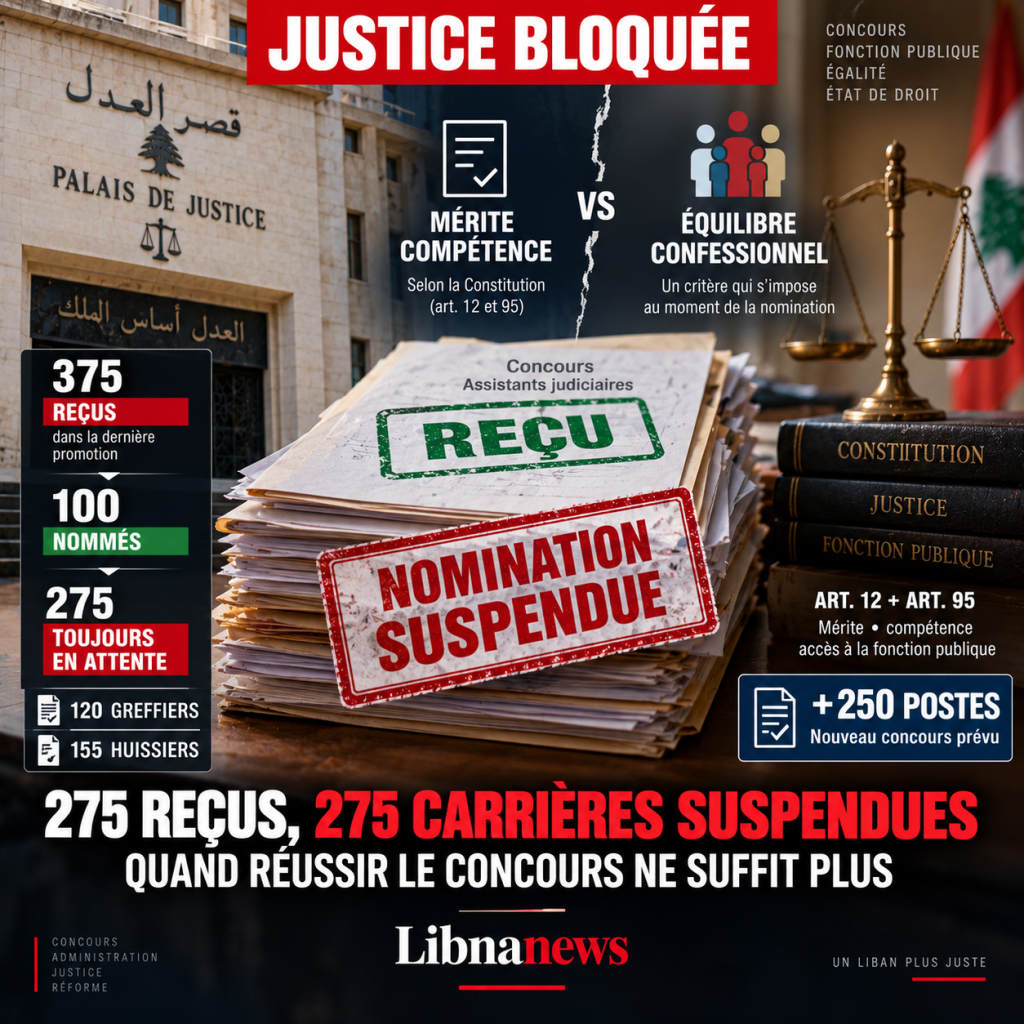
They passed the competitions organized to integrate the judicial administration. They did it. Yet,275 legal assistants, including 120 candidates for the office of clerk and 155 for the office of bailiff, remain without appointment. Their case highlights an ancient contradiction of the Lebanese administration: success in a competency-based competition can be called into question at the time of appointment by seeking a religious balance that was not one of the criteria for separating candidates.
The source of the dispute is the processing of the fifth and final promotion of legal assistants received, with 375 persons. The Council of Ministers examined their situation on 26 February 2026. His decision number 7 allowed the appointment of only 100 of them, i.e. 80 clerks and 20 bailiffs. The remaining 275 were left out. At the same time, the decision provided for the opening of a new competition for 250 legal assistants.
The situation creates an anomaly that is difficult to explain to the candidates concerned. The administration already has a list of people who have completed the tests. However, rather than completing their recruitment, the State is considering a new competition. The candidates excluded from the appointment therefore do not contest a failure. They challenge the consequences of a success that no longer automatically opens them up to the function for which they were selected.
The file thus exceeds 275 persons concerned. He asked a much broader question about the value of public service competitions. If success is no longer sufficient, candidates must know what second criterion occurs after the results are published. It was precisely on this ground that the denominational question was imposed.
However, the Constitution places jurisdiction at the forefront
Candidates are supported by specific constitutional provisions. Article 12 of the Constitution guarantees Lebanese access to public service without distinction other than those relating to merit and competence, under the conditions laid down by law. The principle is therefore equality of access to administration, subject to meeting the professional criteria imposed.
The case of legal assistants also refers to Article 95. For public office under the first category, the text provides for the abandonment of the rule of denominational representation and the use of specialization and competence. The principle applies in particular to the civil service, the judiciary, military and security institutions and public and mixed institutions.
It is this articulation between the two articles that nourishes the contestation. The positions of judicial assistants concerned do not fall within the highest political or administrative functions for which institutional balances may be subject to special provisions. They correspond to administrative and judicial jobs accessible by competition. Candidates therefore consider that their ranking and success should be the determining factors.
The stakes are all the more acute as the justice system has been suffering for several years from difficulties of functioning, lack of staff and administrative delays. Judicial assistants play a daily role in processing cases. Registrars provide an essential part of the continuity of the courts. The bailiffs participate in the execution and transmission of acts. The blocking of appointments therefore does not only affect candidates’ careers. It potentially affects the capacity of the judiciary to function.
The paradox becomes even more visible when the state plans to recruit new candidates. If there is a need for a competition for 250 additional posts, the 275 people already received ask why their appointments remain suspended. The debate therefore does not concern the existence of unnecessary posts. It deals with the political and administrative conditions under which they can be filled.
The Council of Ministers at the centre of the dispute
The decision of 26 February puts the government directly at the heart of the issue. The Council of Ministers did not cancel the results of the competition. Nor did he establish that the candidates concerned had failed an additional occupational condition. He chose to split the last promotion and limit appointments to 100.
This decision commits the government toAmbassador Nawaf Salam. The challenge underscores the contradiction between the Prime Minister’s career as a former judge at the International Court of Justice and a government decision accused of making confessional logic prevail over the results of a competition. The argument is political, but it mainly affects the credibility of the administrative reform defended by the power.
The problem is not to deny the reality of religious balances in Lebanon. They structure part of the political and institutional system. The question asked by the candidates is different: should these balances be applied to functions for which the Constitution specifically provides for a logic of competence, particularly under the first category?
The file thus puts in opposition two conceptions of the state. The first considers that the administration must continue to reflect the major Community balances in order to avoid a group becoming underrepresented on a sustainable basis. The second view is that extending this logic to administrative competitions means gradually evading the merit principle of its content. The further away the level concerned from the top political positions, the more difficult this contradiction becomes to legally justify.
For successful candidates, the concrete effect is immediate. They invested time in the preparation of the tests, met the required criteria and achieved the necessary results. Some have been able to organize their professional future around this success. The suspension of appointments turns this success into a waiting success without a certain deadline.
Adel Nassar facing a politically locked folder
Minister of JusticeAdel Nassaris directly concerned. The Legal Assistant Monitoring Committee has increased meetings with officials to obtain a change in the decision. But the process has so far failed to unblock all appointments.
According to the information gathered by the follow-up committee and reported in the file, the Minister of Justice had explained that he was under pressure and considered that what had already been obtained was as much as possible in the current circumstances.Ali Al Mawla, member of the Monitoring Committee, relayed this assessment. The wording is revealing: the blockage would not be linked to a technical inability to appoint candidates, but to the political limitations to the processing of the file.
This situation places Adel Nassar in the face of a particular difficulty. The Department of Justice needs staff. At the same time, the Minister does not alone decide on appointments requiring government intervention. Even if it wants to broaden recruitment, it must deal with the balance within the Council of Ministers and with the political forces involved in the matter.
The candidates, on the other hand, cannot be satisfied with this division of responsibilities. Their natural interlocutor remains the state. They participated in a competition organized by its institutions and not in a procedure led by political parties. Their claim therefore aims at the final result: the appointment of those whose success has already been recognized.
The Monitoring Committee is specifically seeking to maintain this distinction. His argument is not to claim political favour. He states that the right has already been acquired through the success of the competition. Mobilisation is therefore intended to prevent an additional criterion from being added after the tests.
Lebanese Forces and Kataeb directly involved
The challenge also took on a partisan dimension. Sources of the Monitoring Committee accuse theLebanese forcesandKataebhaving defended an approach aimed at maintaining a religious balance among the appointees. Critics use a particularly harsh formula when speaking of « denominational blood tests » imposed on successful candidates.
This accusation must be seen in its context. It comes from those involved in the challenge and does not in itself constitute proof that both parties have legally imposed a religious criterion on the contest. However, it shows how candidates interpret the blockage. In their view, the obstacle is no longer administrative. It is political and community.
The essence of the problem lies in the composition of the candidates themselves. The data presented by the Monitoring Committee show that there was no digital equality between Muslim and Christian candidates from the outset. To obtain a strict parity among the receipts therefore amounts to changing the logic of the contest after the fact. If applications are not equally distributed among communities, results based solely on scores cannot mechanically guarantee a balanced denominational distribution.
The figures for previous promotions reinforce this argument. In the fourth promotion, the proportion of successful Christian candidates who still wished to join the position would have fallen below 25 per cent, while it was around 35 per cent a year earlier. Some of them had meanwhile found other jobs. The problem is therefore not only with the results of the competition. It is also due to changes in the labour market and to the professional choices of candidates.
This creates a structural difficulty. If the State wishes to maintain a certain denominational representation in certain functions, it must have a sufficient number of candidates from each group. Where this is not the case, two options appear: to accept the result of the competition or to delay appointments pending new applications. This is the second logic that legal assistants denounce.
A problem far beyond the courts
The file is not isolated. Other public recruitment has already been delayed by comparable controversies. The case of forest guards is cited as an example. In a competition involving 1,600 candidates, only 200 Christian candidates reportedly ran. The difficulty in constructing a balanced distribution had helped to delay appointments.
Secondary education also had similar problems. Again, the number of candidates from different communities did not necessarily correspond to a logic of parity. When the administration tries to match the results of an open competition with a denominational representation determined in advance, both principles inevitably become tense.
These precedents give the 275 legal assistants a national scope. This is no longer just a conflict between a promotion and the Department of Justice. It reveals a recruitment difficulty that can affect several sectors of the public service. The demographics of candidates, their professional choices and the attractiveness of public wages have changed. Political mechanisms, however, sometimes continue to operate according to balances built in another context.
This contradiction is likely to worsen when certain categories of the population are more diverted from public employment. Remuneration, career prospects and administrative instability can push graduates to the private sector or emigration. If a community provides fewer candidates for a given competition, then the administration is faced with an impossible choice if it simultaneously wants to respect the ranking and maintain strict parity.
The result can be freezing. Positions remain vacant. Successful candidates are waiting. Administrations continue to operate with insufficient staff. Then new competitions are organised in the hope of producing a different composition.
Opening a new contest crystallises anger
This is precisely the prospect of a new competition for250 legal assistantswhich makes the current case particularly sensitive. The 275 candidates left without appointment do not understand why the State would seek new receipts when it did not resolve the situation of those already existing.
From an administrative point of view, a new competition could address future needs or change the composition of the pool of candidates. But politically, the message is difficult to defend. It gives the impression that the success of a first promotion can be put on hold until a second one produces a distribution considered more acceptable.
Such a practice would undermine confidence in the competition itself. The candidate could no longer regard his classification as the outcome of the procedure. He should wait for a second informal selection, based not on his note but on the collective composition of the receipts.
This uncertainty directly affects the principle of equality. Two candidates who have achieved comparable results could have different destinies for reasons unrelated to their professional skills. The administration would then risk turning the competition into a first step in a process whose actual criteria are only revealed at the time of appointment.
The problem is becoming particularly sensitive in justice. The courts are specifically responsible for ensuring the application of the rules. Their administrative staff cannot be recruited on a long-term basis according to procedures the outcome of which seems unpredictable to the candidates.
Behind the 275 names, the question of the state that Lebanon wants to rebuild
The government says it wants to reform institutions, restore confidence and strengthen state authority. These objectives are also applied in less dramatic cases than security in the South, international negotiations or banking restructuring. The way in which the State recruits its civil servants is a very concrete test of its ability to apply the rules it sets itself.
The 275 legal assistants are at exactly this point of friction. They do not request that their results be reassessed in their favour. They demand that the results already obtained produce their effects. The government, on the other hand, must reconcile this demand with political pressures related to religious representation and with the real needs of the judiciary.
The choice will have consequences beyond this promotion. A full appointment would include the primacy of the competition for these categories of positions. A lasting maintenance of the freeze would instead set a precedent: success would not necessarily be enough to be recruited.
The question asked by the 275 candidates is therefore simple, but its answer relates to the very functioning of the Lebanese system. When the Constitution states that competence and merit must govern access to the public service concerned, the administration must determine how far it agrees to apply this principle when the results do not correspond to the desired political balances. Until this contradiction is resolved, the 275 legal assistants will remain the faces of a much larger problem: that of a State that organizes competitions on behalf of merit, and then still hesitates to accept what the merit produces.





Comments