

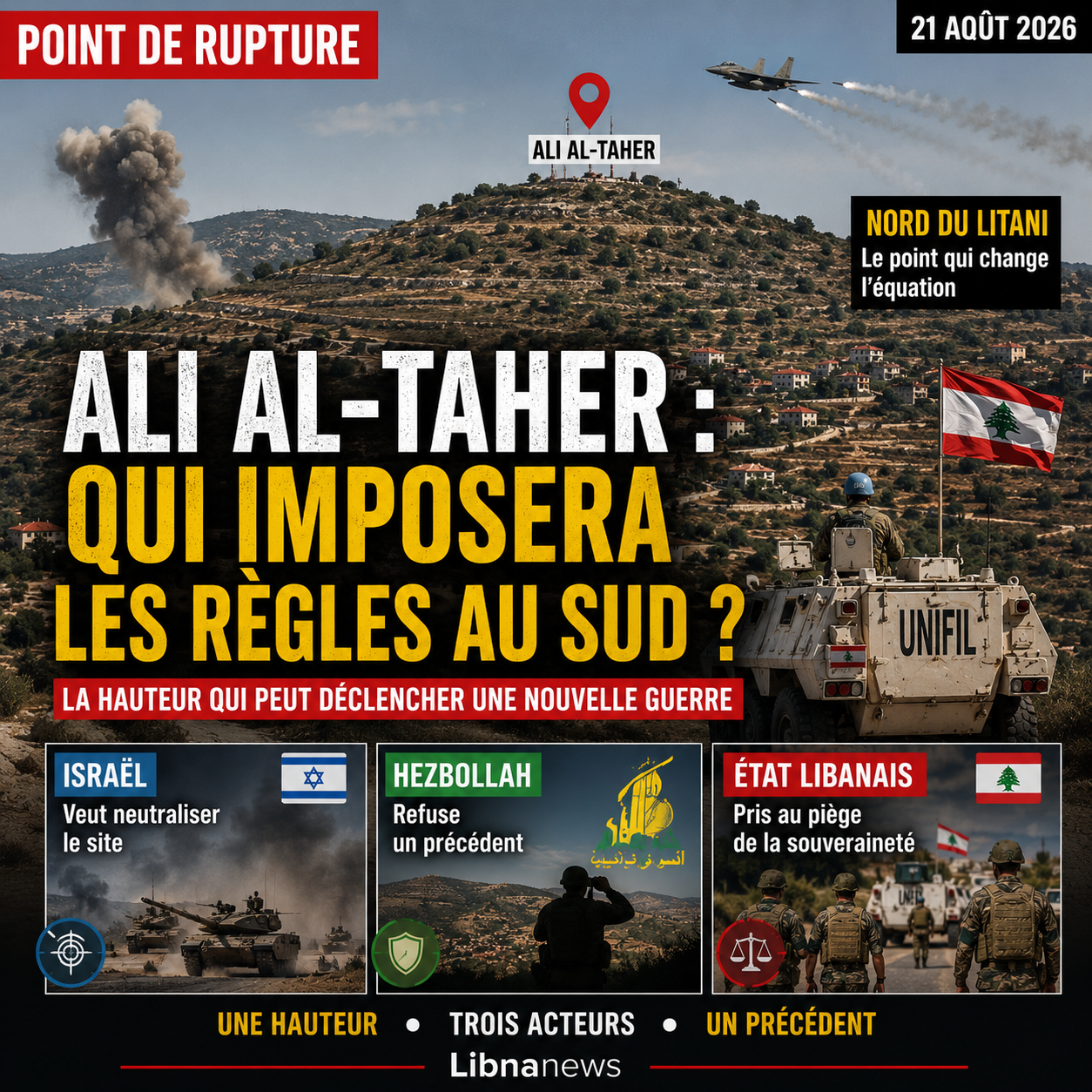
At first glance, Ali al-Taher is just a height among many others in the rugged terrain of the South Lebanon. Yet this area east of Nabatiyeh now concentrates a considerable part of the Israeli-Hizbullah arm, while placing the state and the Lebanese army on a particularly sensitive issue of sovereignty. The continuation of Israeli strikes and Hezbollah’s refusal to abandon the site raised concerns that a geographically limited battle would undermine the laborious arrangements negotiated in the South. For behind Ali al-Taher is now a broader question: who will lay down the military and political rules applicable to Lebanese territory after the war?
The paradox alone summarizes the new fragility of the South Lebanon. A few square kilometres of relief can now weigh on negotiations involving Beirut, Israel and the United States, complicate the deployment of the Lebanese army and threaten the stabilization of villages whose inhabitants still hope to return to their homes.
Ali al-Taher has thus moved from a military position to a political test. Israel wants to neutralize what it presents as an important infrastructure of Hezbollah. The Shiite movement refuses to allow Israeli military pressure to determine which positions it must abandon. Between the two, the Lebanese State must defend the principle of the monopoly of the law enforcement force without giving the impression that its army carries out, under the bombs, an order decided outside.
This contradiction explains why the height has become much more dangerous than its only dimensions suggest.
Ali al-Taher, a hot spot north of Litani
Israeli operations around Ali al-Taher intensified in August. The area and several localities in Nabatiyeh governorate were hit, while there were consistent reports of Israeli preparations for the height. The sequence of 15 August further aggravated the tension: Israel launched a series of strikes after a drone attack on its forces in the area, an attack it attributed to Hezbollah.
This pressure does not occur on pristine terrain. By June, Ali al-Taher had been at the centre of conflicting information on the reality of height control. Israel had announced that it had taken control of it, which Hezbollah had formally denied. A Lebanese military official had then told an Arab media that there had been no Israeli progress on the ground in line with the announcement.
Since then, the question is no longer just who physically controls such a point of relief. It concerns the possibility for Israel to transform its air superiority and military pressure into a lasting change in the ground system in South Lebanon.
Geography explains part of this insistence. The heights of Ali al-Taher are located east of Nabatiyah and offer a dominant position on several surrounding axes. They include Nabatiyah, Kfar Tebnit and the reliefs leading to Iqlim al-Touffah. Israel also claims that the area is home to underground infrastructure used by Hezbollah, which the movement did not detail publicly.
But another feature has become politically essential:Ali al-Taher is located north of Litani.
This location directly feeds the argumentary Hezbollah. The movement maintains that the security arrangements applied to the area south of the river cannot be extended automatically northward. To accept that Israel should obtain, either through military pressure or through negotiations, the evacuation of a position north of the Litani would therefore, according to this logic, gradually change the scope of the constraints imposed on Hezbollah.
This is where the file changes its nature. If the dispute concerned only the neutralisation of a position directly threatening Israeli forces, a local arrangement could theoretically be sought. But Hezbollah believes that Ali al-Taher could create a case law: a first position evacuated under pressure would pave the way for a second, then a third.
The danger no longer lies solely in an Israeli offensive. He is also concerned that Hezbollah may decide that it must militarily prevent the fall of the position in order to prevent it from becoming the model of the next steps.
Hezbollah refuses to set a precedent for Ali al-Taher
Hezbollah’s speech on Ali al-Taher intensified as military and diplomatic pressure increased. Officials and sources close to the movement have rejected the idea of abandoning the height without compensation. In particular, MP Hassan Ezzeddine, a member of the Hezbollah parliamentary bloc, presented the site as an essential position that the movement does not intend to abandon in the face of an Israeli operation.
However, information circulating around a possible transfer to the Lebanese Armed Forces remains contradictory and must be treated as such. Some diplomatic sources claimed that a formula for the handing over of the area to the army had been considered, or even proposed under certain conditions. Hezbollah has publicly maintained a much more restrictive line, while other reports have referred to the possibility of a transfer only after a complete Israeli withdrawal.
This divergence does not alter the heart of the problem. Hezbollah refuses to allow the sequence to be dictated by Israel: military pressure, evacuation of the movement, entry of the Lebanese army, and then verification of the site. In his view, such a mechanism would make the Israeli force the real trigger for Lebanese internal redeployment.
The stake of the precedent becomes decisive. If Ali al-Taher is evacuated because Israel designates him as a threat, what would prevent Israel from then claiming the same treatment for another position further north? And how far could this mechanism extend?
That concern did not mean that all future Israeli demands would necessarily be accepted. However, it explains why Hezbollah attributes Ali al-Taher a value that far exceeds that of the ground. To cede on this height would, in his reasoning, be to recognize a mechanism allowing Israel to participate indirectly in the definition of military arrangements within Lebanon.
The movement therefore seeks to dissociate two issues that its opponents would like to bring together: the role of the Lebanese State and that of Israeli demands. He may be confronted with the internal claim of a state monopoly on arms while refusing that this transformation takes place according to a timetable and geography determined by Israel.
It is precisely this distinction that places the Lebanese army in a particularly uncomfortable situation.
The Lebanese Army caught in a mechanics that it does not control
On paper, entrusting Ali al-Taher to the army might appear to be the solution most consistent with the principle of sovereignty. An area on Lebanese territory would pass under the authority of the national military institution, while non-State forces would withdraw from it. Presented in this way, the formula seems almost obvious.
In the field, it is much less.
The first problem is the sequence in which this deployment would occur. If Israel designates a Hezbollah position, the bomb, threatens to occupy it and then demands that it be handed over to the Lebanese army, its deployment would no longer be seen as the mere exercise of a sovereign decision in Beirut. It could appear as the direct result of an Israeli military injunction.
This nuance is crucial for an institution that is trying to present itself as the army of all Lebanese.
The army would then face two imperatives difficult to reconcile. The first is to extend the effective authority of the State throughout the territory. The second is to avoid being transformed into an instrument allowing Israel to obtain without direct land use what it demands on the ground.
The case of Ali al-Taher therefore raises a more profound question than the question of who will occupy a height tomorrow:who decides to deploy the lebanese army to lebanese territory?
While this decision belongs to the Beirut institutions, it is a matter of national sovereignty. While the timing and locations are gradually determined by Israeli demands supported by the threat of strikes, the same operation takes on a completely different political significance.
The previous one is particularly concerned that the formula could become reproducible. Israel could identify a site, demand its evacuation, exert military pressure and then ask the Lebanese army to take possession of it. The debate would no longer focus solely on the disarmament of Hezbollah, but on Israel’s ability to determine, site after site, the security mapping of Lebanon.
For Beirut, the trap is obvious. Refusing to deploy the army would expose the state to the accusation of not exercising its sovereignty. To accept each deployment according to a sequence imposed by Israel could, conversely, weaken that same sovereignty by giving the impression that the State acts under external coercion.
Ali al-Taher concentrates these two contradictions.
An Israeli political affair
Israeli determination also has an internal dimension that should be distinguished from military considerations. According to reports published in the Lebanese press in recent days, Benjamin Netanyahu may seek to portray Ali al-Taher’s takeover as a success before the Israeli legislative elections announced on 27 October.
This reading comes in particular from official Lebanese sources cited by the press. It is not evidence of the personal intentions of the Israeli Prime Minister and must therefore remain presented as a reported analysis, not as an established fact.
However, it is part of an identifiable political context. Benjamin Netanyahu mentioned on 8 August the preparation of an important operation without publicly specifying its nature. Several media then brought these statements closer to the pressure around Ali al-Taher.
The question of northern Israel adds an additional dimension. The security of border communities and the ability to ensure the sustainable return of their inhabitants is a major political issue in Israel. In this context, an operation presented as the neutralisation of an important infrastructure of Hezbollah could acquire a symbolic value greater than its immediate territorial outcome.
This is also what makes the situation more dangerous. A military operation that meets only a tactical need may be limited when its objective is achieved. An operation with political or electoral value is subject to other constraints: it must produce a victory image sufficiently clear to be presented to the public.
Ali al-Taher has become a symbol. After weeks of statements, strikes, reported attempts at progress and negotiations, its fate can now be interpreted by both sides as an indicator of their ability to impose their conditions.
For Israel, not getting change could be presented as the inability to eliminate a persistent threat. For Hezbollah, abandoning the position under Israeli pressure could be interpreted as accepting a new rule of the game.
The margin of compromise is reduced as the symbolic value of the height increases.
In Ali al-Taher negotiate future rules of the South
This is probably where the main danger lies. A battle for Ali al-Taher can remain localized in space while producing consequences that would not.
The negotiations between Lebanon and Israel are the first likely ground to be affected. Contacts with American involvement have led to reported progress on certain issues, including borders and prisoners. But the issue of cessation of attacks and that of Ali al-Taher continue to hamper broader stabilization.
An Israeli offensive would immediately alter the logic of these discussions. It would no longer be a matter of negotiating the modalities for stabilization, but of determining whether a change in the military balance of power should then be incorporated into the political agreement.
The risk for Lebanon is clear: that negotiations will cease to define the rules of the ground and that the ground will begin to dictate the rules of the negotiations.
A second challenge is the sustainable return of the inhabitants. Each major resurgence of strikes in Nabatiyah governorate revives the fear of further displacement. The attacks of 15 August, which affected several localities and caused civilian casualties, showed that a confrontation centered on Ali al-Taher could quickly exceed the immediate perimeter of the height.
A land battle would have even heavier consequences. Roads, surrounding villages and areas used for military movements would be exposed to an expansion of strikes. The inhabitants who have already experienced the successive displacements would then remain suspended from the evolution of a confrontation whose stakes exceed their own locality.
Finally, Ali al-Taher intervenes at a time when Lebanon must think of the southern security organization beyond the presence of the United Nations Interim Force in Lebanon. The question is therefore not only that of the next confrontation. It concerns the architecture which must prevent the next.
Who will monitor sensitive areas? What freedom of action will Israel retain when it claims to identify a threat? How far can the Lebanese army deploy without being caught between Hezbollah and Israeli demands? And what guarantees will prevent a procedure designed for a particular site from becoming a permanent mechanism applicable to other sectors?
Ali al-Taher has become the place where all these issues meet.
The height is therefore not only disputed for what it contains or for what it allows to observe. She is for the rule she could create. Israel seeks to prevent Hezbollah from maintaining capabilities that it considers threatening. Hezbollah wants to prevent Israel from turning its military power into a permanent watch over its northern Litani. The Lebanese State must try to restore its authority without suggesting that this authority is exercised at the request of another State.
It is this superposition that makes a local confrontation potentially explosive.
A compromise around Ali al-Taher could, on the other hand, offer a model: Israeli withdrawal or guarantees, sovereign deployment of the Lebanese army and mechanism preventing the return of armed confrontation. But such an arrangement presupposes that everyone can present it as something other than a surrender.
At the moment, this formula does not exist. The military strikes and pressure maintain the hypothesis of an Israeli operation, while Hizbullah maintains its refusal of an imposed evacuation. Between the two, the Lebanese army remains at the centre of an equation that it has not itself defined.
The next movement around Ali al-Taher will therefore say more than the name of the force that will control a height of Nabatiyah district. He would indicate whether the future security order of the South was being built through inter-State negotiations and the decisions of Lebanese institutions, or whether it would gradually emerge under military pressure.
That is why Ali al-Taher can still serve as a currency exchange in a wider negotiation. But the more the strikes continue and the harder the public positions become, the less the space separating this negotiation from the point of break.




