

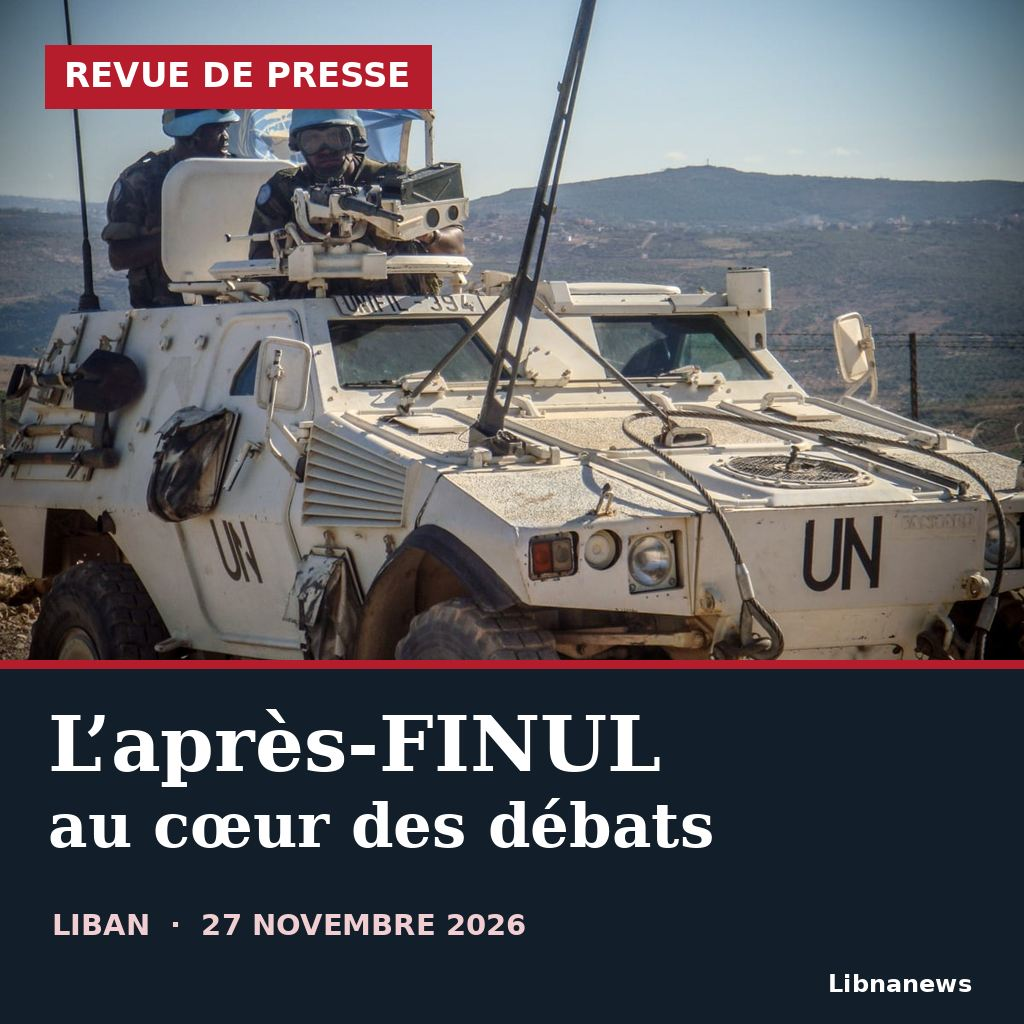
On the front page: the withdrawal of UNIFIL and the battle over what will follow
Al Jumhouriya, Al Sharq and An Nahar of 27 November 2026 place the end of UNIFIL’s mandate at the centre of their Lebanese pages. Al Joumhouriya details a French track to stagger the withdrawal and avoid a break in the international presence in the South. An Nahar insists on the Israeli opposition to the deployment of a French force after the mission. Al Binaa reports exchanges between Paris and Washington, but stresses that the composition, prerogatives and duration of a possible mission remain to be specified.
The debate covers three different issues. The mandate of UNIFIL expires on 31 December 2026. The withdrawal of its staff must then be organised. A successor force would need a separate framework. Al Quds Al Arabi of 27 November presents these negotiations as a disagreement over the deployment of the post-FINUL, not as an already acquired vote in the Security Council. Nidaa Al Watan reports uncertainty in Beirut about an agreement between the capitals concerned. The newspapers do not produce any adopted text that would introduce a new force.
Ad Diyar and Al Akhbar of 27 November link these discussions with the Israeli strikes on Thursday night in the area of Ain al-Tinh in Western Bekaa. Al Akhbar sees it as an Israeli attempt to further expand the scope of his interventions. Al Liwaa also reported strikes and fire in several southern localities, including a building destroyed in Haris. The reporting of strikes, the identity of targets claimed by the Israeli army and the interpretation of their political objective fall under three different levels of verification.
Lebanese policy: State authority and the fate of southern villages
Al Binaa and Al Sharq of 27 November reported that the Amal movement refused to amend resolution 1701 to incorporate a new agreement. Al Akhbar brings this position closer to Hizbullah’s earlier refusal of a force that is not under the authority of the United Nations. Al Joumhouriya distinguishes between the discussions on the mandate, the debates within the government and the relationship between the two Shiite formations. A party declaration does not amount to a government decision on the formula to be proposed to the United Nations.
In An Nahar on 27 November, the political pages return to tensions over the arms monopoly and the interpretation of ceasefire commitments. The daily also examines the relationship between the parties and the municipalities, trade unions and collectives that are mobilizing. These analyses shed light on the means of pressure available to political formations; they do not establish that all the demands of the drivers or inhabitants meet a partisan direction.
Political declarations: the olive trees of the South and the reform of the State
Ad Diyar, Al Quds Al Arabi and Al Binaa of 27 November report the statements of Joseph Aoun, Nabih Berri and Nawaf Salam around the olive tree. Berri describes the grubbing up of olive trees in the South as a war crime. This is the public qualification of the President of Parliament, not a judicial finding. Aoun presents the protection of these trees as a national responsibility. To follow the concrete scope of these comments, it will be necessary to distinguish between destroyed or torn trees, crop losses and parcels that are no longer accessible to their operators.
Al Sharq and Al Liwaa reported on the same day on Nawaf Salam’s intervention at the launch of a repository to describe positions and competencies in the public service. The Prime Minister presents the benchmark as a step in administrative reform. The announcement focuses on how to define the expected jobs and qualifications. It does not decide on its own whether to recruit new staff or whether to increase remuneration.
Diplomacy: military support and cooperation with the Emirates
Al Jumhouriya of 27 November highlights border cooperation between Lebanon and the United Kingdom. The figure of 85 rounds is presented in the framework of this cooperation. It does not correspond to the announcement of 85 new facilities. A separate statement from the British, American, Australian, Canadian and Japanese embassies recalled on 25 November that the Lebanese State should have the sole prerogative to decide war and peace. It does not describe a mandate to replace UNIFIL.
An Nahar and its 27 November international edition document the visits of Emirati delegations to Beirut. Al Sharq distinguishes the meetings on the modernization of public services from those on electricity. The newspaper also reports the signing of a protocol with the Netherlands on future projects and the handing over to the Qatari ambassador of a proposal by the Free Patriotic Movement on the international presence in the South. These approaches are neither the same scope nor the same state of progress: submitting a proposal for force is not a commitment to deployment.
Economy: who pays public bills and how deposits are repaid
Ad Diyar, Al Binaa and Al Sharq of 27 November report on the review of the operating budget of the Ministry of Energy by the Finance Committee. Its president, Ibrahim Kanaan, requests audited accounts on Electricity of Lebanon. Ad Diyar awarded him $421 million for the accumulated invoices and exemptions mentioned in the discussion. This precise scope is important: this figure does not represent all the debts of EDL or the annual cost of electricity. This stock must also be distinguished from the additional credit discussed in order to settle part of the claims on public institutions.
Al Akhbar of 27 November puts forward, in a separate file, the figure of $100 million per month for banks as part of withdrawals on old deposits. The journal describes a treatment of deposits at different exchange rates and criticizes the resulting losses for savers. The amount in its columns should be compared with the Bank of Lebanon circulars and actual payments. It is not enough to calculate the rate of repayment of an account, which depends in particular on the applicable arrangements and the currency in which the withdrawal takes place.
On 27 November, Ad Diyar published two insights into food prices. The Director General of the Ministry of Economy, Mohammad Abu Haidar, reported on 21,114 checks, 1,119 records and 983 transmissions to the courts. These numbers distinguish between inspection, finding of an infringement and referral of the file. The department states that the transmissions also include minutes of previous periods: therefore, the share of the new findings already transmitted cannot be inferred. One agricultural official, Ibrahim Tarshishi, refers to losses due to the freeze. Its estimate cannot be extended to all Lebanese agriculture without knowledge of the crops and areas selected. The same newspaper gave Bechara Asmar the floor on the failure of the last wage talks. Al Sharq deals separately with the announcements of Minister Fayez Rassamny on the ports and the Beirut–Erbil air service. A frequency announced by a company must still be controlled in its sales schedules before serving as practical information.
Nidaa Al Watan on 27 November looks back at the meeting between economic organizations, the World Bank and the International Finance Corporation on private sector financing. Al Sharq Al Awsat, on the same date, deals with U.S. tariff proposals related to accusations of overcapacity and the possible effect of flea restrictions on Asian data centres. In both cases, the consultation schedule and the conditions of application are more important than the amounts announced.
Justice: Seizures in the Salame case and proceedings before the military court
Al Liwaa of 27 November reports that the French courts confirmed seizures of assets abroad in an investigation, including the former Governor of the Bank of Lebanon, Riad Salamé. The decision concerns the maintenance of provisional measures. It does not establish guilt, permanent confiscation or restitution to the Lebanese State. The details of the assets should be reported to the exact scope of the decision and not added to the amounts of other procedures.
An Nahar and Al Sharq Al Awsat of 27 November are returning to the investigation into five persons arrested in northern Lebanon. An Nahar reports that judicial sources challenge the version of a Scouting activity and deny the accusations of American intervention. These claims remain attributed. Al Sharq and Al Liwaa deal with a different procedure, concerning Ahmad Al-Assir and the events in Abra: the hearing was postponed after the accused was absent. Al Akhbar refers to a request from the defence for release. This request and removal do not mean that a release has been ordered.
Society: war continues to stop care and school
An Nahar and An Nahar International of 27 November devote four pages largely common to wartime education. Their files follow the interruptions of classes and the students’ movements in Lebanon, Syria, Gaza and Iraq. The articles on Lebanon distinguish between the functioning of schools for internally displaced persons, the situation of Palestinian and Syrian students and the need for psychosocial support. Re-registering a student, ensuring a journey and maintaining attendance over a term are three different results. The common pages of both editions do not constitute independent confirmations.
Al Akhbar of 27 November goes back to the work of Médecins Sans Frontières in the South. The organization’s report, published on 24 November, documented attacks on civilians and health services, as well as delays in access to care. According to MSF, a strike near Jabal Amel Hospital in Tyre injured 127 people on 1 June, including 39 health professionals. Al Quds Al Arabi of 27 November also devotes an article to meningitis among children in Gaza. Data on these two files cover distinct periods, regions and phenomena.
International: from attack on Kuwait to European negotiations
Al Quds Al Arabi, Al Sharq Al Awsat and Al Liwaa of 27 November reported the death of two Italian nationals after an attack in Kuwait. Kuwait assigns responsibility to Iran, which denies it. In the Strait of Ormuz, Al Sharq Al Awsat parallels Iranian claims concerning oil tankers. Claims must be reconciled, ship by ship, with marine notices. The UKMTO’s warning of an oil tanker hit off Khasab on 25 November does not determine the origin or precise nature of the projectile reported.
Al Quds Al Arabi and Al Sharq Al Awsat also discuss the escalation between Saudi power and the Houthis around Jazan, the situation in Gaza and tensions between Baghdad and Erbil. The Iraqi authorities are seeking a solution to the dispute over the smuggling of oil and the control of passages. The articles of Al Binaa of 27 November discuss the role of judicial mediation. Traffic charges do not assume responsibility for an ethnic group or for each local government.
In their European pages, Al Sharq Al Awsat and Al Quds Al Arabi of 27 November follow the discussions on the EU budget for 2028–34 and the financing of Ukraine. The additional aid proposal for 2027 is separate from the loan already in place for 2026 and 2027. The two daily newspapers also go back to the decline in the British migration balance. This balance corresponds to the difference between inputs and outputs; It alone does not measure new asylum applications or the extent of irregular immigration.
Culture and personalities: Ziad Rahbani, displaced children and Fairouz
Al Akhbar of 27 November followed the work of plasticist Abdel Kadiri with displaced children. The journal describes drawing sessions and the transition from this experience to an artistic project. He also dedicated a page to a tribute to Ziad Rahbani in Sanayeh. Al Quds Al Arabi reported on the same date the initiative linked to a statue of the musician in the garden of the National Library and reviewed the movement of independent cinema from Beirut to Tripoli, Saida and Rayak, as part of the Metropolis project.
Najwa Karam, Elissa and Nancy Ajram are among the artists who celebrated Fairouz’s birthday on the art pages of Al Sharq on 27 November. An Nahar and its international edition publish an interview with Denis Ménochet and Reda Kateb on cinema and the portrayal of the nuclear threat. Nidaa Al Watan devotes his cultural pages to literature and Ad Diyar returns to a French translation of the Great Comment of Averroès. These articles open separate tracks: portraits, reading or exits, without confusing the tributes already rendered with the upcoming appointments.
Sport: Lebanon prepares its Asian judo competitions
Nidaa Al Watan on 27 November presents three judo competitions scheduled for 2-6 December at Champville College in Dik el-Mehdi. The international calendar distinguishes the Cadet Cup, the Junior Cup and the Asian Under-23 Championship. Al Liwaa returns to the qualifying game between Lebanon and Japan in basketball and the rest of the calendar. In their international pages, Al Jumhouriya, Al Quds Al Arabi and Al Sharq Al Awsat cover European football competitions, tennis and preparation for weekend meetings. Future competitions in Lebanon deserve a separate practical treatment of the results.
Technology: artificial intelligence in university, administration and hospital
Al Sharq and An Nahar of 27 November describe initiatives for Lebanese-Emiratian cooperation in artificial intelligence and public innovation. Al Sharq refers to a training programme and a competition for students. A distinction remains to be drawn between the number of persons advertised, the duration of the training courses and the criteria for the competition. Al Joumhouriya devotes its health page to alert systems that report deterioration of patient parameters. His debate on assisted driving in the technology pages raises the same question of validation: what measures the system and under what conditions is the result reliable? The two editions of An Nahar also evoke the place of AI in mathematical research. A track proposed by a tool and a verified demonstration are two different steps.
Corpus of 27 November 2026: Ad Diyar, Al Akhbar, Al Binaa, Al Joumhouriya, Al Liwaa, Al Quds Al Arabi, Al Sharq Al Awsat, Al Sharq, An Nahar International, An Nahar and Nidaa Al Watan. The eleven files total 141 PDF pages, including double pages. The common contents of the two editions of An Nahar were reconciled before synthesis.





Comments