

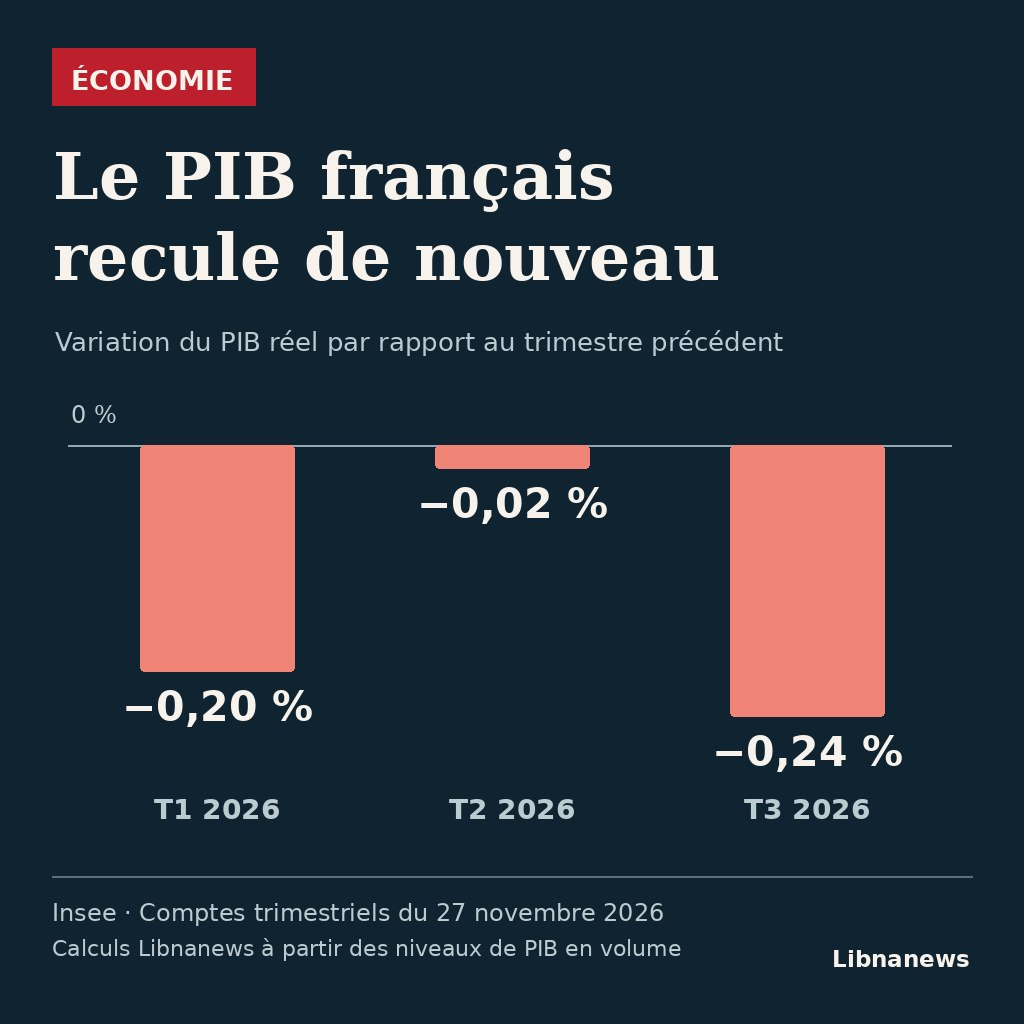
French GDP fell by 0.2% in the third quarter, according to detailed accounts published on Friday 27 November by INSEE. The second quarter, shown as stable in rounded figures, was also slightly negative. France thus fulfils the usual criterion of a technical recession, two consecutive quarters of contraction, without this meaning that GDP will fall over the whole of 2026.
At the end of October, INSEE estimated the third quarter’s decline to 0.1%. The new tables show real GDP at €662.622 billion, compared with €664.222 billion in the second quarter and €664.368 billion in the first. The calculation from these levels gives a decrease of about 0.02% in spring and then 0.24% in summer. The first quarter was already down by about 0.20% compared to the end of 2025.
Exports and investment weigh on activity
Exports fell by 1.6 per cent in the third quarter, up 2.9 per cent in the second. Imports rose by 0.1 %. External trade thus reduced 0.6 percentage points to GDP. Changes in stocks contributed 0.3 points, offsetting part of the decline.
Investment fell by 0.9%, after 0.5% in the previous quarter. The decline is 1.8% for manufactured goods and 0.9% for construction. INSEE explains the revision since October, in particular with new less favourable data on investment in construction and information and communication.
Household consumption expenditure increased by 0.3%, after 0.2%. Their purchasing power per unit of consumption, which takes account of the size and composition of households, rebounded by 0.2% after a decline of 0.5%. Savings remained at 17.4% of disposable income. Domestic demand excluding stocks did not contribute to growth, with rising consumption offset by declining investment.
A 0.1 % gain, far from the 0.5 % budget forecast
If GDP remained at its summer level in the fourth quarter, average growth of 2026 would be around 0.1%. This is the meaning of the growth acquis published by INSEE, not a forecast for the whole year. The scenario used by the government in its budget documents was based on an annual increase of 0.5% and had been finalized before the first estimate in the third quarter.
To reach exactly 0.5% on an annual average, unchanged data for the first three quarters would require an increase of about 1.5% of GDP in the last quarter, according to a Libnanews calculation based on the levels published by INSEE. The first estimate for the fourth quarter is expected on January 29, 2027.





Comments