

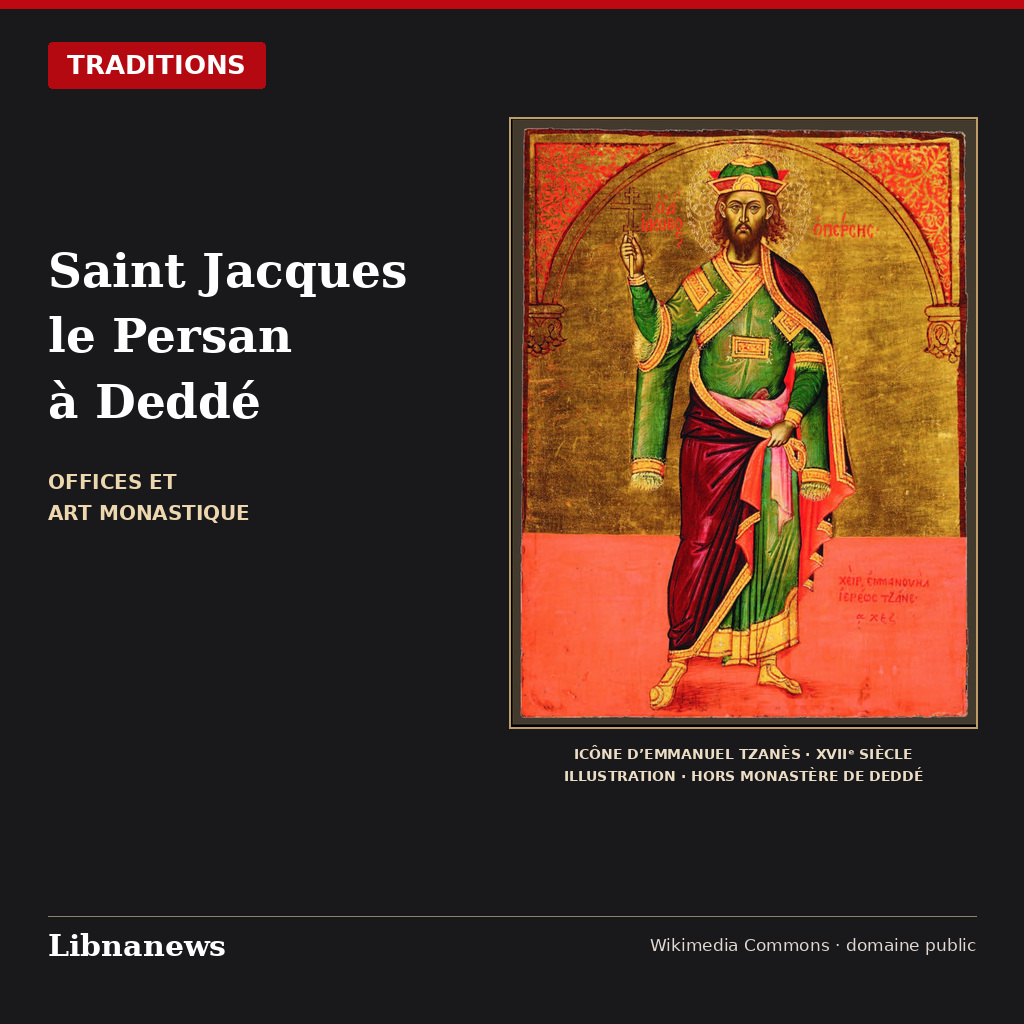
On November 27, the Greek-Orthodox calendar of Antioch commemorates Saint James the Persian. In Deddé, in the Kura region, this patronal feast illuminates the work of nuns. They paint icons and embroider liturgical ornaments next to a church that preserves images from several epochs.
In the church of Deddé, the icon of the saint is located near the iconostasis. This image partition separates the nave from the sanctuary. Nearby, the monastery preserves relics attributed to James the Persian. The diocesan record links the icon of St James to the painter Michel Polychronios, which she located in Tripoli between 1816 and 1825. Small images of the saints and liturgical year celebrations are hung on the walls. Others, more recent, bear the mark of nuns.
Saint James the Persian, from the office to the iconostasis
The Antiochian calendar sets 27 November as the memory of this martyr of ancient Persia. The account transmitted by the Church makes him a close friend of the Persian sovereign. James would first have renounced his faith to keep his place in court, before professing it again. His cult has travelled far beyond Persia. The Patriarchate notes that churches and monasteries in northern Lebanon have chosen as their patron.
In Deddé, the feast also coincides with a memory unique to the monastery. In 1964, the sisters went on pilgrimage to Jerusalem, where they venerated the saint’s relics. Through the Patriarch of Antioch, they asked the patriarchate of Jerusalem for some of them. Two years later, on the morning of the feast, the monastery received them in procession. The eparchy places the reliquary in front of the iconostasis, next to the image of the saint.
The archives provide information on how the festival was celebrated, without presuming the event this year. A bulletin of Tripoli’s epiarchy published in December 2009 reports vespers with the blessing of five loaves, wheat, wine and oil. Three novices received the monastic habit during this office. The eparchy of Zahlé keeps, for its part, the trace of a liturgy of the feast celebrated in Deddé on 27 November 2025. This year, November 27 falls on a Friday. The ads consulted do not specify the program of the party in Deddé.
The return of a community, not the foundation of a monastery
The nuns were present on 9 March 1956. The group, led by mother Salam, had previously lived in Furn el-Shebbak, then in the monastery of Saint George in Deir el-Harf. The Metropolitan of Tripoli offered to settle in Deddé, after the necessary repairs to make the premises habitable. Saint-Michel adjacent Saint-Jacques. Both churches are part of the old building where the sisters settled.
This date marks the arrival of the female community, not the birth of the monastery. Fires have made some of the archives disappear, and the eparchy does not give a certain date of foundation. On the other hand, she cites a 1712 dedication on the margins of a book of sermons printed in Aleppo. The inscription of the book in the monastery of Santiago, outside Tripoli.
Icons and clothing for churches
The work of nuns is part of the organization of buildings. In the so-called Nazareth wing, inaugurated in 2001, a floor houses the painting, sewing and embroidery workshops. The sisters make ornaments for worship. Leparchy also describes their work in translating and collecting spiritual texts. The library is located in another wing, that of the Samaritan, inaugurated in 1986.
In June 2019, during a common prayer in the church with the Irenaeus Patriarch of Serbia, the Metropolitan of Tripoli recalled Deddé’s place among the first centres of contemporary Orthodox monastic renewal. Workshops are a concrete aspect of this. Leparchy describes manual work as a way to earn a living and help other people, but also to support attention during prayer.
The small icons of the church also keep track of a serial work. According to a tradition recorded by the eparchy, a man from El Mina had promised to offer 365 images for the feasts and saints of the year. The panel author is not identified. The record contains more than 94 records after wars and looting, without dating this inventory. It also indicates icons painted by the sisters, present in the same church as these ancient panels.





Comments