

An old photograph can be used to find a neighbourhood, prepare an exhibition or document a family history. Yet we need to know where to look and what we can do with the image found. In Kaslik, the Pierre Maadanjian fonds conserved by the Phoenix Center of L-USEK offers a concrete entry point. Its inventory, published in 2025, is not the announcement of a new opening in November 2026.
Photographic archives: from an identified background
The collection includes 46,279 negatives in eighteen containers. The inventory shows coverage from 1941 to 2001, mainly from 1965 to 1998, and an acquisition from the photographer in 2017. The general rating is PM. These boundaries describe the fund; they do not automatically date each shot.
The catalogue includes urban scenes, portraits and cultural events. He keeps the photographer’s work numbers as the basis of the ranking. In preparing a research, it is therefore best to associate a subject with a period and note the precise reference of the selected document, rather than only keeping a single capture.
An appointment before moving
The general rules for consulting the special collections of the USEK require a prior request, with at least three working days’ notice. The visitor must wait for confirmation of the appointment. The documents are not loaned outside; The team may propose a copy of the consultation rather than the original. Telephones and cameras are not allowed in the room.
The fact sheet of the fund distinguishes between research, educational, cultural and academic uses and other uses, for which it provides for the written authorization of rights holders. This does not preclude compliance with the reception procedure and the conditions specific to the document requested.
Consult is not republish
The library requires a separate approach to reproduction or publication. It recalls that the material possession of a document does not mean that it holds all its rights. The researcher must obtain the necessary authorizations from their holder. An image visible in a catalogue does not therefore become a freely reusable illustration.
For a draft book, film or exhibition, three questions must remain distinct: what document do we want to consult, what copy can be obtained and what use do we want to make of it? Applying them at the time of preparation avoids discovering restrictions when printing. This guide covers an identified fund and the rules of its library, not the opening of all Lebanese political archives.
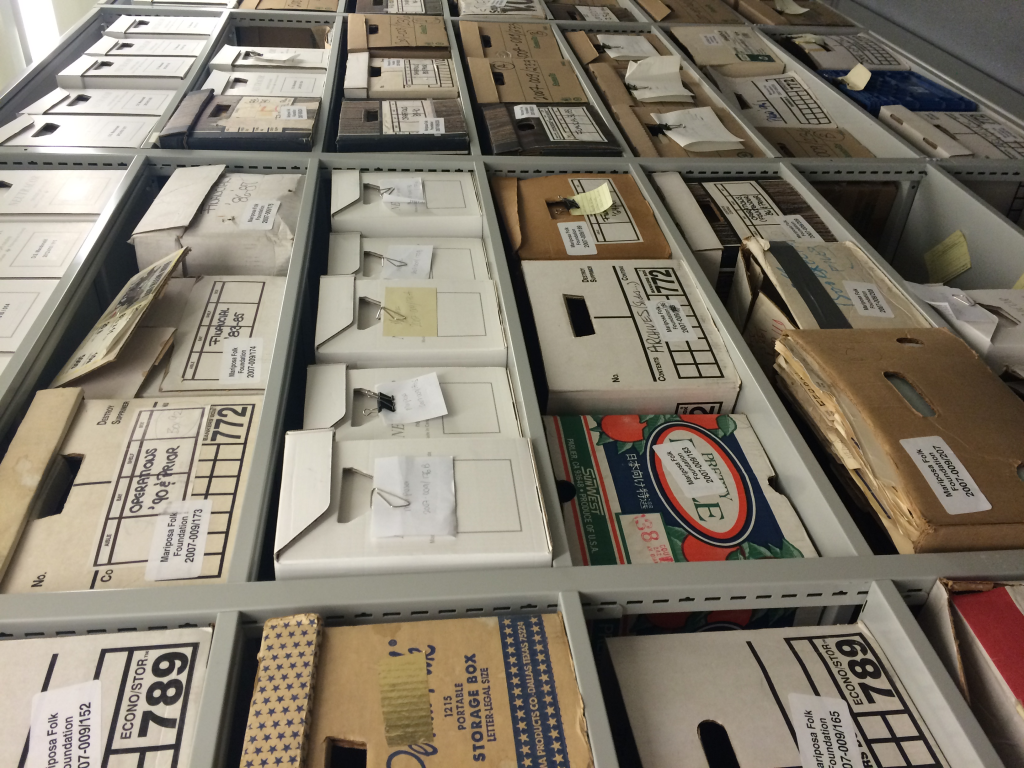
Illustration: Archive boxes at York University libraries, Toronto, June 19, 2015. Smallison / Wikimedia Commons, CC BY-SA 4.0, unmodified photograph. This cliché does not show either the USEK or the Maadanjian fonds.





Comments