

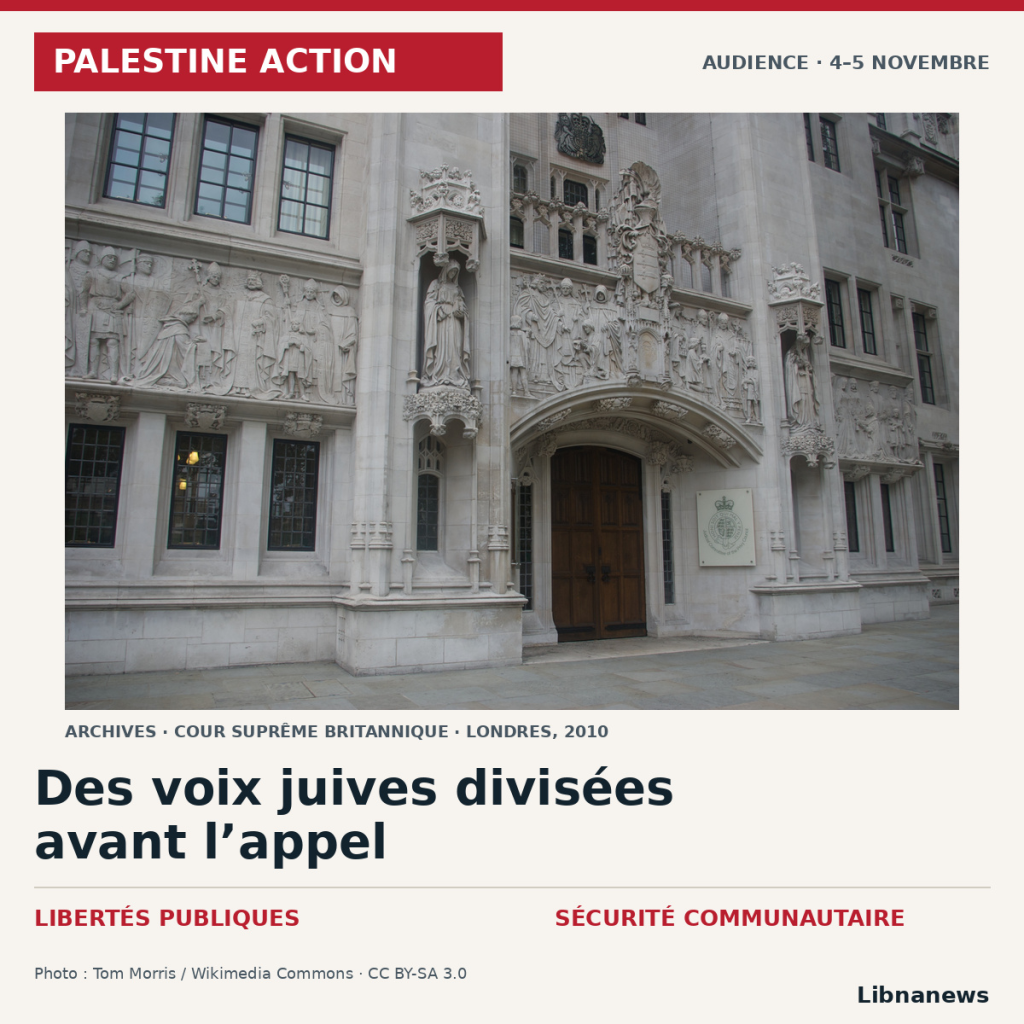
The British Supreme Court is scheduled to review the ban on Palestine Action on 4 and 5 November. On the eve of this hearing, Jewish organizations defend opposing positions. Some call for the lifting of the ban, in the name of public freedoms. Others believe that it is necessary for the security of Jewish institutions.
Palestine Action: a collective appeal against prohibition
A statement issued on 31 October by Jewish Voice for Liberation defends the lifting of the ban. It rejects the idea that all British Jews would feel threatened by Palestine Action. The signatories defend their opposition to Israeli policy and their support for Palestinian rights. They claim that these positions are also part of the Jewish public debate.
They reject the accusations of anti-Semitism aimed at the group’s objectives. According to them, companies and their partners were targeted for their supposed links with the supply of weapons to Israel. They refute a targeting linked to the Jewish identity of the owners. This is their argument, challenged by other organizations.
Defend Our Juries, which campaigned against the ban, announced on 1 November more than 260 signatories and 12 support organisations. The original page had 223 signatures in the morning of October 31. These counts correspond to two stages of mobilization, not a British Jewish opinion poll.
Community safety at the heart of JLC and CST intervention
On the contrary, the Jewish Leadership Council and the Community Security Trust support the continued prohibition. The Supreme Court allowed them to intervene jointly in the proceedings. Their written submission was made public on 2 November. He stressed the consequences of the group’s actions for Jewish organizations and businesses.
Both institutions maintain that the targets of Palestine Action have expanded. They cite owners, insurers, banks and community organizations, beyond weapons manufacturers. They claim that the prohibition has provided a security benefit and ask the judges to take this into account.
They also highlight the rights of individuals to conduct their private, religious and cultural life without intimidation. These statements set out the position of the interveners before the Court. They do not prejudge future judgment.
Huda Ammori also challenges these charges in a supplementary submission dated 19 October and published on the Court’s website on 2 November. His lawyers reject the idea of discrimination against Jews. They blame the JLC and the CST for wanting to expand the grounds for the ban. They also contest factual statements which, in their view, the applicant was unable to answer by evidence.
Jewish Bloc defends another reading of freedoms
The Jewish Bloc also intervenes in the case. This coalition of Jewish organizations committed to Palestinian rights blames the reasoning for the ban on neglecting its own members.
His memory points out that some British Jews do not consider themselves threatened by Palestine Action. On the contrary, they feel affected by the restrictions imposed on its support. It calls for their freedom of expression and assembly to be included in the assessment of proportionality.
The disagreement therefore also concerns those whose rights must be examined. The interventions filed show several Jewish positions in the same procedure. None can be described as that of all the Jews in the country.
A hearing focused on proportionality
The ban came into force on 5 July 2025 under the Terrorism Act 2000. Huda Ammori, co-founder of Palestine Action, challenged it. The Divisional Court ruled in February 2026. The Court of Appeal then upheld the decision of the Ministry of the Interior in June.
The Supreme Court limited the use of articles 10 and 11 of the European Convention on Human Rights. These concern freedom of expression and assembly. It did not accept the other plea, concerning the application of the department’s internal policy.
The group remains banned pending the outcome of the court proceedings. The November 4 and 5 hearings are not an announced date of judgment. The meeting on 5 November is to be held without a public or broadcast, the Court notes.





Comments