


Artificial intelligence finds buyers on Wednesday, November 11, 2026, but corporate accounts recall the price of its expansion. Technological indices are increasing in available U.S. surveys after a positive closure in Tokyo. The oil goes up. CoreWeave increases sales while remaining in deficit, Siemens Energy turns its orders into profits and RWE takes advantage of new capabilities. Behind these different trajectories is the same question: who advances the money, for how long and with what yield?
File of 11 November 2026. The market observations below are not simultaneous. Asia closed; the European and American figures used are statements in session. Courses are not presented as real time. At that date, Beirut is at UTC+2, Paris at UTC+1 and New York at UTC−5.
World markets of the day: rebound remains selective
On Wall Street,Associated Press reportsat 1045 hours in New York, 1545 UTC and 1745 hours in Beirut, an increase of 1 per cent in S&P 500 and 1.6 per cent in Nasdaq Composite. The Dow Jones fell by 55 points, or 0.1%. This contrast prevents a uniform increase in U.S. values. Technology derives more movement than the historical index of the thirty major companies.
These are variations from the previous closure, not final performance on 11 November. The report does not specify the time frame for the underlying flow. Thenew York Stock Exchange calendardoes not rank Veterans Day among its days of closing shares; The main meeting normally concluded at 4 p.m. in New York, or 11 p.m. in Beirut. The American session is therefore still under way during the survey.
In Europe, the financial statements of the financial statements of the financial statements of the European Union, the financial statements of the European Union, the financial statements of the European Union and the financial statements of the European Union, the financial statements of the European Union, the financial statements of the European Union, the financial statements of the European Union and the financial statements of the European Union, the financial statements of the European Union and the financial statements of the European Union, the financial statements of the European Union and the financial statements of the European Union, the financial statements of the European Union, the financial statements of the European Union and the financial statements of the European Union, the financial statements of the European Union, the financial statements of the European Union, the financial statements of the European Union and the financial statements of the European Union, the financial statements of the European Union, the financial statements of the European Union, the financial statements of the European Union, the financial statements of the European Union, the financial statements of the European Union, the financial statements of the European Union and the financial statements of the European Union, the financial statements of the European Union and the financial statements of the European Union, the financial statements of the financial statements of the financial statements of the European Union and financial statements of the European The photograph is earlier than Wall Street. It shows a modest increase in the pan-European basket, without deducing its level at the end of the meeting. The announcements by Siemens Energy and CoreWeave are among the new highlights by the agency; they do not provide a measure of their exact contribution to each index.
In Asiabaystreet closing balance sheetgives the Nikkei 225 at 61 248.59 points, up 789.01 points, or about 1.3%. Hong Kong followed another direction: Hang Seng finished at 24,315.92 points, down 241.12 points, close to 1%. Reuters separately confirms the increase of about 1.3% in Tokyo. The terminal time and the time limit for closing values are not specified in the balance sheet used.
A Japanese increase and a Hong Kong decline are not a contradiction. The indices do not represent the same sectors or enterprises. They also have different sensitivity to foreign currency and external demand. The interest of the panorama is to show this diversity, rather than looking for a unique explanation that would be artificially suitable for all places.
Oil bounces, without clearing physical uncertainties
Reuters takes overbrent at $92.81 per barrel, up $1.32, and WTI at $87.12, up $1.08 on 11 November at 1.14 p.m. GMT, or 3.14 p.m. in Beirut. The rounded changes are 1.4% and 1.3% respectively. The deadline for distribution shall not be communicated. These are intraday observations, not closing regulations. The agency links this rebound to the statements of the Iranian security official refusing to have enriched nuclear materials leaving the country, while Washington wants to include nuclear in the negotiations. This reading of the market does not constitute confirmation of the outcome of the discussions.
The dispatch does not name the months of delivery. The contracts of first maturity of the day are Brent January 2027 and WTI December 2026, according to the contract point published byEnergyNow. This identification of the calendar is distinct from the Reuters survey: it does not amount to having a terminal history for these two courses. The figures should therefore not be used to construct a precise contractual series or to calculate an arbitration between maturities.
The economic mechanism is broader than the barrel movement alone. A diplomatic improvement can reduce the premium required to carry a risk, before transport returns to normal operation. Conversely, an incident can quickly increase coverage. But a ship, its insurance and its cargo are subject to concrete constraints. The financial price can change in a few minutes; The organisation of a supply takes more time.
For fuel buyers, this difference is essential. The cost actually paid depends on the refined product, freight, purchase date and commercial conditions. The barrel of crude oil remains a central indicator, without constituting a gas oil bill delivered. A 1% daily increase in oil is not enough to predict or date an identical increase in retail prices.
The motto must also be retained in the reasoning. A supplier may announce a stable price in dollars while the cost increases for a customer who cashes in another currency. In contrast, an appreciation of the currency of payment can absorb part of the increase in the price of the product. This interaction explains why companies often follow the fuel and change it together, instead of dealing with their risks separately.
Energy forecasts have their own timetable
Theenergy Information Administration monthly reportpublished on November 10, brings a different framework. The U.S. agency is planning a Brent in cash close to $100 a barrel for the rest of the year, and an average of $77 in the fourth quarter of 2027. However, she indicated that she had stopped the data from her model on 5 November: later events were not specifically integrated.
This precision prevents the forecast from being treated as a comment of Wednesday’s movement. Among other things, the report identifies tight global stocks and transport constraints. US trade stocks of crude oil are estimated at about 410 million barrels at the end of October, their lowest level at the end of October since 2014. This stock does not measure the volume available worldwide, nor the strategic reserves of all States.
A forecast and a rating answer two different questions. The first describes a conditional trajectory, with assumptions about production, consumption and trade. The second indicates the price at which a market values an instrument at a given moment. Their gap can shed light on a disagreement about the future. It alone does not prove that one of the two observations is false.
The weekly calendar also deserves attention. Due to the U.S. federal holiday, EIA announces its next oil report for Thursday, 12 November, with broadcasts at noon and 2 p.m. from New York, 7 p.m. and 9 p.m. in Beirut. To present on Wednesday a change in the stocks of this publication as already known would be an error. The carry-over changes when operators can confront their expectations with official data.
Currency and gold: instruments to be read separately
For 11 November, theEuropean Central Bankfixed its reference at $1.1127 for one euro. The remaining values are 177.18 yen, 0.83618 pound sterling, 0.9234 Swiss francs and 7.4225 yuan per euro. These are informative reference rates. They are neither commercial offers nor guaranteed market prices at the time of reading.
The ECB states that its consultation normally takes place at around 14.10 p.m. in Central Europe, i.e. 13.10 p.m. UTC, and that the publication usually takes place at around 16.00, i.e. 15.00 UTC. These schedules are those of the usual procedure, not a certification to the second day rate formation. The central bank does not recommend their use as a transaction price.
To understand the commercial impact, let’s take a fictitious order of 100,000 euros paid in dollars. At today’s reference, it represents $111,270, before fees and margin of exchange. The calculation is simple; The coverage decision is less. It is necessary to know the date of payment, the possibility of revising the price and the revenue that will be used to finance the order.
It requires another precaution. Thetable Associated Pressindicates the COMEX contract from December 2026 to $4,024.50 per troy ounce, down $5.70 on 11 November at 10 a.m. in New York, or 3 p.m. UTC. The standard contract covers 100 troy ounces; the price quoted is one ounce, not the entire contract. The deadline for distribution is not indicated.
This futures price should not be mixed with an earlier spot price. Instruments, shipping costs and schedules differ. Similarly, a one-time decline in gold is not enough to conclude that geopolitical risk is disappearing. An asset can respond simultaneously to rates, the dollar, liquidity needs and portfolio arbitrage. These factors cannot be separated by daily variation alone.
CoreWeave: revenue increases, debt remains expensive
CoreWeave publishedtuesday evening its results for the quarter ended September 30. Revenue reached $3.661 billion, up from $1.365 billion a year earlier. The result of accounting operations is positive at 207 million. But the net interest expense is 846 million and the net loss 709 million. The graph brings these three measures together without presenting them as an exhaustive breakdown of the result.
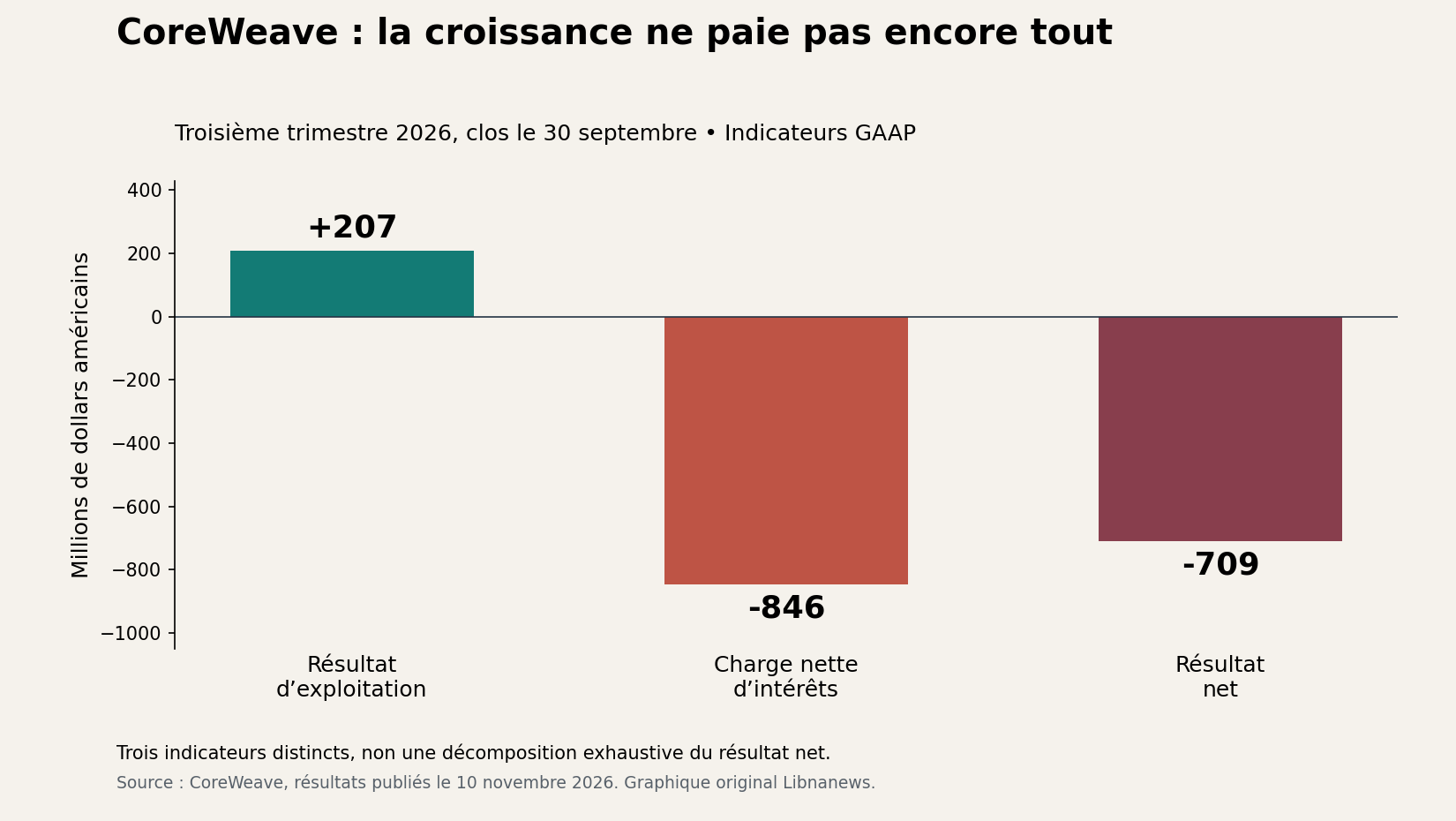
The group’s forecast of annual revenues is $13–13.3 billion and plans to invest 37–39 billion in 2026. The active power exceeds 1.7 gigawatt, compared with more than 4.6 gigawatts contracted. The difference counts: a reserved capacity is not an installation already in service. Growth prospects must go through the construction, connection and delivery stages before they become revenue.
The economic message is not that the demand would have disappeared. It is that the financing must last until it is converted into cash. A data centre requires expenditure prior to the full use of its equipment. If revenues arrive later than expected, interest will continue to run. Even a large order book does not remove this lag.
The risk then moves to the terms of the contracts. An advance payment from the customer alleviates the need for funding from the supplier. A payment after delivery produces the opposite effect. A guarantee of availability can protect the client while imposing costs on the provider. To appreciate the quality of growth, it is therefore necessary to look at what is sold, but also when the seller is paid and what obligations he retains.
Siemens Energy converts more orders into profits
Thesiemens Energy resultspublished on 11 November for the financial year ended 30 September, show another position in the investment chain. The group recorded EUR 44.2 billion in turnover, with a comparable growth of 15.5% and 68.1 billion orders. His notebook reached 164 billion. The annual net profit is EUR 4.129 billion; the margin before exceptional items is 12,4 %.
The group aims for 2027 a comparable growth of 14–16% and an exceptional front element margin of 14–16%. These are goals, not results. Siemens Gamesa achieves the annual balance on the result indicator before exceptional elements. It would be excessive to transform this adjusted operational balance into a general statement on all its financial flows.
The comparison with CoreWeave shows why we should avoid an overly broad stock market category called « l的IA ». An electric equipment manufacturer delivers turbines or network equipment. A computer operator then finances facilities for which it sells. Both can benefit from the same investment cycle, while supporting very different risks and cash requirements.
An important order creates visibility for the supplier, but it also mobilizes its workshops, teams and purchases. For the client, it reserves equipment that does not yet generate revenue. The success of the package implies that industrial deadlines and dates of use remain compatible. A chain of orders can be commercially robust and nevertheless exposed to construction or connection delays.
RWE recalls the role of assets and weather
RWE announcesfor the first nine months of 2026 an adjusted EBITDA of 4.6 billion euros, compared to 3.4 billion a year earlier. Its adjusted net income is $1.8 billion, compared to $1.3 billion. The producer cites the introduction of new assets, more favourable wind conditions in Europe and improved trading. It invested 10.7 billion euros net over the period.
The group maintains its adjusted annual range of EBITDA of 5.75–6.35 billion and expects a result up its range. It also mentions the favourable effect of UK capacity payments and Dutch compensation on its flexible production activity. An increase in the result is therefore not exclusively due to a higher electricity selling price.
This distinction helps to understand the energy saving. An installation may be remunerated for the electricity produced, but also, in certain devices, for its availability. The purpose of capacity remuneration is to maintain resources that can be mobilised when needed by the system. It is not read in the same way as income depending solely on the number of kilowatt hours sold.
For renewables, the installed capacity is not sufficient to provide for actual production. Wind, sunlight, shutdowns and network constraints are involved. Two periods can therefore display different results with comparable equipment. The analysis should reconcile the volumes produced, the prices realized and the costs, rather than deduct the profits of a single wholesale price curve.
Bank benefits from a different environment
ABN AMRO publisheswednesday a quarterly net profit of 940 million euros, up 52% over one year. The perimeter has included NIBC since 1 August. The bank raised its forecast of net income of commercial interest by 2026 by more than €6.9 billion. It mentions a favourable rate environment, as well as 11 million net recoveries of credit provisions and depreciations.
Banking performance cannot be compared mechanically with that of an industrial borrower. The bank receives interest on its assets and pays interest on part of its resources. The margin depends on both sides of the balance sheet, the rate revision rate and the cost of risk. An increase in rates can be favorable without being to all its customers.
This asymmetry explains why the same new currency can redistribute performance across sectors. A variable-rate borrower sees its cost change faster than a company that has set its financing for several years. An applicant may obtain a better remuneration, but with a special time lag or conditions. Monetary policy acts through contracts, not as an identical switch for all.
Rates remain a point of vigilance
Lastfederal Reserve Decision Statement, dated 28 October, maintains the range of fed funds at 3.75–4%. Lisa Cook and Beth Hammack preferred a quarter-point increase. This reminder describes a past decision; It should not be confused with a new announcement of November 11 or with the probabilities deducted from futures markets.
TheUS ICC published on November 10increased by 0.4% in October compared to September, after seasonal adjustment, compared with 0.6% the previous month. The BLS notes that the absence of some data from October 2025 prevents the calculation of the corresponding annual changes. A missing box is not zero, and an estimate does not replace an official statistic.
For companies investing, the practical issue is the security margin. Expected profitability slightly higher than the cost of funding may disappear if a project lags behind or if its costs increase. The rebound of an action does not automatically solve this problem: it can facilitate a fundraising, but only the conditions actually obtained change the financing of the project.
For Lebanon, three concrete channels to monitor
Global movements can affect a Lebanese company without holding US shares. The first channel is that of purchases: energy, imported equipment and services. The second is the change when the billing currency differs from the revenue currency. The third is financing, especially when a supplier passes on its own credit cost in its prices or payment deadlines.
This allows a small business to incur an additional cash requirement without an immediate increase in its accounting expenses. It is sufficient for a supplier to require a greater advance or shorten the settlement deadline. Stock management, advance payments and payment synchronization become as important as unit price trading. These mechanisms do not prejudge the situation of a particular company.
Wednesday’s panorama therefore invites us to distinguish the signs of activity from evidence of profitability. Technological rebound, electrical controls and growth forecasts provide useful information. Interest, deadlines and delivery commitments complete the table. For both the investor and the manager, the decisive question remains the ability to turn real demand into cashed revenues, without weakening financing during the journey.





Comments