

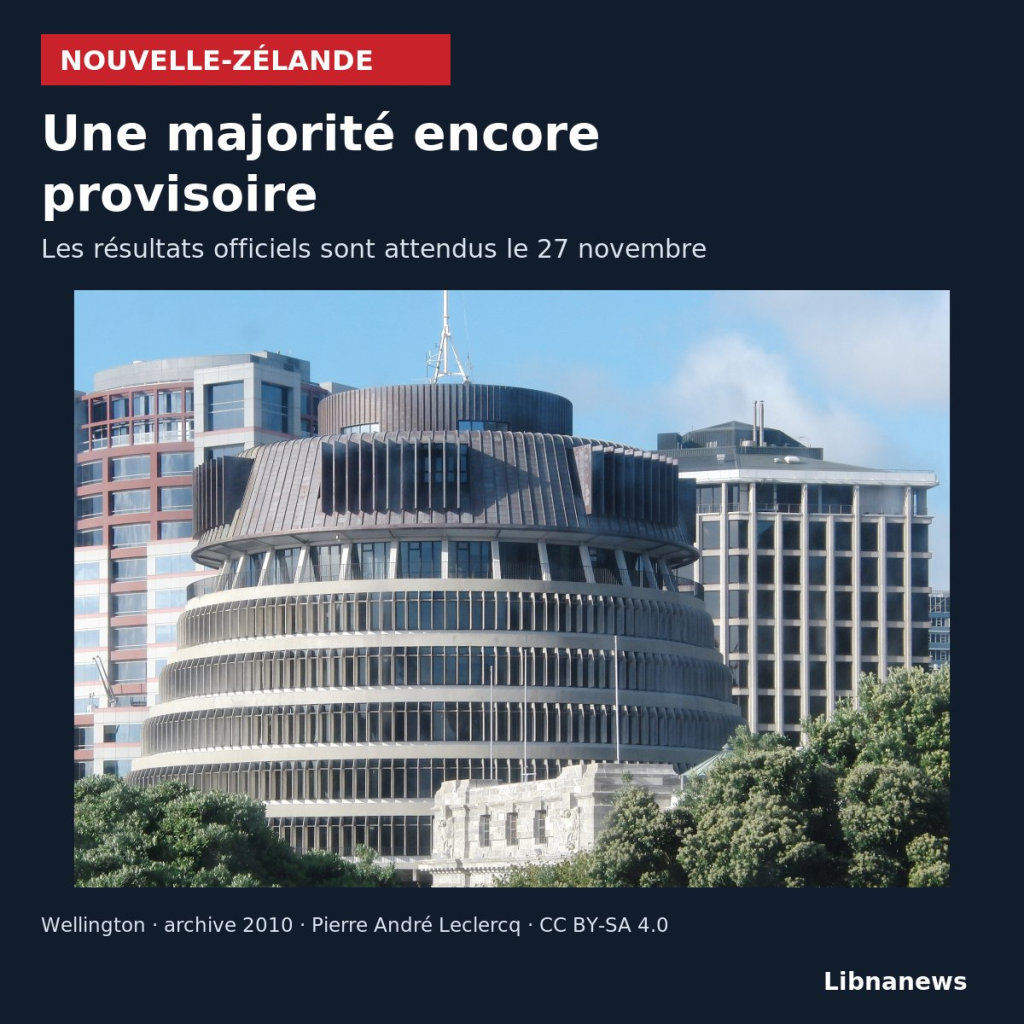
The preliminary counting of the New Zealand elections on 7 November places Labour slightly ahead of the National Party, but still gives a small majority in seats to the three outgoing government parties. Official results are expected on 27 November. The projection remains subject to change.
The National Labour Advance by 3,650 votes
The Electoral Commission’s table, consulted on 7 November at 1435 UTC, shows 100 per cent of the results of the preliminary counting carried out by polling stations. Labour received 710,330 votes, or 29.36%, against 706,680 votes and 29.21% for National. The gap between the two formations reached only 3,650 votes.
This rate of increase of 100% does not mean that the result is definitive. It corresponds to the preliminary counting of the election night. The official count, including special votes, has yet to be completed. The Commission expressly states that its table does not constitute a formal proclamation.
67 seats projected for the outgoing coalition
At this stage, National won 42 seats, ACT 13 and New Zealand First 12. These three parties, which make up the government of Prime Minister Christopher Luxon, thus total 67 seats out of 131 planned. In this configuration, the absolute majority is 66 seats.
The Labour is credited with 36 seats, the Greens of 16, Opportunity of seven and Te Pāti Māori of five. These figures describe a provisional distribution, not a government agreement or nomination. The small margin of the outgoing block makes the official count particularly important.
The projection attributed 13.30% to the Greens, 10.92 % to ACT, 9.78 % to New Zealand First and 5.96 % to Opportunity. The two main parties thus remain clearly below the threshold that would allow them to govern alone.
Why votes and seats do not follow the same ranking
The New Zealand electoral system combines a party vote and a constituency candidate vote. Proportional distribution takes into account partisan voting, while electoral district winners retain their mandates. When a formation wins more constituencies than its theoretical right to proportional representation, these additional seats may enlarge Parliament.
The preliminary table illustrates this particularity: the 42 seats allocated to National come from the constituencies, while the 36 of Labour are divided between 21 constituencies and 15 seats on the list. A small national lead in votes does not automatically lead to first place in seats.
The next deadline is the publication of the official results, which the Commission is aiming at by Friday 27 November. It is this step, not the only closing of the preliminary count, that will confirm or alter the parliamentary balance announced tonight.





Comments