

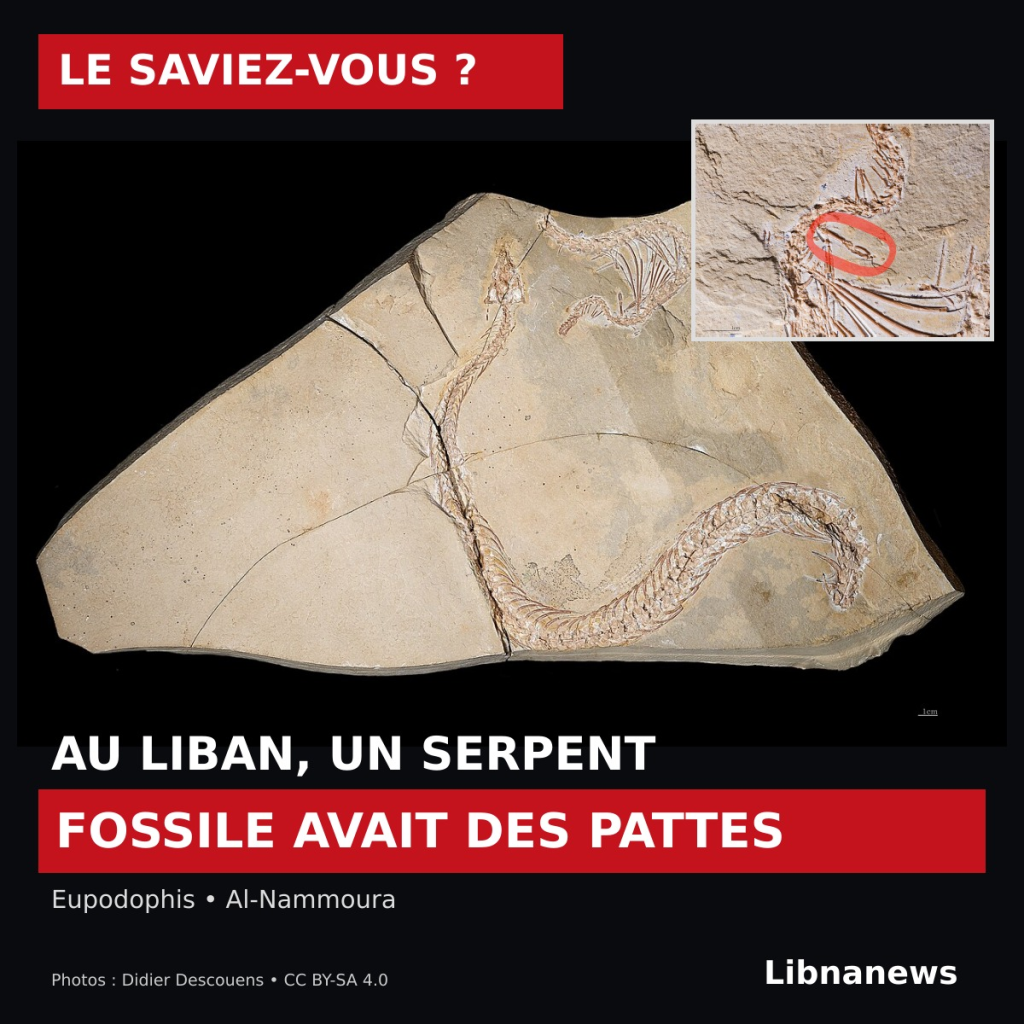
Did you know that? In Lebanon, a fossil snake retains two small hind legs. Discovered in Al-Nammura, Eupodophis descouensi lived in the Cretaceous. His skeleton observed a stage of limb reduction in snakes. One of her legs, hidden in the rock, was studied with X-rays in 2011.
On the limestone plate, the spine draws a long curve. The ribs follow each other, thin and tight. The animal looks like a snake. Yet, near the pelvis, a few tiny bones change the reading of the fossil: this reptile still had hind limbs.
The specimen comes from Al-Nammura, one of the fossil deposits in Lebanon. It belongs to the Cenomanian, a subdivision of the Upper Cretaceous. Scientific outreach work devoted to its review in 2011 attributed it approximately 95 million years. This number remains an order of geological magnitude, not a specific date of birth.
A fossil snake from Lebanon, with real legs
The name of the species, Eupodophis descouensi, appeared in scientific literature in 2000. Jean-Claude Rage and François Escuillié described this animal in the research on the first snakes. His interest lies in an anatomical combination: a very elongated body, but a pelvis and small back limbs still present.
So it’s not a current snake born with an anomaly. The fossil bears witness to an ancient species. Nor should we imagine a reptile running on two large legs. These limbs are tiny compared to the body. Their presence is not sufficient to establish how the animal used them.
Paleontologists bring Eupodophis closer to other fossil snakes with hind limbs, including Pachyrhachis and Haasiophis, known in the Middle East. These forms show that serpentine anatomy did not consist of the simultaneous disappearance of all structures. A snake body could coexist with recognizable limb remains.
The second leg was still in the stone
A leg was visible on the surface of the specimen studied. The other was hidden in the plate. To examine it without breaking the fossil, an international team used a synchrotron imaging technique. Alexandra Houssaye, then at the National Museum of Natural History and the CNRS, led this research.
The measures took place in Grenoble, at the European Synchrotron. Researchers from the Karlsruhe Institute of Technology were also involved. The instrument made it possible to observe a flat object, difficult to study with certain classical methods of tomography.
The principle is to record many images from different angles. Their processing then reconstructs a digital volume. This allows researchers to distinguish between structures buried in the rock. This operation does not physically turn the bones bare: it produces a virtual observation of their organization.
The results, published in 2011, confirmed the presence of the second member. The images show a paw folded to the knee. They also identify small bones of the ankle, without bones of the foot or fingers. This detail documents an already advanced member reduction, rather than a complete miniature leg.
What bones reveal, and what they don’t say
The study also examined the interior of the bones. Their architecture was similar to that of members of today’s terrestrial lizards. The researchers suggested that the small size of the legs correspond to slower, or earlier, growth.
This interpretation is not a direct observation of live animals. The fossil retains mineralized structures; scientists draw information on their development. The observed bones should be distinguished from the proposed mechanism to explain their size.
Eupodophis does not regulate by itself all the history of the origin of snakes. The relationships between different fossil lines, their way of life and the appearance of their characters require comparison. Presenting him as « the ancestor of all snakes » would go beyond what his study establishes.
Current snakes keep other clues
The file is not based solely on fossils. Some current snakes, including boas and pythons, retain vestiges of the basin and hind limbs. These structures do not make them animals capable of walking on legs. However, they offer elements of anatomical comparison.
Research published in 2016 also examined the genetic mechanisms of member development. These include sequences that control the activity of a gene called Sonic hedgehog. This gene intervenes in the organization of the limbs in vertebrates.
This work shows that changes in genetic regulation can contribute to the reduction of members. They complement anatomical observations. They do not constitute an analysis of the DNA of Eupodophis: the experiments concern current organisms and genetic sequences, not genetic material extracted from the Lebanese fossil.
Al-Nammoura, an archive of the marine world
The link with Lebanon is concrete. Eupodophis belongs to the marine fossils discovered in its limestones of the Cretaceous. Al-Nammoura, along with Haqel, Hjoula and Sahel Alma, is one of the fields studied for the diversity and conservation of their organisms.
These groups include fish, crustaceans and cephalopods. Reptiles add other parts to the reconstruction of ancient ecosystems. A scientific synthesis published in 2024 describes Eupodophis as one of the outstanding examples of this heritage, with its vestigial back members.
Photographs of the specimen already identify the basin and the small visible leg. But the surface of the stone delivers only part of the information. In the case of this al-Nammura snake, the other member was waiting for an X-ray observation, buried from the Cretaceous in a few millimetres of limestone.





Comments