

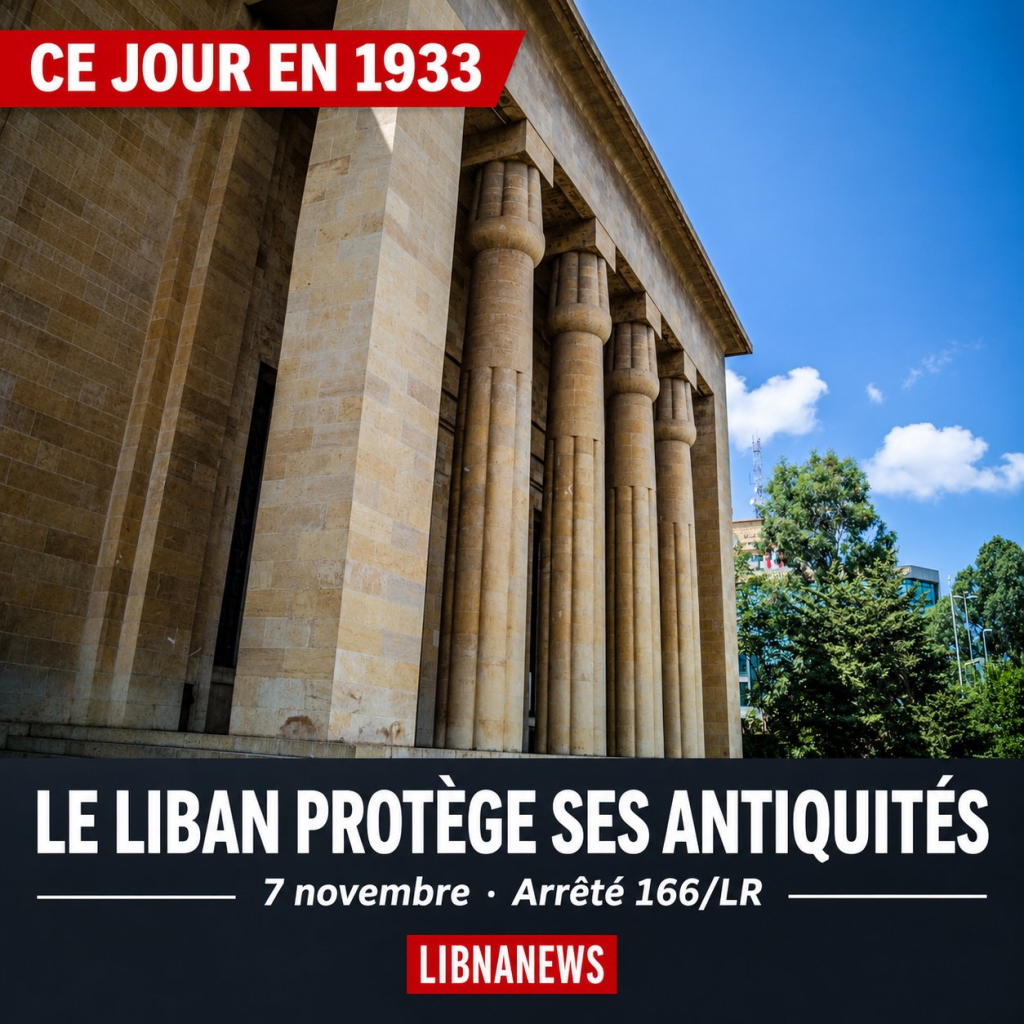
This day in the history of Lebanon.On 7 November 1933, the French High Commissioner adopted Order 166/LR on antiquities in Syria and Lebanon. The text defines protected assets, organizes their inventory and subjects searches to authorization. The protection of Lebanese antiquities now has a detailed framework. Ninety-three years later, this date allows us to understand a sustainable choice: the preservation of remains is of public interest, even when they are on private property.
The date does not refer to a spectacular discovery or the opening of a museum. It marks an administrative decision taken under the French mandate. Its object is very concrete: to determine who can search, who owns the discoveries and what works can touch a monument. Behind these rules is a question that is always familiar in Lebanon: how can we preserve the traces of the past in inhabited, cultivated and built territories?
Protection of Lebanese Antiquities in 1933
The order then concerns Syria and Lebanon, under French mandate. It belongs to a set of previous decisions. Its preamble includes the 1926 Regulation and the 1927 Antiquities Trade Provisions. So it does not create archaeological protection from nothing. It gathers and specifies mechanisms that affect discoveries, monuments, collections and research.
Three dates must be distinguished. The decree bears that of 7 November 1933. Its publication reference refers to the Official Bulletin of 30 November. A printed edition of the regulations then reads Beirut, 1935. The latter date appears on the presentation page of the document, but does not constitute its date of adoption.
The international basis for the laws of the Republic of Lebanon is 7 November 1933. This precision counts for an ephemeride. It avoids confusing the decision, its administrative publication and the subsequent production of a copy for services or readers.
The 1700 threshold and its exceptions
The first article provides a broad definition. Productions of human activity before 1700 fall into the category of antiquities, regardless of their civilization. The criterion is therefore not limited to Roman temples or Phoenician objects. It allows to include vestiges of different eras and traditions.
The same article provides for an opening for certain immovable property after 1700. Their conservation must be of historical or artistic public interest. Their inclusion in the general inventory of historical monuments makes them enter the system. Seniority is thus a first landmark, but it does not exhaust the heritage issue.
The regulations then distinguish between antiques and antiques. The first category includes buildings, their remains and buried remains. It also includes tells, these accumulations of traces of human occupation. Caves or rocks with inscriptions and sculptures are also included in the definition. Man-made objects which do not fall within this category are movable property.
This cutting has practical consequences. Preserving an old wall, an inscription fixed in a wall or transportable object does not require the same decisions. The text therefore organises a number of procedures, rather than a single prohibition applied indiscriminately to all goods.
Private discovery also interests the state
The regulation gives a central place to incidental discoveries. A vestige may appear during a construction site or agricultural work, without prior archaeological research. Articles 9 and 11 then require a declaration within 24 hours to the nearest administrative authority. The latter must inform the officials responsible for antiques and the competent museum.
The declaration concerns both real estate discoveries and movable objects. It must allow the administration to identify the property before dispersal or transformation. In this sense, finding an object is not enough to immediately resolve the issue of its property.
The text provides for different situations depending on the location and nature of the discovery. It recognizes private rights, while organizing those of the State. For certain movable objects discovered incidentally, it defines in particular a right of acquisition within a specified period. It also provides for compensation procedures in certain situations. This architecture contradicts a too simple reading that each old property would automatically fall under the same regime.
These provisions describe the historical regulations here. They are not a guide to the administrative procedures to be followed in 2026. Subsequent rules, current competencies and the precise situation of a property must be verified separately.
Inventory, classify, frame work
The decree organizes a general inventory of historical monuments in each State. The register must contain public property, but also private or community property of historical or artistic interest. The inscription gives an administrative existence to the monument and allows to inform its owner of the corresponding constraints.
Classification is another step. The regulation provides for a decision by the Head of State, on the proposal or after the opinion of the head of antiquities. For a classified building, destruction, displacement, restoration and modification cannot be treated as ordinary work. The competent department must intervene.
Protection can also affect the immediate environment of the monument. Neighboring lands or buildings may be involved in order to clear a building or preserve its character. The scheme recognizes that the interest of a vestige sometimes depends on what surrounds it. A new building can affect a monument without removing a single stone.
Article 19 even links antiquities to town planning. It provides for the intervention of the service in the plans of extension and beautification. For those localities where archaeological interest dominates, it gives it a stronger role. The protection of heritage is thus part of the construction of urban space, beyond the management of museums alone.
Search becomes an authorized and documented activity
The title of search is subject to authorization. The Regulations reserve applications to scientific bodies pursuing a scientific objective. The person responsible for the works must provide guarantees of archaeological experience. The file must identify the site, the research program and the person in charge of the management.
This requirement distinguishes organized research from the simple search for objects. The vestige has a value that exceeds its appearance or price. Its location, other elements discovered in the vicinity and the conditions of its updating contribute to its interpretation. The framework of excavations seeks to preserve this documentary dimension.
The system remains that of the mandate. The High Commissioner intervenes in licensing and concession contracts. To present the text as a decision of the independent Lebanese Republic would therefore erase its institutional context. His reading sheds light on both the construction of heritage tools and the political authority that administered them.
A visible legacy in heritage records
The 1933 regulation then appears in international documents on Lebanese sites. The Qadisha Valley record mentions Order 166/LR as one of the protective instruments. A mission dedicated to Tyre in 2012 also mentions this, with the urban planning texts and local provisions that complement the legal framework.
These references show administrative continuity. They do not prove that each monument enjoys the same level of protection, nor that the only decree settles all conflicts. A general arrangement must include inventories, classification decisions, plans and conservation methods.
Finally, the document provides very concrete information. Article 50 provides for the communication of the lists to the land authorities and their posting in local government. Protection must be known, not just decided. To trace the history of a Lebanese monument, the regulation of 7 November 1933 thus opens a precise trail: to find its inscription, its possible classification and the limits of the property actually protected.





Comments