

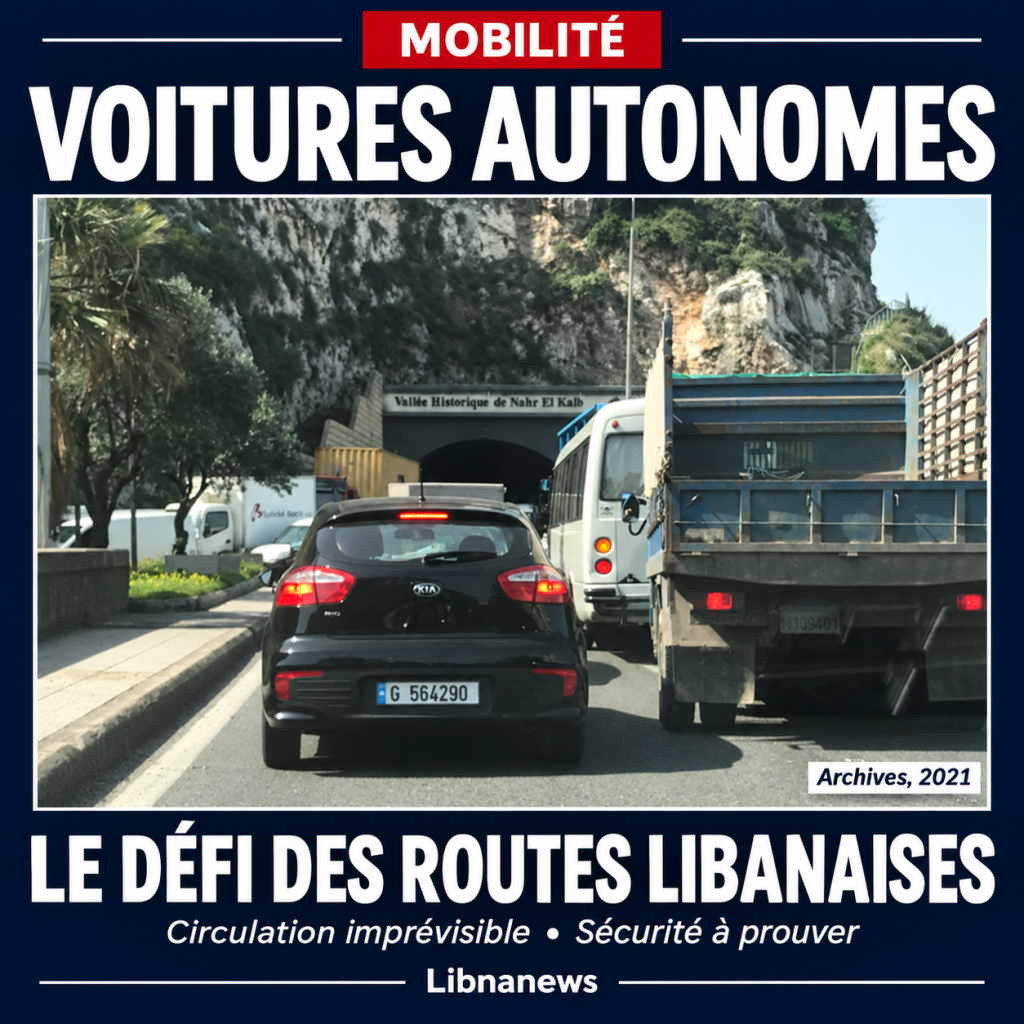
Autonomous cars in Lebanon, in the middle of scooters, changes of line and priorities negotiated at the horn: the image ready to smile. However, it raises a serious technical question. Can a system capable of driving in certain cities face the « fadwa », this traffic disorder familiar to Lebanese motorists? No local essay documented in the ads consulted allows to answer by a result. However, the criteria to be checked are known.
The announcements presented by Nvidia in Berlin on 21 October 2026 give new news to this question. Several European manufacturers and operators are developing uses of its Hyperion platform and Alpamayo software. These include Volvo Cars, Mercedes-Benz, Volkswagen Commercial Vehicles, Bolt and Einride. Their rapprochement opens up development programmes. It does not certify their ability to circulate everywhere.
Autonomous cars in Lebanon: everything depends on perimeter
The term « autonomous » covers very different capacities. At level 2, the system can affect direction and speed, but the driver remains responsible for monitoring. At level 3, he must be able to resume driving on request. At level 4, the system assumes the non-intervention of a human driver in the intended area of operation.
This area can combine a geographical area, track types, traffic or weather conditions. Therefore, a car authorized on a defined route does not become, by simply changing its destination, a vehicle suitable for all Lebanese roads. The relevant question concerns a precise configuration, not a general « artificial intelligence » ability.
This distinction changes the scenario of possible deployment. A service restricted to evaluated streets, at certain times and at a limited speed would pose a different problem for a free journey between Beirut and a mountain village. These are examples of possible perimeters, not announced projects for Lebanon.
Fadwa becomes a series of situations to test
For engineers, a congested crossroads is not just an image of chaos. Vehicles should be distinguished, their movements planned and a margin of safety maintained. The system must also identify less visible users: a pedestrian behind a utility, a motorcycle in a narrow space or a cyclist masked by traffic.
In a Lebanese scenario to be evaluated, let us imagine a car stopped in double queue. The automatic should determine whether it will leave, whether a door can be opened and whether its exceedance remains safe. Another scenario would be an intersection without exploitable signage. A third would test the actions of a person who temporarily runs the vehicles. These examples describe a necessary test programme, not already observed performance.
The difficult point is uncertainty. A human driver can read a hesitation or gesture as an invitation to pass. This interpretation remains flawless. An automated system must translate the available information into possible trajectories, then choose a manoeuvre compatible with its limits and applicable rules.
It would therefore be misleading to announce that an autonomous car will necessarily remain blocked at the first roundabout. It would be equally imprudent to say that it will control local interactions from the outset. The behaviour depends on the software, the sensors, the data used and the conditions for which the whole was assessed.
Slow down, stop or give up the journey
A vehicle without a driver must also be able to manage a situation which it can no longer deal with normally. The safety frameworks for testing provide for a back-up response to reduced risk. Depending on the context, this may mean slowing down, stopping or joining a safer location.
Applyed to a crowded street, this requirement raises a concrete difficulty. A stop sometimes protects the passenger and other users. Poorly placed, it can also obstruct a passage or complicate emergency response. The assessment must therefore consider how to stop, not just the ability to brake.
For an operator, continuity of service becomes a separate issue from normal driving. Who intervenes when a vehicle cannot continue? How are passengers informed? What procedure makes it possible to secure and then move the car? These issues belong to the operation of a fleet. They do not disappear because the steering wheel no longer has a driver.
Why European programmes start with data
Bolt plans to start collecting driving data in Madrid in 2027, subject to regulatory authorizations. This step must help develop and validate its technology. The company also presents a European programme with at least 25 000 future Lucid vehicles capable of operating at level 4.
Timeline is instructive. The operator shall first announce a collection and validation adapted to the routes concerned. It does not present this fleet as already in service. Local adaptation work is part of the project, even in the selected European markets.
Nvidia describes, with Halos SAFE, a chain of evaluation combining simulation, software and hardware tests, road tests and fleet monitoring. The stated objective is to produce measurable and traceable security evidence. This framework remains a tool for developers, distinct from an administrative authorisation for a given service.
The kilometres travelled are not enough
To compare two systems, a total of kilometres or collisions would be insufficient without knowing the traffic conditions. The speed, traffic density and type of route influence the situations encountered. A successful demonstration does not provide information on all rare or difficult cases.
American accident reporting systems also show the importance of precise definitions. They distinguish automated systems from Level 2 aids and report the limitations of the data collected. A gross count must not be converted into a safety classification between operators.
In order to judge a possible Lebanese experiment, the useful information would therefore be very concrete: authorised journey, excluded conditions, necessary interventions and observed incidents. The operator, the applicable insurance and the means of taking care of passengers should also be identified.
The first credible test in Lebanon would not be to send a car alone into traffic to see if it « understands » the country. It would begin with an announced perimeter, framed trials and verifiable success criteria. It is on these elements, still absent from the European announcements for Lebanese territory, that a real local calendar could be built.





Comments