

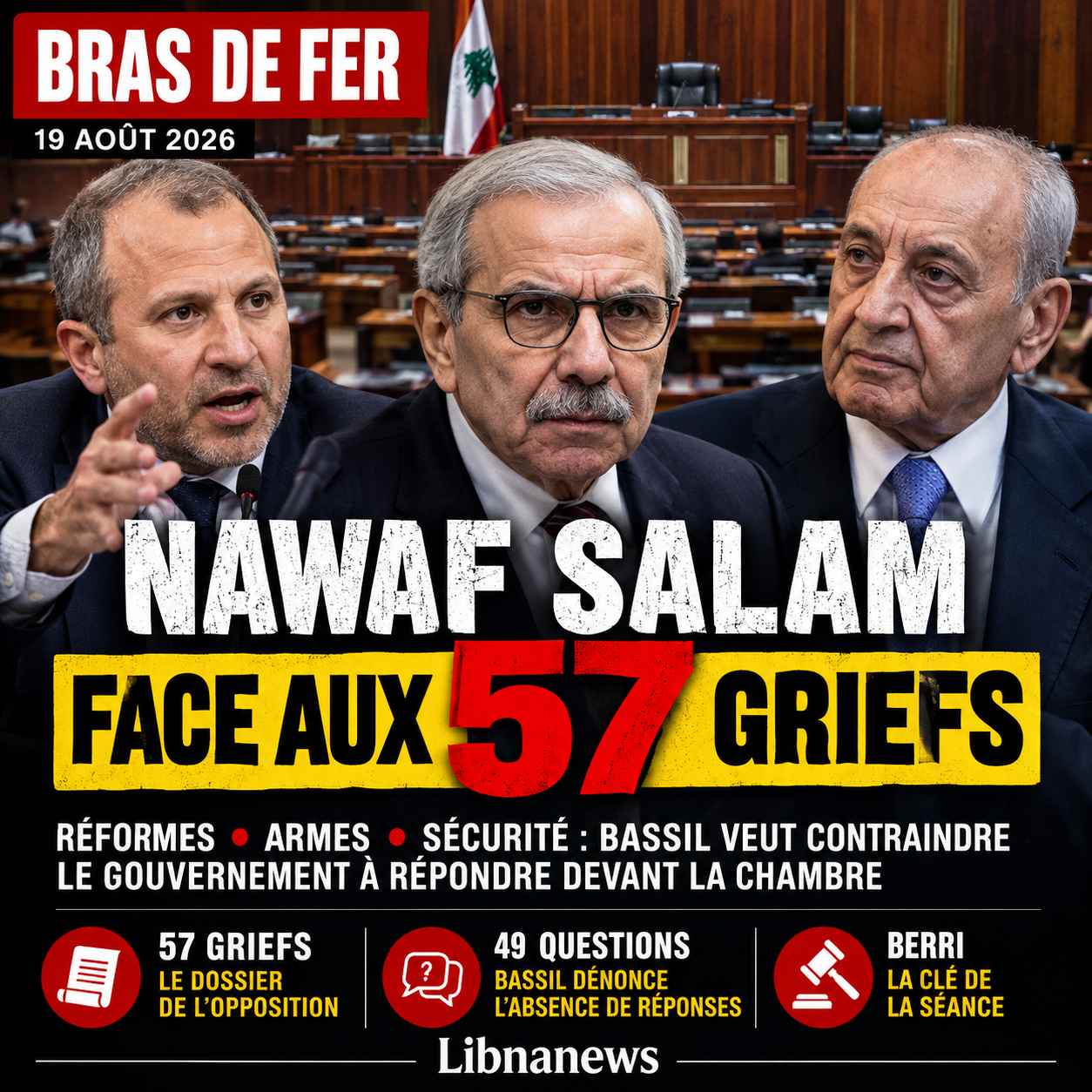
Gebran Bassil wants to bring Nawaf Salam’s government back to Parliament with 57 points. The President of the Free Patriotic Movement calls for a public monitoring session to confront the executive with his commitments on reforms, war, weapons and security arrangements concluded or discussed since the beginning of his mandate. However, the issue goes beyond the content of these grievances. One year after a first session that had largely renewed confidence in the cabinet, Basil must demonstrate that he can now transform the accumulated criticisms against Nawaf Salam into a balance of parliamentary strength. And before that, he must convince Nabih Berri to call the Chamber.
Gebran Bassil no longer only asks the government for answers. He called for a confrontation before the Members. At a press conference reported on 19 August 2026, the President of the Free Patriotic Movement (FPC) announced that the opposition had57 points on which it intends to hold Nawaf Salam’s office to account. He called for a public session on monitoring government action.
The figure gives an architecture to the offensive, but it should not be told more than the information available. The 57 points were not published in the form of an inventory to detail them one by one. On the other hand, Basil has clearly identified the areas on which he intends to question the executive: the implementation of the promised reforms, the management of the war and its aftermath, the arms issue, the framework agreement with Israel and, above all, the possible existence of security texts that would not have been made public.
It is this last question which gives the offensive a dimension beyond the traditional controversy between the PLC and the government.
Bassil wants Nawaf Salam to say in front of the Chamber ifall security commitments made on behalf of Lebanon are known to Parliament, or if annexes, implementing arrangements or supplementary documents exist in parallel with the officially published texts.
Bassil returns the promise of reform against Salam
The attack begins with the very name Nawaf Salam had given his cabinet: the government of « reform and rescue ».
His ministerial agenda had set specific commitments. It linked the state’s recovery to the restoration of its sovereignty. He promised to strengthen the independence of the judiciary, pursue economic and financial reforms, restructure the banking sector and protect depositor rights. The Government was also committed to ensuring a state monopoly on arms and extending its authority throughout the country.
Bassil thus attacks the firm on a criterion he did not himself choose:the gap between this programme and the results achieved.
His formula is deliberately biting. The government, he said, risks moving from a « rescue and reform » government to a « relief » government« rescue against reform ».
The prosecution does not mean that no reform has been undertaken. It is to argue that the cabinet’s action is no longer up to the reform mandate on which Nawaf Salam had sought the confidence of the deputies.
The judicial record also offers a concrete example of the complexity of this assessment. The reform of the organisation of the judiciary progressed well until a law was passed. However, in February 2026 the Constitutional Council annulled the entire text, in particular because of a violation of the constitutional requirements of the Supreme Council of the Judiciary. Members of the CPL were among the authors of one of the appeals.
The political result is paradoxical: the government can argue that reform has been undertaken; its opponents can answer that one of the major institutional reforms did not ultimately survive constitutional control.
This is exactly the type of confrontation that Bassil now wants to carry in the Chamber.
War and arms: the government faced with its own commitments
The second front is otherwise more sensitive as it concerns arms and sovereignty.
The government programme was not content with general formulations. It affirmed the right of the State to exercise its authority over the whole territory and the principle that arms should be the responsibility of the State.
At the July 2025 parliamentary session, Nawaf Salam had further clarified this line. He had defended the army’s action south of the Litani and affirmed that the government wanted to continue the extension of state sovereignty to the north and south of the river.
Basil, however, does not approach the case from a defence of the military status quo. His earlier positions show that he too considers that the problem of arms must be resolved. In particular, its divergence concernsthe method, the counterparties obtained by Lebanon and the conditions under which commitments are made while Israel retains positions on Lebanese territory.
In early 2026, he described the ongoing negotiations as concessions and defended the idea of a Lebanese strategy to simultaneously recover Lebanon’s rights and address the issue of Hezbollah’s weapons.
So the question he asks the government is less « do we have to solve the problem of weapons? » than it is« that Lebanon accepted to settle it, according to what timetable and against what Israeli obligations? »
This distinction is essential to understand his offensive.
The real sensitive point: is there another text?
The third front concerns the framework agreement and its security component.
The debate is not theoretical. At the end of June 2026, the information released on the agreement already provided that the Lebanese army would gradually regain control of the territory and that the concrete modalities would be specified by a security mechanism. This component should address, inter alia, verification mechanisms, deployment and implementation of commitments in the field.
In the following weeks, contradictory information circulated.
Media outlets published what they presented as elements of a« safe supplement »sometimes described as a secret. Reports attributed to Israeli sources included verification mechanisms, the dismantling of military infrastructure and conditions for a progressive Israeli withdrawal.
But not all of these versions could be authenticated independently.
More importantly,the lebanese presidency publicly denied, in early august, the existence of a « secret security supplement ».
It is in this area of contradiction that Bassil puts his question.
It is therefore not enough to write that the head of the CPL accuses the government of having signed a secret agreement. Such an assertion would go beyond what is established. What he wants is politically more precise:that the government appear before Parliament and officially state which texts exist, which have been approved, which are still under negotiation and whether implementing documents accompany the published agreement.
The difference is fundamental.
The parliamentary session could turn a controversy fuelled by leaks and denials into an institutional issue addressed directly to the Prime Minister.
Bassil has already tried: in 2025, Salam had won
This offensive has a precedent that cannot be ignored.
On 15 and 16 July 2025, Parliament had already devoted two days to the control of the Salam government. More than 50 Members had asked for the floor. Weapons, sovereignty, reforms, public services and the economic situation had dominated interventions.
Bassil had then indicated that his group had forwarded a series of questions to the government which he felt did not receive satisfactory answers.
Nabih Berri had given him a very clear procedural indication:turning issues into questioningif he wanted to go further.
Bassil had finally asked for a vote of confidence.
The result was unambiguous:69 mps had renewed their confidence in the government, 9 had voted against and 4 had abstained.The nine hostile voices corresponded to the deputies of the Basil bloc present in this battle.
This precedent changes the reading of the offensive of 19 August 2026.
The question is not simply whether Bassil can put Nawaf Salam in trouble in a speech. He already faced him in Parliament and, arithmetically, he had lost.
For the new initiative to be a real test for the Prime Minister, a change must have taken place since July 2025:members who had supported Salam must now agree to contest it with the CPL, or at least to subject its action to a much more severe control.
This is precisely what the 57 points are supposed to allow.
From questions to inquiries: the procedure counts
The difference between a question and an inquiry is not only semantic.
Parliamentary scrutiny allows Members to question the government about its actions. But an inquiry opens a politically heavier sequence. After government responses and debate, the discussion can lead to the question of trust.
Bassil knows this mechanics since he used it in July 2025.
Its new request therefore aims to move the criticisms accumulated since then from a political stage to an institutional stage. The 57 points must provide the subject of the debate; the public meeting must provide the arena; The question of trust is, in the background, the ultimate pressure instrument.
But Basil does not control the procedure alone.
Nabih Berri holds the first key
This is where Nabih Berri comes in.
The Speaker of the Chamber obviously does not decide the content of Nawaf Salam’s replies or the vote of the deputies. However, it has a decisive power over the organisation of parliamentary work.
Without a summons, the 57 points remain an opposition file.
With a screening session, they become questions that the government must answer publicly under the eyes of the House.
Berri’s role is all the more interesting because his relations with Bassil can no longer be reduced to their former confrontation. On 30 June 2026, the two men met in Ain al-Tinah. Bassil had then indicated that he shared with Berri several concerns, including the refusal of an internal confrontation and the need to protect the military institution.
Berri also expressed his own reservations about how the framework agreement should be treated institutionally.
This in no way means that it will adopt the 57 grievances of the CPL. However, this means thatsome questions from Basil about security agreements and their institutional treatment are not completely isolated in the political landscape.
The Speaker is therefore in a particular position. Convening the sitting would allow Parliament to take over issues that were widely discussed between the government, the presidency, negotiators and foreign mediators. But the same meeting would provide Basil with the platform he is demanding to turn his opposition into an organized offensive.
The 57 grievances will also test the opposition
This is ultimately the paradox of initiative.
Nawaf Salam will be tested if the session takes place, but Gebran Bassil will be tested as well.
The July 2025 precedent showed that it could force Parliament to vote on the government without succeeding in gathering beyond its own side. The cabinet then regained a comfortable parliamentary legitimacy with 69 votes.
In August 2026, the situation was different. The framework agreement, military operations in the South, discussions on weapons, questions about security modalities and the difficulties of reforms have multiplied the issues of challenge.
Butadding up discontent is not enough to make an opposition.
Some Members may criticise the terms of the security agreement while supporting Nawaf Salam. Others may blame the government for not moving fast enough on the arms monopoly. Still others can challenge its economic record without causing a government crisis.
The 57 points announced by Bassil will therefore have a very concrete function if they arrive in the Chamber: forcing these different critics to count.
The session would then measure two power ratios at a time. The first concerns Nawaf Salam: how many of the 69 votes that had supported him in July 2025 would remain behind his government after another confrontation on his record? The second concerns Bassil: can he finally turn a series of criticisms shared by different camps into a common parliamentary strategy?
For the time being, this double test remains suspended from a more immediate decision. The 57 points exist politically, Bassil asks for their examination publicly and the precedent of 2025 shows how far a control session can lead. It is now up to Nabih Berri to decide whether this confrontation will really enter the Chamber.




