

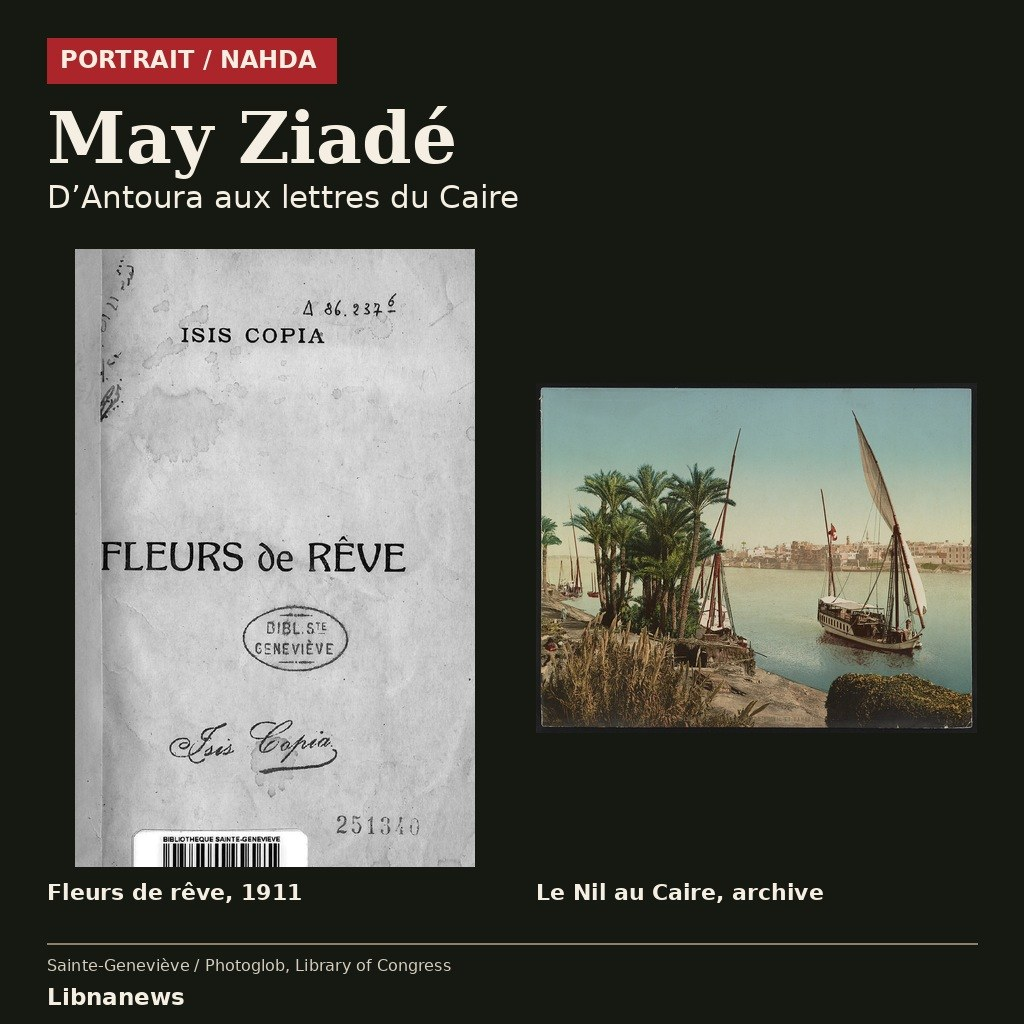
In 1911, a young woman published in Cairo Dream Flowers, a collection in French signed Isis Copia. His name is May Ziadé. Born in Nazareth to a Lebanese father and a Palestinian mother, she studied in Antoura before settling in Egypt. The book gives to read its first verses and a question that will go through its work: to whom do we recognize the right to sign a text and to be read?
May Ziadé, from Kesrouan to Cairo Printing
Mary Ziade was born in Nazareth in 1886. His father, Elias Ziade, is Lebanese; His mother, Nazha Muammar, is Palestinian. She began her schooling in Nazareth and pursued her to the College of Visitandines in Antoura, Kesrouan. The passage through Lebanon leaves a very concrete trace in his work: « Antoura » is the title of one of the poems in his first collection.
The family settled in Egypt in 1908. In Cairo, May Ziadé teaches French and turns to journalism. Her father runs Al-Mahrousa, which offers him a first platform. It also contributes to other periodicals, including Al-Zouhour and Al-Hilal. The press gives him a different audience than the one to whom his volume of poems addresses: she can discuss social issues, but also read and comment on the work of other authors.
In the copy of Dream Flowers kept at the Bibliothèque Sainte-Geneviève in Paris, the name above the title is Isis Copia. The Cairo edition was released from the presses of Boehme and Anderer. The dedication is addressed to Lamartine. The opening of the book places the reader at the edge of the Nile, and several texts plant their decor in Egypt. The language and references in the compendium do not dictate its geography.
» She poet? » or the suspicion of not writing her verses
In « She Poet? », the author gives the floor to unbelieving readers. They admire the verses, but they refuse to believe that the young woman wrote them. Their reasoning is based on two prejudices: she is not French and, as a woman, she can hardly be a poet. It must therefore be a loan. One of the characters even proposes a model all found: Lamartine.
The process allows May Ziadé to play two roles at the same reference. She pays tribute to Lamartine at the beginning of the collection; She turns in derision the idea that this tribute alone would explain her poetry. The text contains votes and not minutes of its receipt. His target, on the other hand, is precise: the reader who recognizes the quality of a work, but does not believe in the signature he has before his eyes.
« Antoura » proceeds differently. The poet returns to the schoolgirl’s memories, to the friendships and nights of the village. The landscape has nothing to do with a borrowed decor: it is the place where the narrator was a child. A few pages away, the book can thus make a discussion about what a woman has the right to write and restore the memory of a village in Kesrouan. May Ziadé’s first French book already contains these two registers.
In Cairo, read women as authors
In the 1910s, May Ziadé hosted a literary salon in Cairo that brought together writers and figures from Egyptian intellectual life, including Hoda Chaaraoui. The living room is a place for discussion. The books she published in Arabic in the following decade showed another, more sustainable aspect of her work: she chose texts written by women, presented them and discussed their ideas.
In 1920 appears Bahithat al-Badiya, his study on Malak Hifni Nassif. The title takes the pen name of this Egyptian essayist. The book thus maintains in the foreground the signature that Nassif had chosen. Ziadé also devotes a study to the poet Warda al-Yaziji. She deals with her prose as well as her verses and discusses her positions on women’s education. She is therefore not content to add a female name to literary history: she returns texts and proposes to read them closely.
These books belong to the Nahda, the intellectual renewal movement that transforms the Arab press and literature at the end of the 19th centurye century and early XXe. In this story, Ziadé’s journey is singular: French is the language of his first collection, while Arabic becomes the language of much of his work as a critic. It also translates into Arabic. In 1921 his version of Deutsche Liebe, by Friedrich Max Müller, under the title Ibtisamat wa doumou‘.
After the death of his father in 1929, his name appears in the direction ofAl-Mahrousa. She died in Cairo in 1941. The correspondence with Gibran Khalil Gibran has become one of the most famous episodes of her life, at the risk of overshadowing the books she signed alone. Two archives now allow them to be reopened in order: the 1911 French collection, with the name of Isis Copia printed on the cover, and then the 1920 volume, where May Ziadé headlines the pseudonym of another woman.





Comments