

On the eve of Independence, Joseph Aoun once again defended a single authority over arms in Lebanon. The President did not set any new deadlines or measures. To measure the transition from speech to action, it is necessary to go back to the decisions of the Council of Ministers, the reports of the army and the findings published by the United Nations. None of these documents, taken in isolation, prove that the monopoly is acquired.
The Council of Ministers decides; Army reports
On 5 August 2025, the Council of Ministers instructed the army to prepare a plan to implement its decision to reserve arms to the legitimate authorities. A month later, the government welcomed the command’s plan. He kept his content and deliberations confidential, while asking the army for a monthly report. The scheme therefore provides for a report to the government, not the monthly publication of a detailed assessment.
On 6 October 2025, the Ministers considered a first report. On 8 January 2026, they again became aware of progress. They called for the continuation of the plan and for preparations for the continuation north of the Litani River. On 16 February, the Commission indicated that it had taken note of a new monthly report. Prepare a step, take note of a report and find that the objective is achieved are three different decisions.
Monopoly of arms in Lebanon: what the UN has seen
The Secretary-General’s report dated 12 November covers the period from 21 June to 20 October 2026. It separates what UNIFIL observed directly from statements by the Lebanese Army, Israel and Hezbollah. The army announced seizures in the pilot areas in September. UNIFIL, for its part, has observed the presence of unauthorized weapons on several occasions in the South. These records document events. They are neither an inventory of arsenals nor a calculation of the remaining share.
The report states that the framework agreement announced on 26 June provides for a gradual and reciprocal process, linking the restoration of Lebanese authority, verified disarmament of non-State groups and Israeli withdrawal. The United Nations notes differing interpretations and difficulties of application in pilot areas. Hezbollah rejected this framework and defended an internal dialogue on the defence strategy after the Israeli withdrawal and the cessation of attacks. This is his position, not a condition adopted by the Lebanese government.
What independence speech does not decide
In his agenda of 19 November, the Commander-in-Chief of the Army reaffirmed that he would implement the decisions of the political power. He also stated that Israeli violations and occupation were hampering the deployment of the army to the South. Two days later, in Nahr al-Kalb, Joseph Aoun called for simultaneous treatment of the end of the Israeli occupation and that of the arms and decisions taken by the State. He did not release a new report or announce agreement on the sequence.
The gap between documents is significant. A presidential statement commits a political line; a decision of the Council of Ministers entrusts a mission; a report shall report thereon over a given period. In order to determine whether the policy is entering a new stage after the November 21 speech, it will require a public decision that designates it or an dated assessment to verify its results. The November UN report ends on 20 October and does not allow the following weeks to be judged.
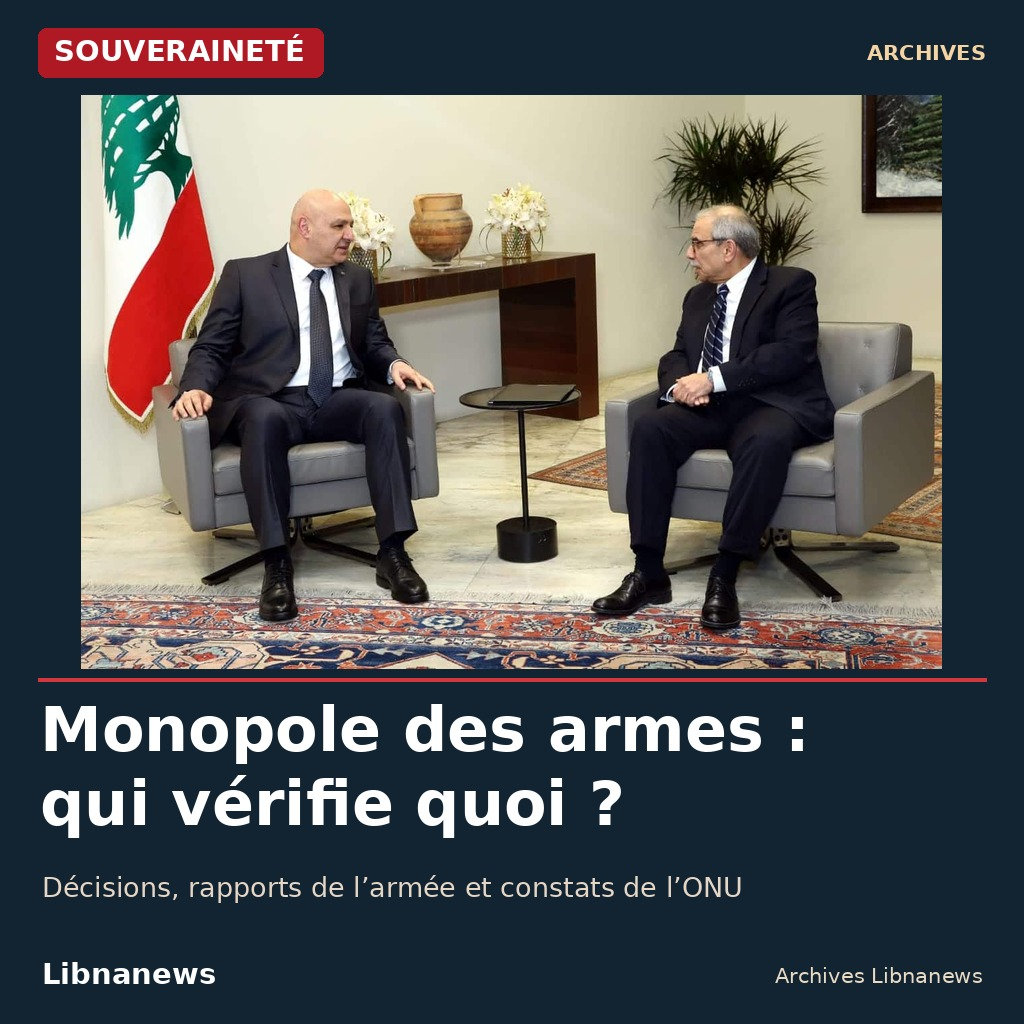
Joseph Aoun and Nawaf Salam, Libnanews archive. The image shows neither the 21 November ceremony nor a Council meeting mentioned in this article.





Comments