

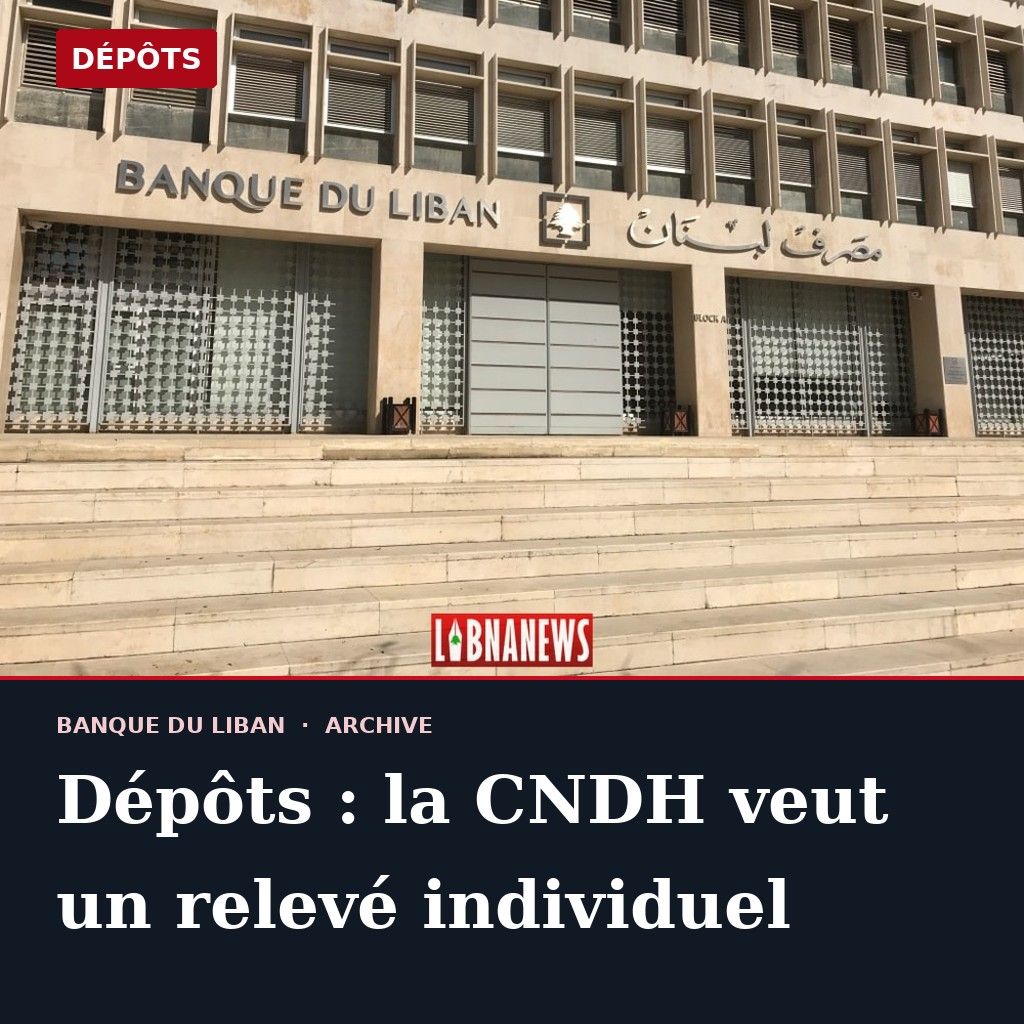
The National Human Rights Commission asks that each depositor be able to know how much his bank recognizes, how he calculated it and how to challenge it. His November 19 opinion concerns the deposit recovery project. It does not create a right to payment, but points to a concrete question: how to verify a balance that would then determine the terms of the refund?
The survey should explain what has changed
Knowing his old balance is not enough to verify the amount withheld after reviewing the file. If two digits do not coincide, then it is still necessary to be able to find the operation at the origin of the deviation. The National Human Rights Commission (CNDH) requests that each applicant receive an individual statement indicating the amount retained by the bank, the reasons for each correction, the parities used and the dates of repayment, as well as the procedure for correcting the calculation.
Let’s take a fictitious case. A depositor receives a statement whose total is less than that of his former bank statement. Without explanation, she could not know whether the difference was due to an already recorded withdrawal, conversion or other correction. A detailed document would allow each line to be reconciled with the corresponding transaction and, if there is a lack or appears to be an error, to clarify what it challenges. The CNDH also calls for temporary suspensions of judicial proceedings related to the resolution of a bank to be subject to judicial review.
The case of the $100,000 exactly
The draft submitted to Parliament at the end of December 2025 illustrates the importance of the calculation. In its version, article 8 provides, after verification and adjustment of balances, for deposits of less than $100,000 and for deposits of more than $100,000. In the first case, the text provides for payments over a period of up to four years. Above the threshold, it distinguishes between a first tranche and a balance sheet which would be subject to asset-backed securities.
The Commission notes that this wording does not explicitly indicate the regime applicable to a recognized balance of $100,000. She asked the legislator to clarify that. This gap does not lead to the conclusion that an applicant in this case would be excluded from the refund or automatically attached to one of the two schemes. Project deadlines are not acquired deadlines.
A common register does not replace an individual explanation
The Bank of Lebanon provided, in a separate decision of 17 August 2026, for a central registry and the assignment of a unique identifier to each depositor, including when holding accounts in several banks. This should make it possible to link the accounts to the same person. The decision requires its entry into force upon the adoption of its implementing mechanism. It alone does not establish that the Register is already functioning or that an applicant can consult the details of the adjustments made.
The register and the statement thus answer two different questions: which accounts are the responsibility of the same depositor, and how has the amount to be recognized been calculated? The first facilitates the reconciliation of banking data. The second would allow the person concerned to monitor the result and to know who to challenge it. It is this possibility that the CNDH asks to include in the law still under discussion.





Comments