

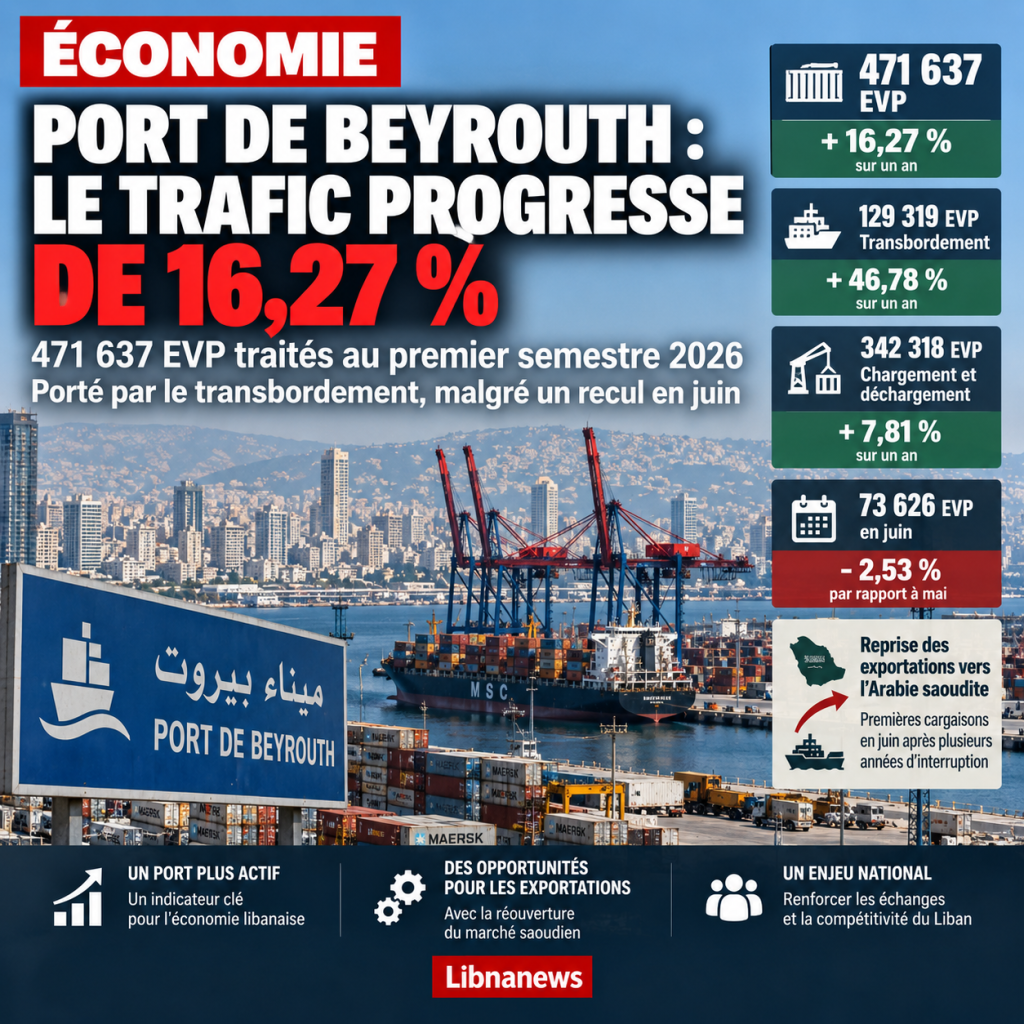
Container activity at the port of Beirut increased by 16.27% over one year in the first half of 2026, reaching 471,637 TEUs at the end of June. The increase is mainly based on transhipment, which jumped by 46.78 % over the same period, while loading and unloading increased by 7.81%. June figures, however, show a slowdown, with 73,626 TEUs treated, down 2.53% from May. These data are used as Lebanon seeks to strengthen its trade and exports to Saudi Arabia have resumed after several years of interruption.
471 637 TEUs processed at the port of Beirut
The port of Beirut handled 471,637 TEUs between January and June 2026, compared with a lower volume over the same period of 2025. The TEU, or equivalent 20 feet, constitutes the international unit used to measure container traffic. The annual increase of 16.27% thus confirms a significant increase in port activity in the first six months of the year.
Loading and unloading operations accounted for 342,318 TEUs at the end of June, an increase of 7.81% over one year. They constitute almost three quarters of the total activity of the containers recorded over the period. This category more directly reflects the movement of goods related to the country’s imports and exports.
The rest of the activity comes from trans-shipment. It reached 129,319 TEUs in the first half of the year, an increase of 46.78 % over the same period of 2025. The growth of this segment is therefore significantly higher than that of operations directly related to Lebanese trade and accounts for a significant part of the improvement in overall traffic.
Transshipment progresses by almost 47%
The increase in transhipment is the main feature of the statistics for the first half of the year. With 129,319 TEUs processed, this activity now accounts for about 27% of the total volume of containers passed through the port of Beirut between January and June.
The transhipment corresponds to containers unloaded from one vessel and then loaded onto another in order to continue their journey to a different destination. These goods are not necessarily destined for the Lebanese market. Their growth is more indicative of the place of the port in the regional maritime circuits than of the development of domestic consumption or exports.
This distinction is essential to interpret the overall increase of 16.27%. Traffic directly associated with loading and unloading is increasing by 7.81%, while transhipment is increasing almost six times faster. A significant part of the growth recorded in the first half of the year is therefore due to the strengthening of maritime transit operations.
A slowdown appears in June
However, monthly data provide a nuance to the progress observed since January. In June, total container activity was 73,626 TEUs, compared with just over 75,500 TEUs in May. The decline is 2.53% in one month.
This decline occurs in an unstable regional and security environment that could disrupt trade flows, shipping company schedules and logistics operations. However, one month alone does not allow for a sustainable trend. The figures for the next few months will be needed to determine whether the decline in June is still punctual or is a further slowdown.
Comparison with the first months of 2026 already shows a gradual normalization of the annual growth rate. Cumulative activity was much higher in 2025 at the beginning of the year. As the months pass, the gap narrows, although the cumulative volume of the first half of the year remains significantly higher than that recorded a year earlier.
Export recovery to Saudi Arabia
The month of June was also marked by the resumption of Lebanese exports to Saudi Arabia. The first shipments left the port of Beirut after the lifting of the ban on Lebanese imports into the kingdom since 2021.
This reopening is of particular importance to Lebanese producers. Prior to the restrictions, the Gulf countries, including Saudi Arabia, were important markets for several production sectors. The re-establishment of these flows therefore offers the possibility of a commercial recovery after several years in which Lebanese companies had to look for other markets.
The effect on the figures for the first half of the year is necessarily limited since the resumption of shipments occurred in June. The third-quarter statistics will allow for a better measurement of its impact on exports and, more broadly, on the loading activity of the port of Beirut.
The port remains essential for Lebanon’s trade
The development of traffic is an important indicator for an economy heavily dependent on maritime trade. The port of Beirut remains one of the main gateways to Lebanon and also plays a role in domestic exports. The increase in its volumes directly influences transport, logistics, storage and distribution activities.
However, the figures should be interpreted with caution. An increase in port activity does not automatically mean an equivalent improvement in the Lebanese economy. A significant part of the 2026 increase comes from transhipment, while trade-related loadings and unloadings are increasing at a more moderate pace.
The composition of traffic will therefore be as large as its volume in the second half of the year. A further increase in trans-shipment would strengthen the regional role of the port, while a sustained increase in exports could benefit Lebanese production and foreign exchange inflows more.
At the end of June, however, the balance sheet remains very positive in annual comparison: 471 637 TEUs were processed in six months, or 16.27% more than a year earlier. The monthly decline observed in June and the evolution of exports to the Gulf markets will now be two of the indicators to follow in future port statistics.




