

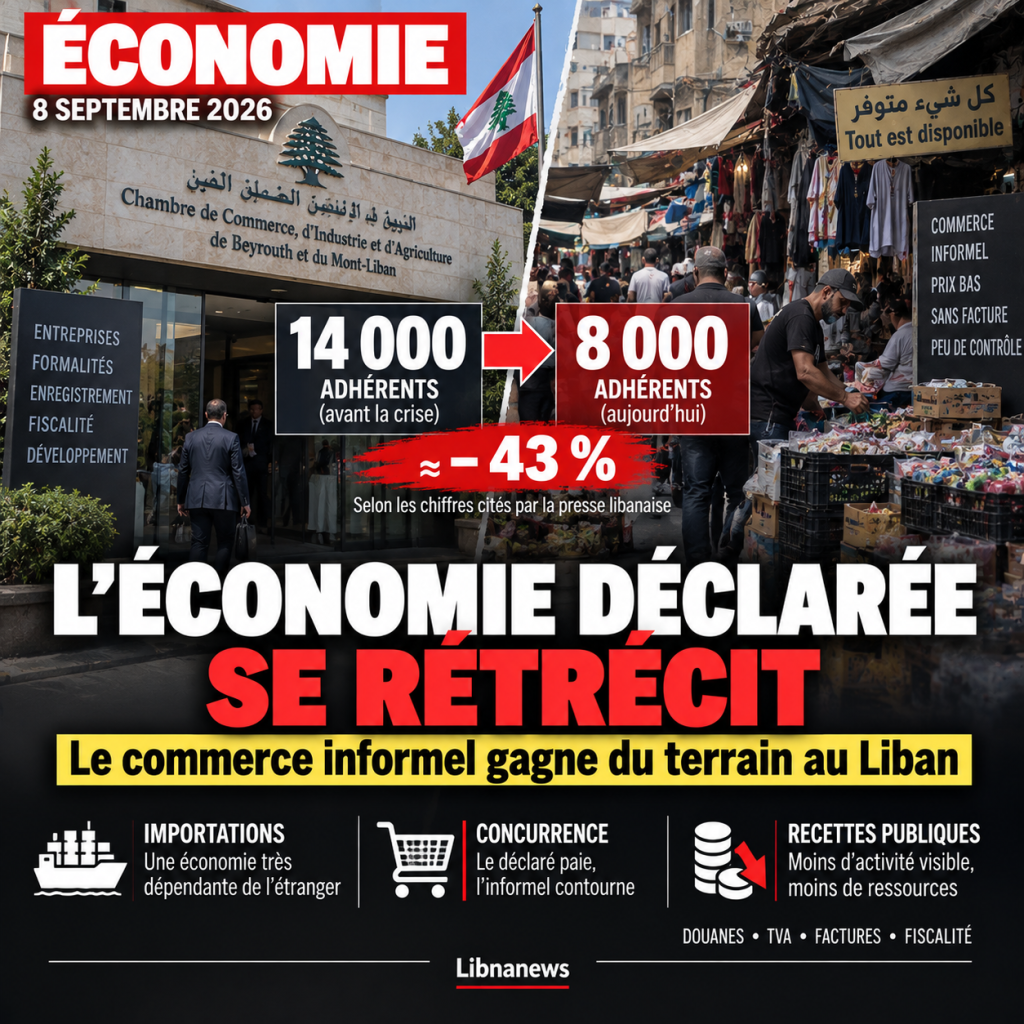
From 14,000 to 8,000 members, the signal of a shrinking economy
The Lebanese economic crisis is no longer only measured by the value of the pound, blocked bank deposits or declining purchasing power. It also appears in the very structure of the private sector. According to data reported by the Lebanese press on 8 September 2026, the number of members of the Chamber of Commerce, Industry and Agriculture of Beirut and Mount Lebanon has increased from about 14,000 to 8,000. This fall is presented as a sign of the contraction of the organized economy. It also reflects a deeper transformation. A growing part of the activity would escape the traditional recording, control and taxation channels. The decline does not mean that several thousand enterprises have all disappeared. Some closed during the crisis. Others have reduced their activity. Still others can continue to work outside the structures that normally govern trade. It is precisely this latter development that concerns the representatives of the formal sector. Registered companies must bear burdens, administrative procedures and tax obligations. They face actors who can offer lower prices when they escape some of these constraints. Competition is no longer confined to quality, cost or productivity. It also depends on the degree of compliance with the rules.
However, the figure should be interpreted with caution. The accessible public data of the Beirut and Mount Lebanon Chamber of Commerce, Industry and Agriculture do not directly confirm the exact evolution of 14,000 to 8,000 members. In 2026 the House continued to propose procedures for renewal and new membership. A public presentation of the institution also shows more than 10,000 enterprises represented. The difference may be due to the definition chosen, the period considered or the difference between registered and active members. It does not remove its scope from the phenomenon described. Since 2019, the Lebanese private sector has suffered a succession of shocks. The banking crisis has deprived companies of normal access to credit. The collapse of the pound upset the costs. The pandemic interrupted part of the activity. The explosion in the port of Beirut destroyed shops and infrastructure. Then successive conflicts added new losses. In this context, the reduction in the number of enterprises that remain fully integrated into official structures is an additional indicator of fragility.
The informal economy becomes a competitor of the declared sector
The problem exceeds the number of members of a professional chamber. It concerns the boundary between formal and informal economies. A declared company has an identifiable legal existence. It maintains accounts, pays fees and can be controlled. It must also comply with rules relating to imports, product safety and work. Informal activity reduces or circumvents some of these obligations. It can take very different forms. Some are related to small survival activities. Others concern structured trade circuits capable of moving large volumes. Putting all these situations in the same category would be misleading. The small seller trying to generate income and an organised network of undeclared imports have neither the same means nor the same economic effects. However, their development is partly in keeping with the same context: when the state operates badly, the cost of formality increases compared to its benefits.
The Lebanese crisis has accentuated this mechanism. Companies had to continue to pay their suppliers in foreign currency while their customers were losing much of their purchasing power. They had to manage several exchange rates prior to the gradual stabilisation of the market. They also worked in an environment where bank financing remained largely paralyzed. A registered company could thus bear the costs of formality without benefiting from the services normally associated with a functioning State and financial system. At the same time, activities outside certain circuits could reduce their costs. This asymmetry nourishes the feeling of unfair competition reported by the press on 8 September 2026. The trader who pays customs duties and taxes no longer compares only his price with that of a more efficient competitor. It may have to deal with a product whose tax cost has been avoided.
This situation creates a difficult circle to break. The more the informal economy progresses, the more government revenues decline. The less the State collects revenue, the less resources it has to perform its functions. The weakness of controls thus further favours information. Formal enterprises may end up considering their status as a disadvantage. Some reduce their reported activities. Others stop renewing certain entries. The risk is therefore not just fiscal. It affects the structure of economic incentives. A system becomes permanently fragile when compliance with the rules costs more than circumventing them and the probability of control remains low.
Massive import dependence amplifies losses
Lebanon’s trade structure makes this issue particularly sensitive. The Lebanese press of 8 September 2026 insists on the dominant position of imports in the economic cycle and puts a weight above 90% for the part of the activity mentioned. Again, this percentage must be reported to the source ahead and cannot be applied indiscriminately to all gross domestic product. The general observation, however, is indisputable: Lebanon relies heavily on imported goods to meet domestic consumption. Food, fuels, medicines, vehicles, equipment, machinery and many consumer products come largely from abroad. Moreover, customs statistics published in September 2026 continue to follow external trade, which is structurally dominated by goods.
This dependency gives customs a major economic and fiscal role. When a large proportion of the products consumed cross the border, their passage is an essential time to identify, assess and collect the corresponding duties. A commodity entering through an undeclared circuit causes several losses. The State may lose customs duties. It may also lose value added tax and some of the tax revenues generated in the next stages of sale. Product traceability becomes weaker. Trade statistics are also becoming less accurate. In the long run, the administration has an incomplete view of the economy which it must regulate.
So the question is not just how much the State loses immediately at the border. An unregistered import may continue to produce effects throughout its trade path. If the product is sold without an invoice, a new part of the activity disappears from the accounts. If the merchant who distributes it is not properly reported, the income generated may also be exempt from tax. A single break in the traceability chain can result in several successive losses. In an economy heavily dependent on imports, the increase in these breaks can become considerable.
The phenomenon also affects statistics. In order to conduct an economic policy, a government must know what is entering the country, what is being sold and in which sectors the activity is concentrated. Incomplete data complicate decisions on taxes, consumer protection or industrial policies. They also make it more difficult to assess real demand in foreign currencies. The informal economy, therefore, does not only deprive the Treasury of revenue. It reduces the state’s ability to know its own market.
The declared trader bears a cost that his competitor can avoid
For the formal sector, this translates into a direct price difference. An importer who complies with all procedures integrates duties, taxes and administrative costs into its final price. It must also finance the accounting and compliance of its company. A competitor who avoids part of these expenses has an additional margin. It can sell cheaper while maintaining comparable or higher profitability. In a country where purchasing power remains weak, a few points of difference may be sufficient to shift demand. Consumers often prefer immediate prices. It does not necessarily have the means to pay more for a product from a perfectly declared circuit.
The consequence may seem paradoxical. The company that respects the rules becomes less competitive precisely because it respects them. As this situation continues, it can be pushed to reduce its own statements to survive. Informality then ceases to be a parallel sector. It begins to contaminate the functioning of the formal sector itself. Companies can maintain a legal structure while moving part of their transactions to less traceable payments or circuits. The boundary between the two economies becomes more difficult to identify.
This is also a problem for companies seeking to export or obtain foreign partners. A company that works with external markets usually has to provide documents, invoices and certificates. She needs stronger traceability. Chambers of commerce play a specific role in this area, particularly for certificates of origin. A sustained contraction in the registered economy can therefore reduce the country’s capacity to develop enterprises capable of operating according to the standards required by international markets.
The decline in formality directly weakens public finances
Lebanon is also trying to rebuild its public finances. This objective becomes difficult if a large part of the activity is excluded from the levy. The state can increase tax rates on identified taxpayers. However, this solution has a limit. The more pressure is concentrated on fewer formal enterprises, the more it increases their disadvantage vis-à-vis the informal sector. An effective fiscal policy must therefore seek to broaden the base rather than to make the same actors bear the bulk of the effort.
One of the possible levers is customs modernization. Statistics published by Lebanese customs on 3 September 2026 cover monthly import and export movements until 31 July. The existence of these data allows for regular monitoring of declared trade. It obviously does not measure the goods that escape the system. This is precisely where the stakes lie. Improving controls should reduce the difference between real and administrative trade.
Border control is not enough. A commodity may enter legally and then be distributed in circuits where billing becomes partial. The fight against informality therefore requires continuity between customs, tax administration and commercial control. It also requires procedures that are simple enough not to encourage companies to remain outside the system. Too heavy an administration can produce the opposite effect of the desired one. Smaller firms rarely have the means to employ teams solely responsible for regulatory approaches.
Formalize without stifling small businesses
The authorities have begun to develop some tools for small and medium-sized enterprises. The United Nations Development Programme, on 16 February 2026, announced with the Ministry of Economy and Trade the launch of the first national trade assistance centre. The scheme aims to provide information and consultation to micro-enterprises and small and medium-sized companies. Chambers of commerce are involved in its operation. The aim is to help companies understand the procedures needed to work in Lebanon and abroad.
This approach addresses part of the problem. Formalization cannot be based solely on sanctions. A company must also have an interest in joining the official system. Access to services, business information, certificates, external markets and possibly financing can be an incentive. The Lebanese challenge is to rebuild this exchange. The company accepts tax and regulatory obligations when the state provides it with a stable framework, predictable rules and useful services.
The reported drop in the number of members of the House takes on particular significance here. It refers not only to the results of the closures caused by the crisis. It can also be read as an indicator of the value companies still attribute to formal structures. If membership, registration and declaration no longer provide sufficient benefits, economic actors will seek alternative solutions. It is therefore necessary to restore confidence in the institutions that govern the organised economy.
Two economies that do not support the same rules
The long-term coexistence of adeclared sector and a largely informal sector may finally create two economies. The first one remains visible. It pays, declares and appears in the statistics. It directly supports tax decisions made by the government. The second is more difficult to measure. It often responds faster to price changes and crises, but contributes less to collective resources. When the latter grows at the expense of the former, official indicators become less representative of reality.
The reported drop in membership of the Beirut Chamber of Commerce and Mount Lebanon must be seen in this context. The forward shift from about 14,000 to 8,000 members represents a contraction of nearly 43% if both figures are established on a comparable basis. A variation of such magnitude exceeds a simple administrative fluctuation. It translates either closures or exits from the system or a combination of both. Each of these opportunities poses a different problem to the Lebanese economy.
Closures indicate destruction of productive and commercial capacities. Outputs from the system indicate an increase in informality. The combination of the two would be even more worrying: it would mean that the organised economy contracts while part of the surviving activity becomes less visible. In an economy dependent on imports and engaged in fiscal reconstruction, this transformation reduces the basis on which the State can finance its services and measure real activity.




