

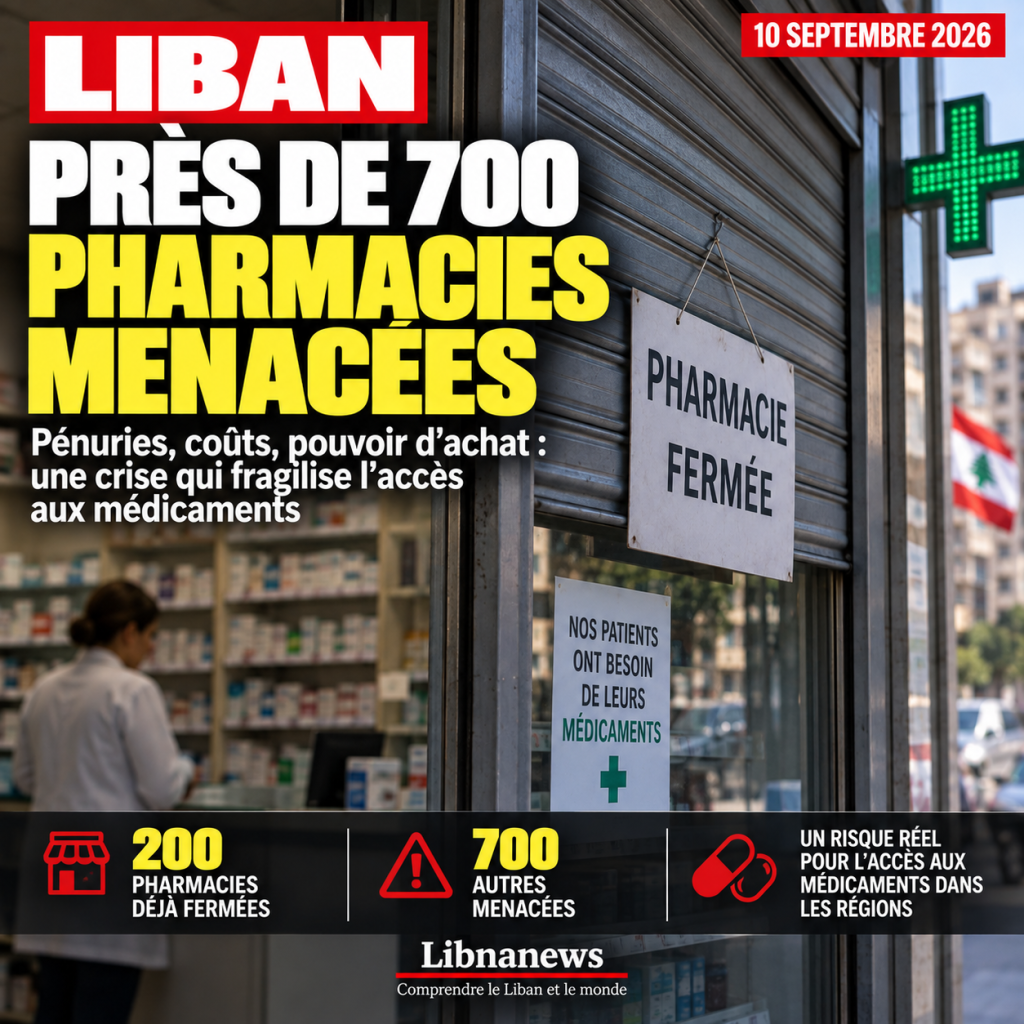
The Lebanese pharmaceutical network is going through a new critical phase. About 200 pharmacies have already closed their doors and nearly 700 more are now at risk, while still active pharmacies see their margins compressed by rising costs, weak purchasing power and changes in the drug market. Behind these financial difficulties now appears to be a health risk: if closures continue, access to medicines could be concentrated in large cities and become more difficult in areas where a pharmacy sometimes serves several localities.
The crisis comes as the sector has already absorbed six years of upheaval since the financial collapse of 2019. Devaluation of the pound, phasing out of subsidies, explosion of the price of imported medicines, development of generics, decrease in purchasing power and disappearance of bank credit have profoundly altered the economy of the officiaries. The rapid increase in electronic payment today adds a new constraint: bank fees, settlement deadlines and transaction costs can reduce an already narrow margin.
Pharmaceuticals in Lebanon: 200 closures and 700 endangered pharmacies
The figures reported by the Lebanese press give the warning measure. Approximately 200 establishments have already ceased operations and an additional 700 would be at risk of closure. When compared to a national network of several thousand officials, these figures do not mean the imminent disappearance of the local pharmacy. On the other hand, they show that a large part of the sector now operates with insufficient profitability.
The problem lies in the very structure of activity. A pharmacy does not freely fix the price of the medicines it sells. This depends on pricing mechanisms and regulated margins. When operating costs increase faster than sales revenues, official prices cannot simply increase as would ordinary trade.
However, these costs have risen sharply since 2019. Rents, electricity, generators, subscriptions, software, security, equipment and part of wages are now billed or indexed to the dollar. In addition, there is the need to maintain a sufficiently large stock of medicines, which holds up considerable cash.
The de facto dollarization of the drug has reduced some of the shortages caused by the old subsidy system. It also transferred a much larger share of the cost to patients and forced pharmacies to finance their stocks at prices far higher than those of the pre-crisis period.
The pharmacist thus finds himself between two constraints: a patient with a low purchasing power and suppliers whose products are largely linked to currencies.
The medicine has changed economy since 2019
To understand the current situation, we must return to the collapse of the financial system.
Before October 2019, the Bank of Lebanon officially held the book around £1,507.5 for a dollar. Imported medicines then benefited from a foreign currency financing mechanism to limit their prices in local currency.
This model became unsustainable when the central bank’s foreign exchange reserves contracted.
Lebanon imports the bulk of drugs consumed in the country, even if a local pharmaceutical industry exists. When the dollars began to run out, importers encountered difficulties in financing their orders. Shortages have increased and pharmacies have seen some common treatments such as drugs for chronic diseases disappear from their shelves.
The subsidy system was then gradually reduced.
This development was virtually inevitable in financial terms: continuing to finance imports at the artificial rate of the old parity would have consumed already very weakened foreign reserves. But the abolition of aid has led to a considerable increase in the prices paid by patients.
The sector has thus moved from a crisis of availability to a crisis of accessibility.
Medicines are more available than at the peak of shortages, but some households are now having difficulty buying them. For pharmacies, this means that the nominal increase in turnover does not necessarily correspond to an improvement in profitability: the stock price has increased at the same time.
Expensive stocks in a creditless economy
The almost complete disappearance of bank credit is one of the fundamental differences between a Lebanese pharmacy and an office in a normal economy.
A pharmacy must always have hundreds or even thousands of references. Some turn quickly; Others may remain on the shelves for several months before being sold. However, they must be kept in order to meet the requirements.
This stock represents fixed capital.
Before the crisis, a company could use banking facilities, overdrafts or other financing instruments to manage its working capital. Since 2019, these mechanisms have remained extremely limited. Many Lebanese companies have to finance their business with their own cash flow.
For a pharmacy, the difficulty is compounded by the nature of the product. It cannot decide to reduce its catalogue to the only most profitable drugs without directly affecting the service provided to patients.
The products also have expiry dates. An unsold drug is not simply a sleeping stock: it can become a loss.
This constraint mechanically favours institutions with more capital. A large pharmacy located in a densely populated area can spread its costs over a larger sales volume and renew its stock faster. A small rural area has much less room for manoeuvre.
This is where the economic crisis can gradually become a problem of access to care.
The risk of a pharmaceutical desert in certain regions
Two hundred closures do not produce the same effect depending on their location.
The disappearance of a pharmacy in a neighbourhood in Beirut where several establishments operate a few hundred meters away can be absorbed by the neighbouring network. The closure of a small town in Akkar, Bekaa or the South may require residents to travel several kilometres for treatment.
This issue becomes particularly important for the elderly and patients with chronic diseases.
Hypertension, diabetes, cardiovascular disease, psychiatric treatment or other pathologies often require regular renewal. Pharmacy is also the first point of contact with the health system in many regions.
The pharmacist obviously does not replace the doctor. However, in a country where a consultation may represent a significant expense, patients frequently seek advice from clinics on minor symptoms, drug use or referral to a health professional.
The reduction of the network therefore increases the distance between the patient and this first level of access.
It can also accentuate territorial differences. Of course, pharmacies have an interest in settling in areas where population density and purchasing power allow sufficient sales volume. If the overall profitability of the sector declines, this logic becomes even stronger.
The least profitable areas are then the first exposed.
Electronic payment adds a new equation
The increase in card payments and other electronic means could be seen as a welcome modernization in an economy that became heavily dependent on cash after 2019.
For pharmacies, however, it raises a question of cost.
Each electronic payment may involve a commission or costs related to the provider and the bank. Taken in isolation, the percentage seems limited. Applied to an activity where the margin on the drug is regulated, it can become significant.
The equation is simple: the pharmacist cannot necessarily pass this commission on to the price of a regulated medicine. It is therefore absorbed by its margin.
The problem becomes more sensitive as the share of electronic payments increases.
There is also a need to distinguish between turnover and real income. An officer can cash large amounts because drugs have become much more expensive, while keeping a small margin after the supplier and expenses have been paid.
A commission calculated on the total amount of the transaction can thus represent a substantially larger share of the profit than its apparent percentage.
The development of electronic payments nevertheless has advantages for the Lebanese economy. It reduces dependency on cash, improves the traceability of transactions and can facilitate tax formalization. The problem is therefore not the principle of electronic payment, but its cost when applied to a product whose price and margin are framed.
Adjustment of fees or the processing of pharmaceutical payments may become necessary if the State wishes to simultaneously encourage the digitisation of transactions and preserve the network of pharmacies.
New recession further weakens pharmacies
The economic situation of 2026 further reduces the sector’s ability to absorb these costs.
The World Bank is now planning a contraction in the6.4% of Lebanese GDP this year, after the return to positive growth in 2025. The institution also believes that inflation could reach17.5% on average2026.
This new recession directly affects pharmacies.
Contrary to an intuitive idea, the medicine is not fully protected against falling purchasing power. Patients naturally continue to purchase the necessary treatments, but they can postpone certain purchases, search for cheaper alternatives, ask for generics or give up products considered less urgent.
Demand thus becomes more price sensitive.
Parapharmaceuticals, cosmetics, supplements and care products, which can provide different margins for medicinal products than regulated ones, are particularly vulnerable to this contraction in consumption.
As a result, pharmacies suffer simultaneously from increased burdens and increased caution among households.
The concentration of the sector could accelerate
If several hundred officials disappear, the market will not necessarily contract in the same proportions.
Some of their clients will be transferred to the remaining pharmacies.
The largest establishments, those with a favourable location, high sales volume and sufficient cash to maintain large stocks can therefore emerge from the crisis.
It’s a classic mechanism of concentration.
There are certain economic benefits: large structures can negotiate more efficiently, automate part of their management and allocate their fixed costs over more transactions.
But applied to the pharmacy, this mechanism has a limit. An official is not just a business. It participates in the health network of the territory.
The economic rationalization of the network may therefore conflict with the objective of access to medicines.
The market naturally tends to concentrate pharmacies where they are profitable. Health policy must, on the contrary, ensure a sufficient presence where the population needs it.
If the 700 or so establishments now considered fragile are mostly found in areas with low density or low purchasing power, their disappearance would have a far greater impact than their only share in the total number of pharmacies.
This is precisely what health authorities will have to measure.
A crisis that now exceeds pharmacists
The debate cannot therefore be reduced to the profitability of a profession.
The closure of an ordinary enterprise results in a loss of activity and employment. A pharmacy may also change territorial access to an essential health product.
However, the government has a very small budget margin. In an economy in recession again, with civil servants and military personnel claiming to raise their incomes themselves, massive public support for pharmacies seems to be difficult.
The solutions must therefore probably focus more on the functioning of the market: margins, taxation, the cost of electronic transactions, supply conditions, the development of generic medicines and targeted support for essential pharmaceuticals in underserved regions.
A change in margins would itself have consequences. If it results in an increase in the final price, it would transfer the cost to patients. If absorbed by importers or distributors, it would shift the pressure to another part of the pharmaceutical chain.
There is therefore no cost-free solution.
The first priority is to determine where pharmacies are at risk, what their real difficulties are, and how many communities would risk losing their last pharmacy.
With about 200 closures already identified and nearly 700 additional establishments presented as threatened, this mapping becomes urgent. It will determine whether Lebanon is going through a major economic restructuring of its pharmaceutical network or whether it is beginning to see areas where physical access to medicines itself is now in danger.




