

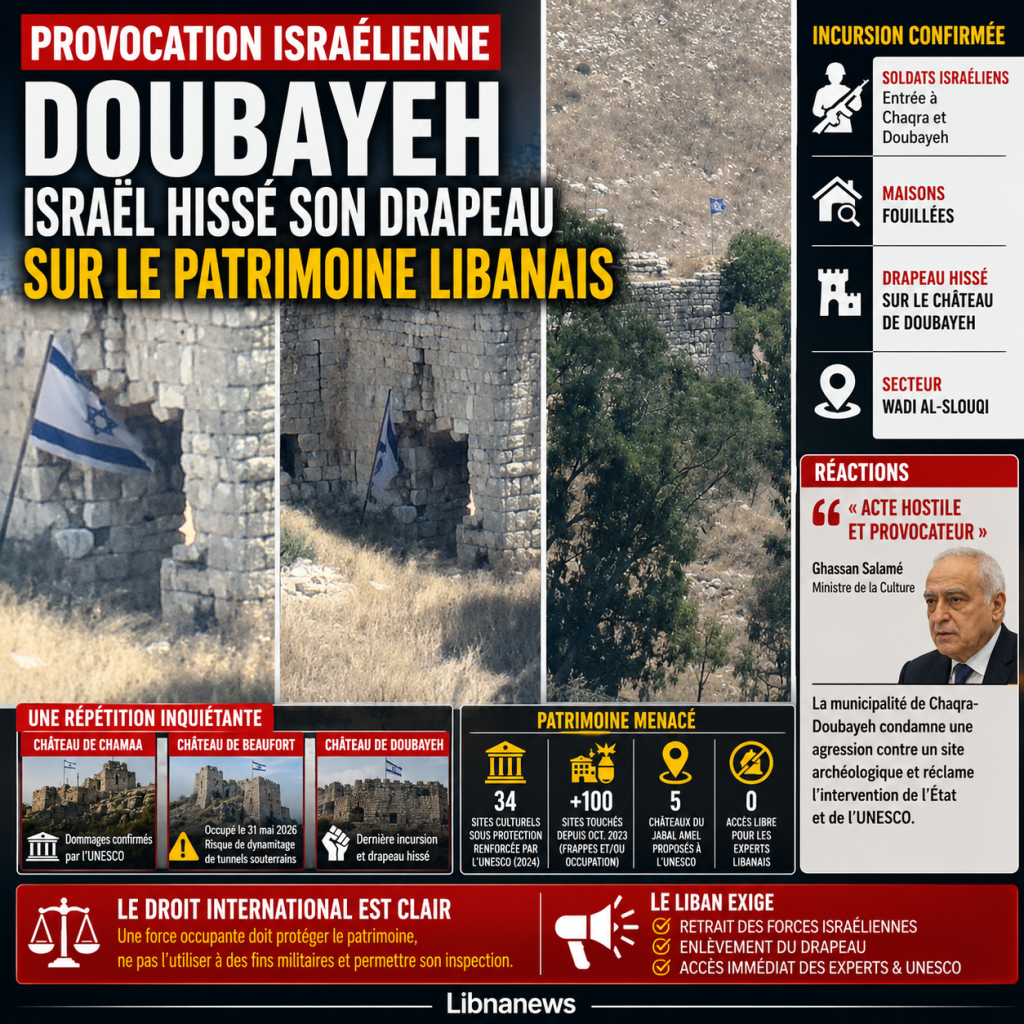
The Israeli flag raised on Dubayeh Castle in Bint Jbeil Caza constitutes a further violation of Lebanese sovereignty and an assumed attack on a historical monument in South Lebanon. The incursion was confirmed by the National Information Agency. Israeli soldiers advanced in the vicinity of Shaqra, reached the area of the castle and Wadi al-Slouqi, searched houses and then installed their flag on the fortress. The Lebanese Minister of Culture, Ghassan Salamé, denounced a « hostile and provocative » act. The municipality of Chaqra-Doubayeh also condemned an attack on an archaeological site belonging to the national heritage. The gesture comes after similar acts on the castles of Chamaa and Beaufort. This repetition gives the case a dimension that goes beyond visual provocation: the Israeli army uses Lebanese monuments as instruments of military domination and political communication.
An Israeli incursion into the heart of Dubayeh
Israeli forces have not confined themselves to observing the castle from an external position. According to information reported by the Lebanese official agency, they carried out an incursion to Dubayeh, on the outskirts of Chaqra, before reaching the outskirts of the historic fortress and Wadi al-Slouqi. Soldiers also searched houses in the area. These elements place the flag in its real context. It is not an emblem seen remotely or an image whose origin would remain uncertain. It was installed following a ground operation on Lebanese territory. No Lebanese authority authorized this entry. No change in the status of the castle was negotiated. Israel therefore entered into Lebanese cultural property, occupied at least temporarily and used it to display its military presence.
Dubayeh Castle, also known as Chaqra Castle or Dubieh Castle in international documents, occupies a corridor of Jabal Amel. This position explains his interest in an army that seeks to monitor roads, valleys and surrounding localities. However, it does not transform the monument into a freely usable objective. Israel’s modern intelligence capabilities, drones and surveillance equipment make it even less defensible that an old castle should be flagged to meet operational needs. The emblem does not improve the protection of soldiers or field observation. Its function is symbolic. It is used to produce an image of conquest and to present a temporary incursion as a takeover, in disregard of Lebanon’s sovereignty and the historic value of the site.
Ghassan Salamé denounces a « hostile act »
The Minister of Culture, Ghassan Salamé, put the incident back in a series of Israeli provocations against the fortresses of the South Lebanon. He stated that the flag raised on Doubayeh, after those installed on Chamaa and Beaufort, was a hostile and provocative act that deserved condemnation and rejection. The Minister recalled that the Jabal Amel castles were an inseparable part of Lebanon and that the State would spare no effort to restore its sovereignty over these sites and to have it recognized. This position is important. She refuses to reduce the case to a simple episode of military communication. It claims that the occupation of a monument and the installation of the flag of a foreign army constitute a political, territorial and cultural attack. Heritage here becomes one of the visible areas of the struggle for sovereignty.
The municipality of Shaqra-Dubayeh also condemned the Israeli act. It described it as a flagrant aggression against Lebanese sovereignty and a violation of protection due to an archaeological and historical site. Local authorities called on the State, the Ministry of Culture and Unesco to intervene. This reaction reflects the concerns of the inhabitants, for whom the castle is not a detached vestige of local life. It belongs to the landscape, to the memory of families and to the history of the region. The Israeli incursion therefore directly affects a community already exposed to bombing, displacement and destruction. It adds to the military threat an attempt at symbolic appropriation. For the inhabitants, seeing the Israeli flag on this fortress means that their heritage remains inaccessible and subject to the decisions of an occupying army.
A confirmed attack, not a mere worry
The absence of technical expertise should not lead to the incident being presented to the conditional. The flag was raised and the incursion was confirmed. The question still open concerns the extent of material damage. Lebanese services have not yet been able to inspect freely the walls, vaults, floors or approaches. They do not know whether soldiers moved stones, installed equipment, created anchor points or modified accesses. This uncertainty must reinforce the demand for inspection, not weaken the conviction. The violation of sovereignty and the use of the monument as military support are already established. A foreign force does not need to destroy a wall to harm cultural property. The occupation, the denial of access and the transformation of a castle into a war trophy are in themselves serious acts.
An inspection will determine whether military movements have aggravated cracks, weakened masonry or damaged archaeological approaches. The ancient fortresses do not support vibrations, vehicle circulation, metal installations and repeated movements on fragile structures. The damage can remain discreet. A displaced stone, enlarged opening or extended crack may compromise part of the monument without causing immediate collapse. Moisture and temperature variations can then accelerate degradation. Lebanon must therefore collect previous photographs, available surveys and recent satellite images. A comparison will distinguish the old damage from the damage that occurred during the Israeli occupation. Without this documentation, Israel would retain control of the site and the account of its condition.
Dubayeh Castle belongs to Lebanon
The installation of the Israeli flag has no effect on the legal status of the castle. Doubayeh remains a Lebanese monument, located on Lebanese territory and protected by national antiquities legislation. The gesture does not create any territorial rights. It only shows that a foreign army has, at this moment, the material ability to access the site and impose its symbol. This distinction is essential. Israel may temporarily control a height, but it cannot alter the historical identity or national belonging of the monument. Ghassan Salamé’s statement responds precisely to this staging. Recalling that the Jabal Amel fortresses are an integral part of Lebanon, the minister opposes law and history to the image of domination produced by the Israeli army.
Doubayeh belongs to a set of five Jabal Amel castles proposed by Lebanon for recognition by Unesco: Beaufort, Tebnine, Deir Kifa, Chamaa and Doubayeh. These fortresses bear witness to centuries of history of the Levant. They bear traces of successive powers, architectural transformations and regional conflicts. Their value is not only based on the preserved walls. It includes their settlement, their relationship with villages, old roads, agricultural land and landscape. A military occupation may therefore affect the entire site, even when the main structure remains standing. Patrols, excavations, the opening of roads or the installation of equipment may alter the approaches and destroy elements that have not yet been studied by archaeologists.
After Chamaa, the same gesture in Doubayeh
The Minister of Culture has explicitly linked Doubayeh to Chamaa Castle. This rapprochement is essential to understand Israeli policy towards the southern fortresses. Chamaa has already suffered damage during military operations. Unesco has confirmed attacks on the citadel and expressed concern about the degradation of the site. The Israeli flag installed on this castle then added a political provocation to the material damage. With Doubayeh, the same scenario is repeated: a military force enters a Lebanese monument, integrates it into its device and uses its visibility to display its domination. Repetition weakens the argument of individual incidents or isolated actions by a few soldiers. Three castles have now been associated with the same practice.
This succession suggests that historical fortresses are chosen for their symbolic value as well as for their location. They dominate landscapes, are visible from afar and occupy an important place in the memory of the South Lebanon. A flag raised to an ordinary military position would not have the same range. On a castle, it produces an image immediately recognizable and can be used in Israeli communication as a sign of conquest. The army thus transforms the heritage of the occupied population into a setting for its own propaganda. This method cannot be justified by the alleged presence of combatants or infrastructure in the region. Even when a military objective exists, the staging of a monument as a trophy responds to a political choice, not a need for security.
Beaufort, the most worrying precedent
The most worrying precedent is the capture of Beaufort, or Qalaa al-Shaqif. On 31 May 2026, Israeli forces took control of the fortress and raised the Israeli flag and that of the Golani Brigade. This occupation revived the memory of the Israeli presence on the site between 1982 and 2000. Beaufort represents, for many Lebanese, a symbol of the years of occupation and Israeli withdrawal from the South. The Israeli army chose to exploit this memory. The images of soldiers advancing in the fortress were disseminated as evidence of military success, even though several specialists pointed out that the modern strategic value of the castle remained limited to the current means of surveillance and strike.
The case did not stop at the flag. Israel then claimed to have discovered an underground network attributed to Hezbollah at Beaufort Ridge. His forces presented these galleries as areas of command, storage and military support. Israeli media reported on the preparation of a blast. The Lebanese Ministry of Culture challenged the existence of tunnels directly under historical structures, while no independent team could verify their location. Israel controls galleries, information and access to the sector. This situation allows him to define the threat alone and to choose the method of destruction alone. It deprives Lebanon of any immediate opportunity to assess the risks to a monument belonging to it.
The risk of blasting in Beaufort remains
Dynamiting in the Beaufort Ridge could cause irreversible consequences. The power of vibration depends on the amount of explosives, their depth, their distribution and the nature of the rock. An explosion can cause fractures, collapses, or ground compaction. Old walls, vaults and foundations can undergo minimal but lasting displacements. Damage is not always visible at the time of the operation. An internal crack can allow water to penetrate, and then gradually expand. A structure already weakened by the 1982 conflicts, the Israeli occupation, the 2000 withdrawal and subsequent wars could lose some of its stability. Without sensors, initial survey and independent expertise, the consequences will remain difficult to measure and attribute.
Israel has not publicly demonstrated that general blasting is the only way to neutralize tunnels. Controlled galleries can be emptied, closed, filled or processed in sections. Some portions may be neutralized with limited loads, while sectors close to foundations may be subject to less destructive methods. Three-dimensional mapping should precede any decision. The Israeli army has not published such a study or allowed Lebanese or international specialists to verify its findings. The concerns surrounding Beaufort therefore remain complete. They explain why the occupation of Doubayeh provokes an immediate reaction: in Beaufort, the flag was not a gesture without tomorrow. It preceded the announcement of operations likely to affect the monument and the mountain carrying it on a lasting basis.
Doubayeh should not know the same scenario
There is currently no evidence that Israel is preparing a blast at Dubayeh Castle. It would therefore be incorrect to present such an operation as announced or imminent. The Beaufort precedent, however, requires close monitoring. The Lebanese authorities must ask whether the soldiers inspected cavities, searched structures, installed means of communication or sought military infrastructure. They must also require that no explosive charge be placed in or around the monument without international expertise. Recent experience shows that Israeli revelations about tunnels can occur after several days or weeks of military control. Waiting for an official announcement before claiming access to the site would waste valuable time.
The priority therefore is to prevent the opacity that characterizes Beaufort from reproducing in Doubayeh. Israel must not be able to occupy the castle, control the information and then announce the state of the monument alone. A mission of the Directorate-General for Antiquities, accompanied by independent specialists, must be allowed to enter as soon as possible. It will have to check the walls, floors, openings, basements and surroundings. It will also be responsible for tracking traffic and determining whether the reported excavations have affected archaeological areas. The protection of the castle cannot depend solely on the declarations of the army which occupied it. A credible assessment requires Lebanese access and, if necessary, a presence of Unesco or organizations specialized in heritage during times of conflict.
A series of damage to heritage since 2023
Doubayeh added to a long series of attacks on Lebanese heritage since October 2023. Israeli strikes hit the old souk of Nabatiyah and destroyed buildings associated with the city’s commercial history. Ancient villages in the South have suffered massive destruction, with the disappearance of stone houses, places of worship, cemeteries and traditional neighbourhoods. The village of Mhaibib was largely destroyed during explosions carried out by the Israeli army, with consequences on its historical fabric and on a sanctuary linked to local memory. In Tyre, the bombings reached neighbourhoods close to the archaeological areas. In Baalbeck, the environmental strikes of the ancient site raised fears about vibrations and damage to the surrounding historical fabric.
Unesco placed 34 Lebanese cultural property under temporary enhanced protection in November 2024. This list includes Doubayeh, Beaufort and Chamaa. However, international status did not prevent Israeli operations, damage or occupation of sites. It provides a legal and diplomatic framework, but it does not replace material protection. The present forces remain bound to respect the monuments and avoid their military use. The increase in attacks shows that general calls for caution are no longer sufficient. Lebanon must make accurate records for each site, with images, records, testimonies and chronology. Such documentation may be used for claims for reparation and investigations into violations of the law applicable to cultural property.
Israeli strategy to erase Lebanon
Ghassan Salamé has already accused Israel of extensive damage to the heritage of the South Lebanon. According to the Lebanese authorities, the destruction involves major monuments but also villages, markets, religious places and cultural landscapes. The Minister believes that these attacks threaten the historical identity of the affected areas. The flag on Doubayeh reinforces this accusation, as it does not result from indirect impact or mistargeting. It was installed voluntarily. The soldiers chose a Lebanese monument and marked it with the emblem of their state. This action does not necessarily destroy stones, but it seeks to modify the image and the meaning of the place. It transforms an element of Lebanese memory into a temporary symbol of Israeli power.
The intentional dimension distinguishes this act from certain collateral damage invoked during the bombings. No military precision argument can explain the need to raise the flag. It is a conscious decision, intended to be seen and photographed. The Lebanese response must therefore remain firm. Israel can claim to be Hezbollah or secure a height, but these goals do not justify the transformation of a monument into a trophy. Respect for the heritage also requires respect for its identity and belonging. Using Doubayeh, Chamaa and Beaufort in the same way, the Israeli army sends a message that goes beyond local operations. It asserts its ability to enter the Jabal Amel and place its symbols on the most visible landmarks in this region.
International law imposes obligations on Israel
The 1954 Hague Convention protects cultural property during armed conflict. It calls on the parties to avoid their destruction and use for purposes that increase the risk. The second protocol reinforces these obligations. An army that controls a monument must not only refrain from bombing it. It must also prevent looting, limit degradation, protect structures and enable necessary conservation measures. In Doubayeh, Israel must therefore be held accountable for the state of the site for the duration of its presence. It shall specify the operations carried out, remove its symbols and facilitate an inspection. The Lebanese character of the monument does not disappear because Israeli soldiers temporarily control its access.
Military necessity cannot be invoked without limits. It must be imperative, precise and proportionate. The flag does not meet any of these conditions. It is not a means of neutralizing a threat and does not protect populations. It is used to display domination. The occupation of the castle can also increase the risk that it will be involved in new operations. If Israel installs equipment or uses it as a post, the monument can become an active part of the military device. This transformation is precisely what protection rules seek to prevent. The Lebanese authorities must therefore request not only the removal of the flag, but the end of any operational use of the site and the handing over of the castle to the competent institutions.
A conviction that must produce acts
The Minister’s and municipality’s response is a first step. It must now be translated into precise steps. The Ministry of Culture may transmit an urgent file to Unesco, request a mission and request the inclusion of the incident in international reports on damage to Lebanese heritage. The government must also integrate Doubayeh, Chamaa and Beaufort into negotiations on the Israeli withdrawal. These fortresses cannot remain outside the mechanisms discussed for the South Lebanon. Their restitution must be seen as a component of sovereignty, as must the return of the army to villages and the reopening of roads. Leaving the castles under Israeli control would extend the capacity to monitor the occupation and maintain symbols of domination over the population.
Lebanon must also centralize information. The General Directorate of Antiquities can gather the plans, photographs and archives of Doubayeh. Municipalities can collect testimony about incursion and excavations. International partners can provide satellite imagery. This work must begin before physical access to the site is made to prevent the disappearance of evidence. Once entry is allowed, experts will have to publish an independent and detailed report. The aim will be not only to identify damage, but also to define urgent measures for consolidation. The same system should apply to Beaufort, where the risk of blasting remains, and Chamaa, where damage has already been confirmed. A coordinated response would allow the three castles to be treated as elements of the same heritage and territorial crisis.
Access to the castle becomes immediate emergency
Several questions remain unanswered. Do Israeli forces still occupy Dubayeh Castle? Is the flag still installed? Did the soldiers place cameras, antennas or other equipment? Were the houses searched damaged? Were objects or architectural elements moved? No detailed Israeli statement was issued on these points. This lack of transparency reinforces the need for a mission. The fact confirmed can no longer be disputed: the soldiers reached the castle and raised their flag there. The material balance sheet remains to be drawn up. It will depend on the ability of the Lebanese authorities to resume the site and inspect it.
The next step should therefore not be a new general statement. It should cover the withdrawal of soldiers, the removal of the flag and the entry of a team from the General Directorate of Antiquities. An international presence could guarantee access and preservation of evidence. The case of Beaufort shows what happens when the Israeli army retains control of a monument alone: information on tunnels, explosives and risks remain unilateral. Doubayeh must not have the same opacity. The castle belongs to Lebanon, and its condition must be assessed by Lebanese institutions. The next development expected now concerns the Unesco response, the restoration of the site and the first official observation of the activities of the Israeli forces in the historic compound.




