





A vital company under surveillance
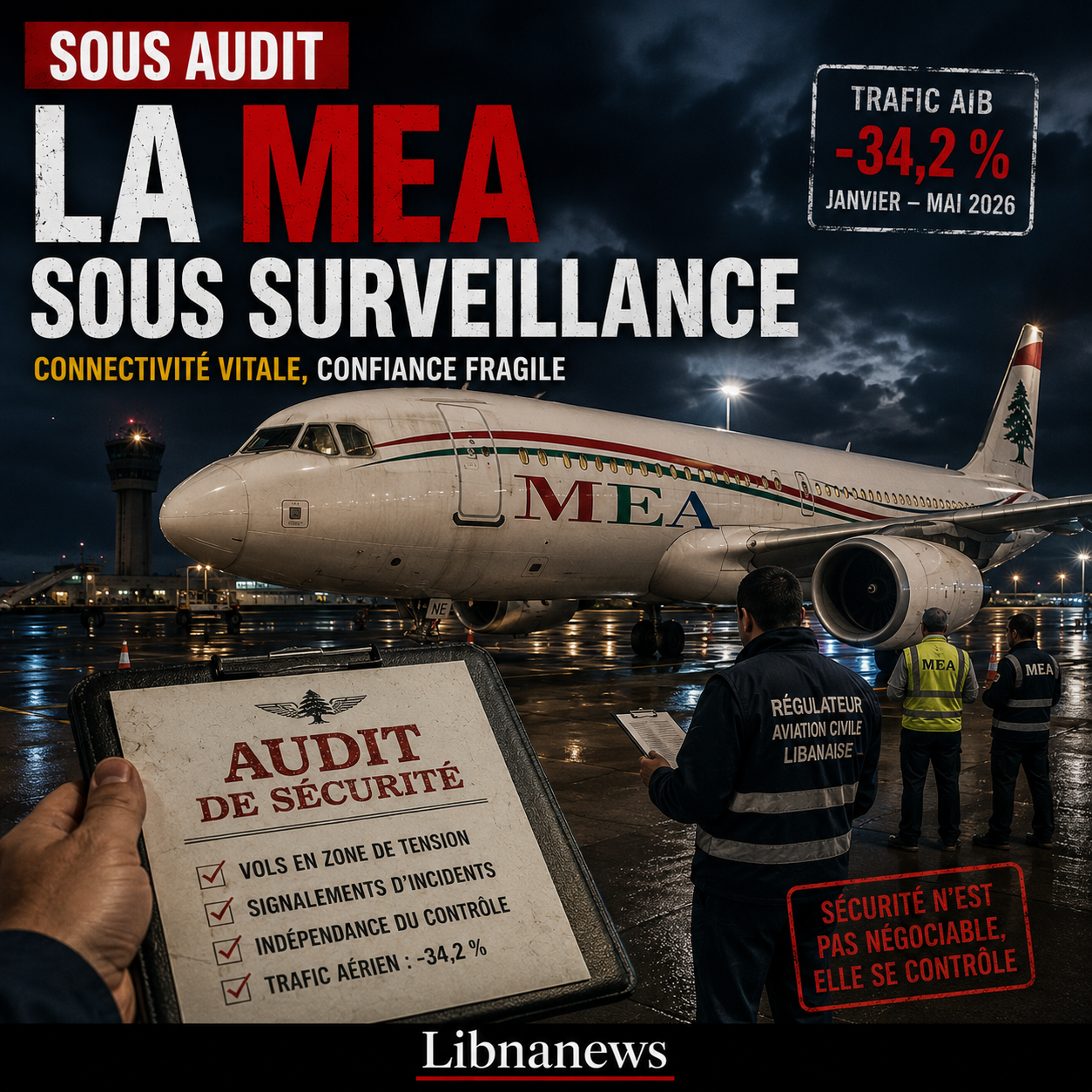
The Lebanese civil aviation regulator has launched a security audit of MEA at a time when the national company is carrying out a mission far beyond its commercial role. While many international carriers are reducing their operations or avoiding parts of regional airspace, Middle East Airlines continues to maintain Lebanon’s external connectivity. This continuity remains vital for travellers, the diaspora, businesses and the economy. It also places the company, its regulator and the entire air ecosystem under exceptional pressure.
The audit follows concerns expressed by international pilot associations. Issues raised include operations during periods of increased military activity, flights near conflict areas, incident reporting practices, and possible pressure on crews reporting security concerns. MEA rejects these accusations. It states that its operations are based on coordinated risk assessments with authorities, and that recent controls have confirmed compliance with regulatory and operational requirements.
The file should therefore be treated with caution. This is not a finding of misconduct against the MEA. This is an ongoing audit, triggered by professional concerns in a war environment. But this nuance does not reduce the importance of the subject. On the contrary, it reinforces it. In a country whose main airport experienced a 34.2% decline in traffic over the first five months of 2026, air confidence became a major economic issue. The security, transparency and independence of control are no longer technical details. They condition Lebanon’s ability to remain connected to the world.
MEA, the last pillar of connectivity
The situation of the MEA is special. The national company plays a role of continuity when other actors withdraw. This function is valuable. It allows expatriates to return, families to travel, businesses to maintain ties, students to travel and the country to preserve some of its foreign currency inflows. But this centrality also creates dependency. When only one company has an essential part of national connectivity, each question about its procedures takes on a collective reach. A crisis of confidence around the MEA would not only affect an operator. It would affect Beirut airport, tourism, the diaspora and the country’s image.
Traffic data measure this vulnerability. Rafic Hariri International Airport welcomed 1,585,526 passengers between January and May 2026, compared with 2,409,618 a year earlier. Arrivals fell by 40.2%, departures by 27.7%, aircraft movements by 26.1% and cargo by 24.4%. In May alone, total traffic fell to 338,772 passengers, compared to 560,713 in May 2025. Landings and take-offs increased from 4,607 to 3,031. These figures show that the decline is not only demand-driven. The air supply itself has contracted.
| Indicator | Level or variation |
|---|---|
| Passengers at AIB, January-May 2026 | 1 585 526 |
| Passengers at AIB, January-May 2025 | 2,409,618 |
| Total decrease in passenger traffic | -34,2 % |
| Arrivals | -40,2 % |
| Departures | -27.7 % |
| Aircraft movements | -26,1 % |
| Air freight | -24.4% |
| Passengers in May 2026 | 338 772 |
| Passengers in May 2025 | 560 713 |
In this context, the MEA is at the centre of a contradiction. Lebanon needs the company to fly. But he also needs these flights to be surrounded by irreproachable confidence. A company can maintain rotations in difficult conditions if crews, passengers, insurers and international partners know that decisions are based on clear procedures. The challenge is not to give in to panic. It is demonstrated that the continuity of flights is not to the detriment of the safety culture.
Risk reporting at the heart of the file
The concerns of the pilots are precisely within this culture. In aviation, reporting an incident or risk must never be seen as an administrative inconvenience or an act of insubordination. It is one of the foundations of modern security. Crews must be able to report an anomaly, anxiety or pressure without fear of sanctions. The strongest companies are those that treat these reports as a source of improvement. In an unstable military environment, this rule becomes even more important.
The first point of vigilance concerns flights close to conflict zones. The region is experiencing episodes of alerts, strikes, partial closures, road changes and tensions between armed actors. Decisions to steal, delay, steal or cancel must be based on an ongoing risk assessment. This assessment involves the company, civil aviation authority, controllers, security services, insurers and available airspace information. The faster the risk evolves, the stronger the documentation and the stronger the decision chain.
The second point concerns economic pressure. A national company in times of crisis can be tempted to maintain the maximum number of flights to preserve revenue, the image of the country and continuity of service. This temptation is understandable. It can even meet a real national need. But it must never weaken the power of the captain, nor should it reduce the ability of crews to refuse a situation deemed dangerous. Aviation safety is based on this hierarchy: profitability and continuity follow the operational risk assessment.
Independence of the regulator in question
The third point concerns the independence of the regulator. The report also mentions governance concerns related to the financial support provided by the MEA to parts of the aviation ecosystem during the financial crisis. The company states that this support was coordinated with the authorities to maintain operations and that it did not compromise regulatory independence. This response will need to be considered in the context of the audit. The subject is sensitive, because a regulator must control the operator without depending on it, directly or indirectly. When financial boundaries become blurred, institutional confidence can weaken.
Lebanon knows this problem too well. The financial crisis has often blurred the roles of public authorities, banks, public or semi-public enterprises and private actors. Institutions without sufficient budget have relied on survival arrangements. These arrangements have sometimes maintained essential services. They also created addictions. In aviation, this risk must be addressed with a particular requirement. The regulator cannot appear as an actor supported by the one to be monitored. Even if the operations are consistent, the appearance of dependency may be sufficient to undermine credibility.
The audit must therefore answer two separate questions. The first concerns operations: has the MEA applied sufficient risk assessments during periods of increased military activity? Were crews able to report incidents or concerns without pressure? Have the flight decisions been documented? Have the authorities exercised effective control? The second concerns governance: did financial support mechanisms for the air sector during the crisis create conflicts of interest or dependencies between the operator and its regulator?
Defend MEA without weakening control
These questions should not be confused with an attack on the company. MEA remains a strategic asset of the country. Its continued operation has allowed Lebanon to avoid deeper isolation. Many countries in crisis are rapidly losing air connectivity. Lebanon was largely preserved by its national company and crews. This reality must be recognized. But recognizing the vital role of MEA must not lead to reduced control. The more strategic a company is, the more demanding it must accept supervision.
Transparency will be crucial. An audit that remains entirely internal or concludes with a general formula will not be sufficient to restore confidence. The authorities must publish, within the limits of security and operational secrecy, the main conclusions of the control. They must state whether procedures need to be improved, whether reporting rules need to be strengthened, whether additional guarantees are needed for crews and whether financial governance mechanisms need to be clarified. Public opinion does not need to know sensitive details. She needs to know that the control is real.
Pilots are at the heart of this architecture. Their confidence depends on that of the passengers. A company can have good planes, good technicians and a lot of experience, but if crews doubt their freedom to report a risk, the safety culture weakens. Professional associations, even when they raise concerns challenged by management, play a useful role. They require operators and regulators to document their responses. They prevent tensions from being stifled by hierarchy or economic urgency.
Passengers look at the visible result. They want to know whether their flights are maintained, whether routes are safe, whether cancellations are managed and whether the authorities are telling the truth. In a country accustomed to crises, confidence is not rebuilt by reassuring statements. It is rebuilt by understandable procedures and credible institutions. Air travel is based on this silent promise: every operational decision has been made by professionals on the basis of safety criteria, not political or financial pressures.
A governance test for Lebanese aviation
The audit also takes place as Beirut airport loses passengers. This decline makes the situation more tense. Less traffic means less revenue for airport players, less margins for companies and more pressure to preserve existing routes. The temptation may be strong to present any criticism as a threat to national connectivity. That would be a mistake. Serious criticism can enhance connectivity, as it proves to international partners that the Lebanese system is being corrected.
The authorities must avoid two traps. The first would be to minimize the audit in the name of economic patriotism. The MEA is Lebanese, so it should be fully defended. This reasoning weakens the company because it replaces the evidence with loyalty. The second trap would increase suspicions to the point of unnecessarily weakening an essential operator. The right balance is to recognize the role of the MEA, address concerns, publish conclusions and correct any gaps. That’s how mature aviation works.
The current crisis can also open up a broader reform of air governance. Lebanon must consider how to finance its regulator sustainably, how to protect its independence, how to guarantee continuous training, how to structure relations between the airport, MEA, service providers and the state. War makes these issues urgent, but they already existed. A fragile system can usually work in normal times. It is tested when missiles, insurance, cancellations and economic pressures accumulate.
Comparison with other Lebanese sectors is instructive. When the rules are blurred, crises favour arrangements. When controls are weak, institutions become dependent on the actors they need to monitor. When public budgets are lacking, exceptional funding fills gaps without always respecting governance principles. Aviation cannot follow this path. It requires international standards, traceable responsibilities and a clear separation between the operator, the regulator and political powers.
The value of the MEA therefore also depends on the audit. A company that accepts independent control can emerge strengthened. It can demonstrate that its risk assessments are robust, that its crews are protected, that its procedures are consistent and that the charges are unfounded. If the audit identifies weaknesses, their rapid correction can also build confidence. The real danger would be opacity, as it would leave pilot associations, passengers, insurers and partner companies in doubt.
Lebanon cannot afford that doubt. Its air traffic declines, its tourism suffers, its foreign exchange needs increase and its reconstruction will require permanent links with the outside world. The MEA remains one of the few institutions able to maintain this link in times of crisis. This position imposes increased responsibilities on both the company and the regulator. The security audit is therefore not a technical episode. It is a governance test in an area where confidence is quickly lost and slowly rebuilt.
The follow-up will depend on the findings of the monitoring and how they will be made public. If the audit confirms the conformity of the operations, the authorities will have to explain it clearly and respond to the concerns of the pilots. If it recommends corrections, they should be implemented without delay. In both cases, the message must be the same: Lebanon’s connectivity is vital, but it can only be sustainable if the security, transparency and independence of control remain above political, financial or symbolic imperatives.