

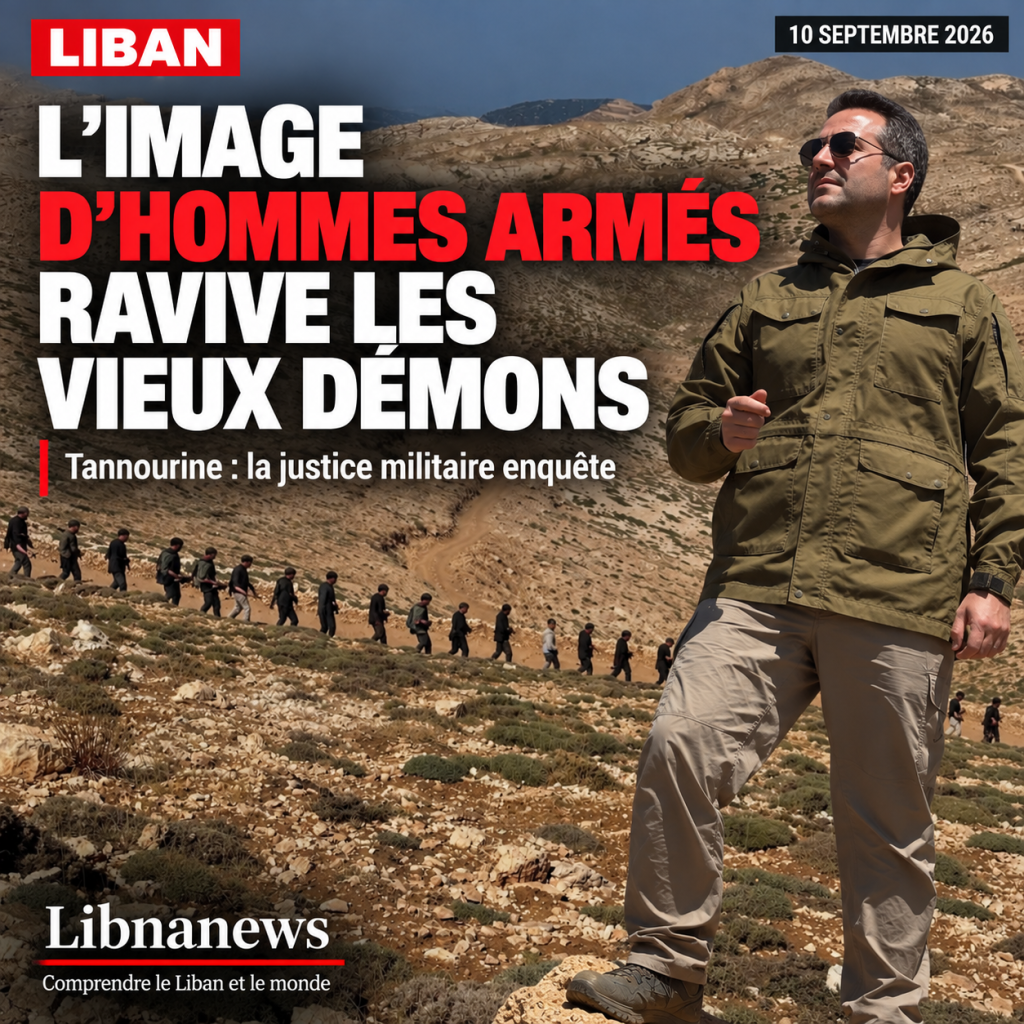
Men marching in line, some armed, others with their faces hidden, around deputy Kataëb Nadim Gemayel: images broadcast from a camp organized at the end of August on the heights of Tannourine quickly exceeded the framework of partisan activity. The military prosecutor ‘ s office took the case and asked the security services to identify participants appearing with weapons in order to verify the legality of their port. In a Lebanon where the arms monopoly is at the heart of a major political confrontation and where the memory of the civil war remains attached to militias and armed demonstrations, the sequence is far beyond the issue of weapons permits.
The judicial investigation will have to establish the facts and possible offences. There is nothing at this stage to describe the gathering as forming a militia or preparing for armed action. But staging is enough to cause malaise: it comes when the state claims to want to restore its monopoly on weapons, the army is called upon to extend its authority throughout the territory and the debate on the disarmament of Hezbollah is deeply polarizing political life.
Gemayel’s name finally gives these images a particular historical resonance. Nadim Gemayel is the son of Bashir Gemayel, leader of the Lebanese Forces during part of the civil war, elected President of the Republic in 1982 and then murdered before taking office. The camp where the images were taken bears his name. In a country where photographs of armed men marching behind politicians belong to the visual memory of the years 1975-1990, the parallel was imposed almost immediately in the public debate.
Military justice wants to identify armed men
The case originated in photographs and videos published in early September. They show Nadim Gemayel at the « Campaign Bachir Gemayel », organized in Tannourine Jurd, in Batrun District. Some 30 men appear in some images. Many carry weapons and some have their faces covered.
The rally was held on 29 and 30 August. Nadim Gemayel has been organizing this camp every summer for several years in memory of his father. The images then circulated widely on social networks, where they caused political controversy.
The file has now left the social media field.
The government commissioner to the military court, Judge Claude Ghanem, sent a rogatory commission to the intelligence branch of the Internal Security Forces and to the Lebanese Armed Forces intelligence services. He asked them to examine the images and establish the full identity of the persons who appeared armed there.
The military prosecutor ‘ s office must then summon the persons concerned to determine, inter alia, whether the weapons were legally held and whether their carrying was authorized.
The procedure therefore remains an investigation at this stage. The presence of a weapon on a photograph alone does not make it possible to conclude an offence. Lebanese law provides for authorisation regimes and investigators must specifically verify the situation of each person concerned.
Nor does the justice system seem to have qualified the gathering as military training or militia activity. Such a qualification cannot therefore be regarded as an established fact.
However, this legal prudence does not erase the political question posed by the images.
A parade that falls at the worst political moment
In another context, the sequence might have been treated as a local polemic around a partisan camp. In September 2026, it took on a national dimension.
Lebanon has been going through one of the most sensitive debates on weapons since the end of the civil war. The government defends the principle that the decision on war and peace must belong exclusively to the state. The United States is stepping up its pressure for the disarmament of Hezbollah. The Lebanese army is presented as the only legitimate military institution to exercise its authority over the entire territory.
The Kataëb are precisely among the formations that have long defended this line.
The party opposes Hezbollah’s weapons outside state control and demands a monopoly of armed force by public institutions. The images of armed persons surrounding one of his deputies thus create a political contradiction immediately exploitable by his opponents.
Supporters and officials close to Hezbollah have also largely relayed the videos by accusing their opponents of practicing what they denounce when it comes to Shia formation.
Comparison has its limits. Of course, Tannourine’s images do not demonstrate the existence of a military organisation similar to Hezbollah, which has an armed structure, an arsenal and a chain of command that has been established for several decades. Consolidating the two realities would prevent understanding of the problem.
But politically, the episode weakens the discourse that no armed demonstration outside the regular forces should be tolerated.
The principle of a State monopoly on arms can only work on a sustainable basis if it applies without distinction as to community, party or historical justification.
This is precisely why the opening of a judicial inquiry is of particular importance.
The spectre of militias remains deeply rooted in Lebanon
In Lebanon, a column of armed men behind a political leader is never a neutral image.
The civil war, between 1975 and 1990, fragmented the territory between Community and political armed organizations. Dams, uniforms, individual weapons, training camps and demonstrations of force were part of daily life.
The Kataëb occupy a central place in this story.
Founded in 1936 by Pierre Gemayel, the party had an important armed organization during the war. Bachir Gemayel gradually established himself as one of the main figures of the Christian camp and played a decisive role in the unification of the main Christian armed forces under the banner of the Lebanese Forces.
Elected President on 23 August 1982 while the Israeli army occupied part of Lebanon, he was assassinated on 14 September 1982 in the explosion of the Kataëb siege in Ashrafieh, before he was able to take office.
His assassination remains one of the most politically charged events in Lebanese contemporary history.
For his supporters, Bachir Gemayel embodies a strong and sovereign state project. For his opponents, his journey remains inseparable from the civil war, Christian militias and alliance with Israel during part of the conflict.
Forty-four years after his death, his memory continued to divide.
It is in this context that the very name of Camping Bachir Gemayel gives the images an additional symbolic charge. The rally does not take place under a politically neutral name: it explicitly claims the memory of a warlord who became elected president.
To see young men, some armed and masked, evolve in this context is enough to reactivate references that Lebanese society has never completely exceeded.
The Lebanon of 2026 is not, however, that of 1975
However, the parallel with civil war must remain under control.
Lebanon is not in the situation of 1975 today. The Lebanese army remains a structured national institution. Security services are functioning. The political system, despite its crises, did not break out into rival administrations. There is no evidence in this case that the Kataëb are preparing a military organization to replace the State.
The reaction of justice is even a fundamental difference with the first years of war.
A few days after the distribution of the images, the military prosecutor’s office asks the intelligence services to identify the armed men and plans to verify their authorizations. The State therefore intervenes precisely to determine whether the law has been respected.
It would therefore be excessive to present the images as mechanically announcing a return to civil war.
But civil wars do not just remain in institutions. They persist in community memories, symbols and reflexes. In Lebanon, this dimension remains particularly strong because the conflict ended without real national work on memory.
Taef’s agreement ended the fighting. The militias were officially dissolved and their weapons handed over, with the notable exception of Hezbollah, whose arsenal was maintained in the name of resistance to Israeli occupation.
But former warlords have entered or remained in politics. Community stories of the conflict continued to coexist. There is still no common historical reading of the fifteen years of war.
So an image can wake up these fractures very quickly.
The arms monopoly cannot be variable geometry
The case comes especially at a time when the concept of the State monopoly of force becomes one of the main criteria for the political reconstruction of Lebanon.
The debate begins with Hezbollah, because its arsenal is by far the main organised military force beyond state command. The war with Israel has made this issue even more urgent.
But the credibility of the principle depends on its universality.
If the State claims that no party can decide alone to possess or use weapons on behalf of its community, security or history, this rule must also apply to Hezbollah’s opponents.
This is where the investigation of the images surrounding Nadim Gemayel acquires institutional scope.
Justice must not demonstrate political equivalence between different parties. She had to answer a much simpler question: were visible weapons legally held and carried, and did the activities shown on the videos respect the law?
The answer must come from the survey and not from political affiliations.
A rigorous enforcement of the law can even strengthen the position of those calling for the disarmament of Hezbollah. It would argue that the state monopoly is not an instrument directed against a particular community, but a general rule applicable to all.
Conversely, any impression of selective tolerance would immediately feed the argument that the issue of weapons would be used as an instrument in the religious balance of power.
A society already under high security stress
The moment chosen by this controversy adds to the unease.
South Lebanon is experiencing a further escalation of Israeli operations despite the June ceasefire. The strikes of the last few days have resulted in several civilian casualties. Villages are bombed and energized. On Wednesday, the Lebanese army reported about 7,700 Israeli violations since the 26 June agreement.
At the same time, the issue of Hezbollah disarmament deeply divides political formations.
This national tension is compounded by more localized community incidents. On 6 September, the army had to intervene in Sin al-Fil after an altercation involving young people associated with the « Soldiers of God » group and others suspected of being close to Hezbollah on account of their appearance. Military intelligence intervened to prevent the incident from degenerating.
Taken separately, none of these events means that Lebanon is moving towards an internal confrontation.
Taken together, however, they show why any armed demonstration today has a destabilization capacity greater than what it would have in a more calm period.
The country has a war not really over in the South, an economic crisis still deep, a political conflict over Hezbollah’s weapons and community memories that remain very present.
In this environment, policymakers have special responsibility for the symbols they use.
Nadim Gemayel facing political contradiction
Nadim Gemayel did not, in the early days of the controversy, provide a detailed public explanation to clarify the nature of the visible weapons or the activities organized during the camp.
This lack of response leaves room for judicial investigation and political interpretation.
For the MP for Achrafieh, however, the problem goes beyond the criminal issue.
His political position is largely based on the defence of state sovereignty, the opposition to Hezbollah’s weapons and his father’s political legacy. Images combining this memory with armed men expose his speech directly to the double standard accusation.
The question is not whether about 30 participants in a camp have Hezbollah’s military capacity. They obviously don’t.
It concerns the consistency of the principle defended.
While the image of men in arms behind a Hezbollah official is considered incompatible with the state, a similar image around a deputy Kataëb cannot simply be regarded as folkloric on the sole ground that the military scale is different.
The law will determine the legality of weapons. Politics will have to answer for their symbolism.
Justice becomes the arbiter of a much wider debate
The investigation conducted under the authority of the Commissioner of the Government to the military court therefore comes at a particularly sensitive time.
Intelligence services must identify persons appearing armed. Any summons will verify their permits and the specific circumstances in which the images were taken.
These elements will progressively separate the facts from the controversy.
In particular, they will determine whether the case remains that of legally detained weapons exhibited in a politically awkward setting, or whether any offences have been committed.
Distinction is essential.
In the first case, the problem will remain primarily political and symbolic. In the second, justice will have to determine individual responsibilities and possible follow-up.
For the Lebanese State, however, the stakes go beyond Nadim Gemayel.
At a time when the government says it wants to restore the arms monopoly and entrust exclusively to the army the protection of the territory, every case involving partisan weapons becomes a test of coherence.
The next concrete development will therefore come from the security services. They must hand over to the military prosecutor ‘ s office the identities of the men appearing armed on the images and verify the legality of their weapons. The result of these investigations will tell whether the Tannourine episode will remain a polemic charged with the ghosts of the civil war or whether it will lead to prosecution before the military justice.




