

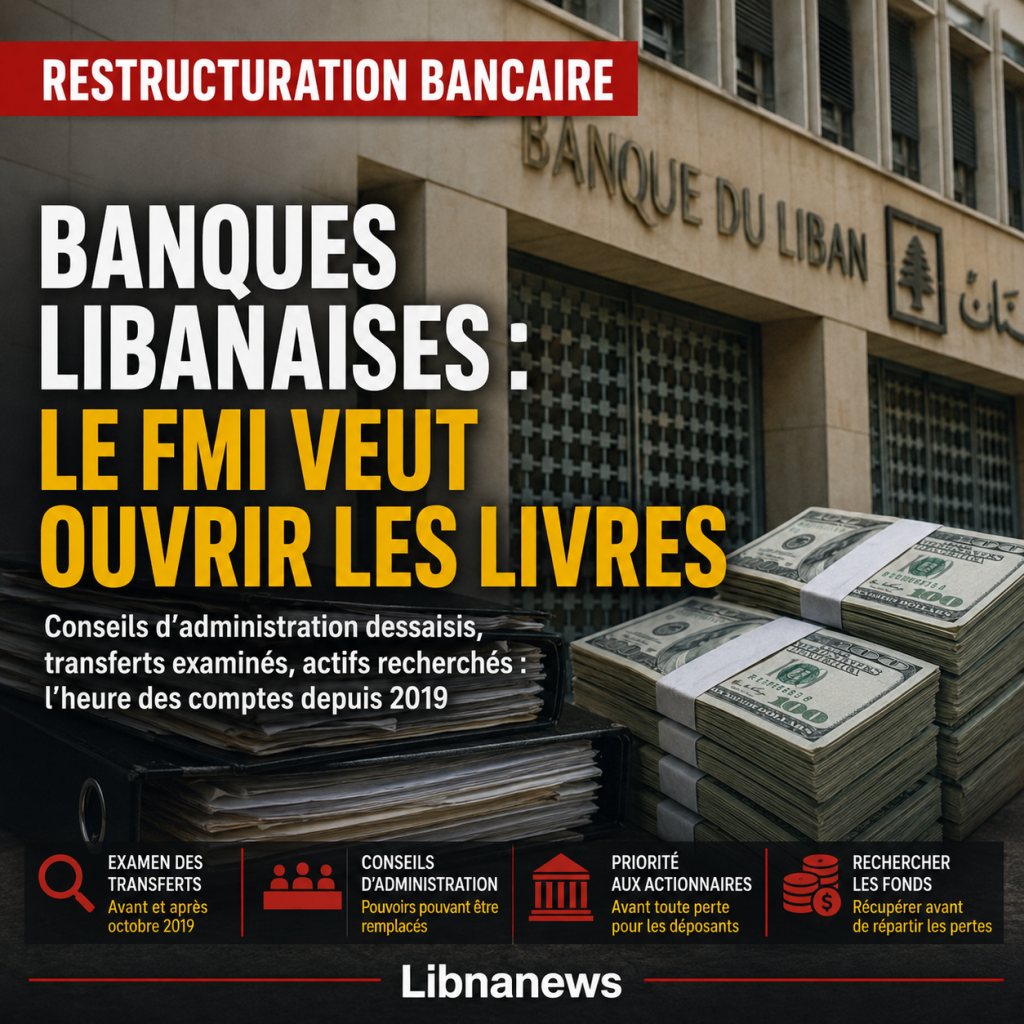
A new stage in Lebanese banking restructuring is being prepared under pressure from the International Monetary Fund. Behind the discussions on the possibility of excluding certain boards of directors is a much more fundamental question: where have the assets corresponding to the tens of billions of dollars of deposits that have been unavailable since 2019 passed? The IMF requires an independent, transparent banking resolution process capable of establishing the real situation of each institution. This mechanism can lead to the divestiture of a bank’s management, the appointment of an independent administrator and the examination of transfers, transactions with related parties and capital movements made before and after the collapse of the system. The challenge is therefore not to place the Lebanese banks under the direction of the IMF, but to prevent those whose management is to be examined from controlling the investigation of losses and assets that could be recovered themselves.
Retrieve money before allocating losses
Since October 2019, the Lebanese debate has focused largely on the amount of losses in the financial system. Estimates varied among governments, the Bank of Lebanon, banks and international institutions. But behind the accounting discussions remains a much more concrete question for depositors: what became of the dollars deposited in banks before the crisis?
A significant part of these funds had been placed by commercial banks with the Bank of Lebanon. The central bank itself had used its resources to finance different needs, defend for years the parity of the pound, cover imports, finance the state and support a model based on the permanent inflow of currencies.
When these entries dried up, the system found itself unable to return simultaneously to the banks the currencies they had placed with the Bank of Lebanon. Banks were no longer able to return deposits to their customers.
This mechanics explains a considerable part of the financial hole. However, it does not answer all the questions.
In particular, it remains to be determined which capital has left banks during the critical period, under what conditions, for the benefit of whom and with what authorizations. It is here that bank restructuring directly joins the issue of board responsibility.
IMF demands independent resolution
The International Monetary Fund explicitly calls upon Lebanon to establish an independent, transparent and effective banking resolution process. By February 2026, the Fund had again requested changes to the framework adopted in 2025 to strengthen this independence and ensure a loss distribution in accordance with international principles.
Parliament finally amended the legislation in August. On 20 August, the IMF described these amendments as a major step in the reform of the banking sector.
This approval does not mean that the file is closed. The Fund is now awaiting the practical implementation of the scheme and the continuation of the reforms necessary to deal with losses.
The independence requested by the IMF is of particular importance here. A bank cannot be evaluated solely on the basis of figures produced by its own managers when the decisions of those same managers may have to be examined.
The resolution authority must be able to access accounts, assess assets and liabilities and decide whether the institution remains viable.
Boards could be divested
The new framework makes it possible to intervene in the governance of a bank in resolution.
A temporary director may be appointed and receive powers normally exercised by the board of directors. Depending on the scope of his mandate, he may take control of the management of the establishment during the proceedings.
This mechanism responds to a simple logic: when a bank’s situation is to be examined independently, its historical managers cannot have an absolute right to control the procedure.
However, divestiture is neither automatic nor general. There is no provision for the simultaneous removal of all Lebanese bank boards.
The intervention must depend on the situation of each institution and the decisions taken in the context of the resolution.
For some banks, the result could be recapitalisation under the existing direction. For others, shareholders could be heavily diluted and governance replaced. In the most serious situations, a director could directly receive the powers of the board.
Why exclude those who currently control banks?
The question goes beyond solvency alone. It concerns access to information and possible conflicts of interest.
The Boards of Directors have or have had privileged access to accounts, credit decisions, shareholder transactions, large transfers and relations with the Bank of Lebanon.
If the objective is to determine precisely what happened before and during the crisis, an independent investigation must be able to examine these operations without dependent on the persons who authorized or supervised them.
This does not mean that bank administrators have committed offences collectively. Such an assertion would require individual evidence and judicial decisions.
On the other hand, their management can legitimately be examined. The distinction is fundamental.
The issue is to identify the normal transactions, those which have received preferential treatment and those which could possibly be considered abusive, fraudulent or recoverable under applicable law.
Transfers after October 2019 at the center of questions
The period opened in autumn 2019 is particularly sensitive.
When banks began to limit clients’ access to their accounts, Lebanon did not yet have a formal capital control law that uniformly organizes restrictions. The institutions imposed different limitations on applicants.
At the same time, the issue of foreign transfers for the benefit of some clients quickly became a political and judicial issue.
The problem is obvious. If an ordinary depositor could no longer freely transfer his money, while a shareholder, director, officer, politically exposed person or privileged customer could still do so, it must be determined on what basis this difference in treatment was decided.
A transfer made during this period is not automatically illegal. The date, beneficiary, origin, contractual obligations of the bank and the law applicable at the time of the transaction must be examined.
But the lack of uniform control of capital does not mean that any transaction was necessarily irreproachable.
This is precisely the type of case that a credible restructuring should allow us to examine.
Related parties are an essential point
Transactions with related parties are another major topic.
A related party may be a significant shareholder, a director, an officer, a corporation belonging to the same group or a person having a particular relationship with the establishment.
In a sound banking system, these transactions must be strictly supervised because they create an obvious risk of conflict of interest. A bank cannot treat its owners as mere customers when they themselves participate in the institution’s decisions.
The review of Lebanese banks must therefore determine whether shareholders or managers have benefited from loans, repayments, transfers, guarantees or other transactions under conditions different from those applied to the rest of the customer.
Again, it is not a matter of presuming an offence. The aim is to search for operations and verify their conformity.
Retrieving funds before making depositors pay
This issue leads directly to one of the main demands of the IMF: the loss hierarchy.
The Fund clearly requested that depositors not bear losses before shareholders and subordinated creditors. Bank owners must therefore absorb the losses corresponding to the capital they invested before a new charge is imposed on savers.
But this hierarchy is not enough.
Before calculating the final loss, it is also necessary to look for assets that could be recovered.
If an operation is recognized by the competent authorities as fraudulent, abusive or legally revocable, recovery of the sums concerned mechanically reduces the remaining hole to be allocated.
This distinction is considerable for applicants. Each billion recovered is potentially a billion that no longer has to be treated as an irreversible loss.
Banks must be examined one by one
The other fundamental change is the abandonment of a uniform vision of the sector.
Not all banks made the same decisions before 2019. Not all of them transferred the same amounts to the Bank of Lebanon, granted the same loans or retained the same amount of liquid assets abroad.
Their exposure to the crisis therefore varies.
A credible resolution requires the actual economic balance of each institution. Asset valuation, measurement of liabilities, identification of doubtful receivables, review of transactions with related parties, and determination of remaining equity.
This work will separate banks that can survive from those that can no longer survive.
A viable bank can be recapitalised. An undercapitalised bank may have to accommodate new shareholders. Some can be merged. Others could be liquidated.
Boards of directors will necessarily be affected by these decisions.
Shareholders risk losing control
For the historical owners of the banks, therefore, the main threat is not that IMF officials will settle in their offices.
It is much more concrete.
If a bank’s valuation demonstrates that its losses have absorbed its own funds, the economic value of existing shares may become very low or zero. Recapitalisation by new investors would dilute the current owners.
The control of the board of directors would follow this evolution of capital.
In other cases, a resolution authority might consider that the continued existence of certain leaders would undermine restructuring or create a conflict of interest. A temporary administrator could then receive their credentials.
This would allow the Lebanese banking sector to experience its most significant change in ownership and leadership in several decades.
A demand for independence that also targets the Bank of Lebanon
The problem does not concern only commercial banks.
The Bank of Lebanon is itself at the heart of the crisis. Commercial banks have entrusted him with a considerable share of the currency deposited by their customers. The central bank is thus simultaneously a regulator, an actor in the crisis and a major debtor in the banking sector.
This creates a delicate institutional conflict.
If a bank holds a massive debt on the BDL, the value assigned to that debt can determine whether it appears solvent or insolvent.
Too high a valuation artificially reduces its losses. On the contrary, a significant discount can remove its own funds.
This is why the IMF insists on the independence and transparency of evaluations.
The forensic audit did not close the file
The judicial audit of the Bank of Lebanon had already identified serious shortcomings in the governance and accounting practices of the central bank.
But looking at the BDL is not enough to reconstruct all the movements of the system.
Commercial banks have their own books, corresponding accounts abroad, credit records and transactions history. To trace the funds, it is therefore necessary to be able to cross sources.
The objective of a real financial investigation would be to follow the course of money: entry into a commercial bank, possible transfer to the BDL, placement abroad, credit granted to a customer or transaction with a related party.
This reconstruction can also show what sums have actually been lost and what amounts still exist in another form.
Bank secrecy can no longer be the same obstacle
The changes made since 2022 to bank secrecy have progressively expanded access to financial information through investigations, audits and legal procedures.
This development is essential for restructuring.
A mechanism to track assets cannot function if information to identify beneficial owners, related accounts and transfers remains legally inaccessible.
The opening of books does not mean the publication of bank accounts of all citizens. It means that the competent authorities must be able to obtain the necessary data when examining a bank or looking for a transaction that may have harmed creditors.
International experts could play a decisive role
It is probably here that some of the current rumours about international control arise.
No text establishes that the IMF will take direct control of the banks. On the other hand, resolution to international standards may require independent evaluators, auditors, resolution specialists and international firms.
Their role can become considerable.
The asset valuation expert helps determine the amount of loss. The person tracing certain transactions can identify recoverable amounts. A person who assesses the viability of an establishment provides some of the elements for deciding whether to survive.
The legal decision remains Lebanese, but international expertise can therefore have a significant impact on its outcome.
Why Boards Are At the Heart of the Problem
The issue of boards of directors finally takes on a different dimension when it is placed in this context.
It is not just about replacing bankers with other managers. It’s about who controls the bank while we look at its past.
A board that retains all its powers controls operational access to archives, teams, computer systems and some internal information. Even when the law requires their transmission, this situation can create a conflict of interest if the decisions of the same board are examined.
The appointment of an independent director can break this link.
It may ensure that the interests of the resolution procedure and of creditors take precedence over those of historical shareholders on a temporary basis.
IMF does not ask to charge depositors first
This dimension should be recalled, while restructuring is often presented in Lebanon as an operation to formalize the loss of deposits.
The position published by the IMF is different. The Fund requires compliance with the hierarchy of claims and requests that shareholders and subordinated creditors absorb losses before depositors.
This does not mean that all deposits will be fully repaid. The magnitude of the financial hole makes this assumption difficult without asset recovery, public contribution or extended repayment mechanism.
But this means that the calculation should not begin by determining how much to take from applicants.
It should begin by determining the real value of banks, capital losses and assets still recoverable.
Seven years after 2019, account time
This is ultimately the political scope of the reform.
Since 2019, depositors have been subject to restrictions, haircuts, multiple exchange rates and the inability to freely use much of their savings. Meanwhile, the banking system has never been thoroughly restructured.
The same questions have therefore come back for almost seven years: how much was actually lost, who benefited from transfers during the crisis, which shareholders must absorb the losses and what amounts can still be recovered?
Finally, the new resolution framework and IMF requirements may require the system to respond bank-by-bank.
The current scenario of international guardianship simplifies this reality. The IMF does not have the power to take direct control of Lebanese banks. But it requires an independent process powerful enough to prevent an unsustainable bank and its owners from controlling their own restructuring.
The consequence could be spectacular. Temporary administrators could be given the authority to board. Shareholders could be diluted or lose their capital. Transactions with related parties could be reviewed. Transfers could be subject to recovery procedures where a legal basis permits.
The next battle will therefore not only focus on the size of the financial hole. It will address access to bank books and the ability of the authorities to trace the financial flows of the crisis. Only after this work will it be possible to establish what has actually disappeared, which corresponds to a claim on the Bank of Lebanon and, above all, what can still be found and recovered for the benefit of the depositors.




