

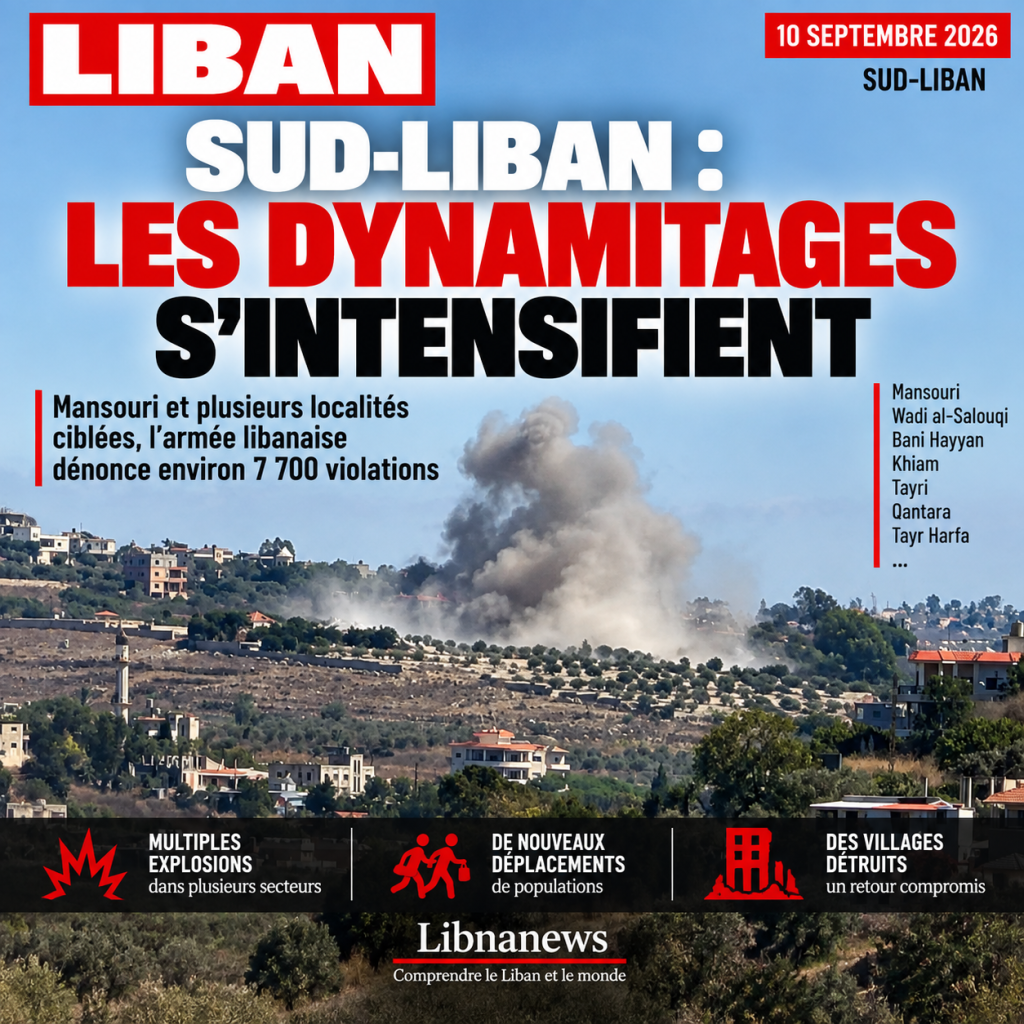
In South Lebanon, the night of Wednesday 9 to Thursday 10 September did not mark a respite. After a day already dominated by blasts and strikes, Israeli operations continued until the early hours of the morning, including around Ali al-Taher Ridge in the Nabatiyah area, Mansuri, Beit al-Sayyad, Qantara and Wadi al-Saluki. At 1446 hours, Beirut time, no lasting return to calm could be observed. Above all, the sequence confirms an evolution now visible on the ground: beyond air raids, the destruction of buildings and blastings become a recurring method in several southern localities, complicating the return of the inhabitants and the deployment of the Lebanese army.
The night extended Wednesday’s operations. Air strikes have been reported in Tyre District, including Mansuri and Beit al-Sayyad, as well as in Nabatiyah Governorate, where Ali al-Taher Ridge has been repeatedly targeted. Qantara was also hit, while Israeli artillery continued to fire in areas close to Ali al-Taher. At 0052 hours artillery fire was reported on Halta. Shortly after 1 hour, further blasting was reported in Wadi al-Saluqi.
Mansouri, symbol of destruction that settles
This continuity between 9 September and the night of 10 is important. On Wednesday, Mansouri had concentrated an exceptionally intense demolition campaign. Several Lebanese media had recorded 33 blasts in the area before the beginning of the evening, after having already counted 29 operations at about 4.30 p.m. One school was one of the buildings threatened by Israeli charges, while houses were destroyed one after the other. Dynamiting is no longer limited to clearly identified military positions: in several villages it directly affects the built fabric.
The phenomenon overflows Mansouri. Explosions were also reported on Wednesday in Bani Hayyan, Khiam, Tayri, Qantara and Wadi al-Saluqi. Armoured movements had been observed in Tallousa and east of Khiam, while artillery struck several areas between Marjayoun, Bint Jbeil and Nabatiyah. The repetition of these operations gives the South a permanent low-intensity war physiognomy, with localities where residents can hear explosions several times a day without a conventional battle necessarily going on.
The human balance of the last few days reinforces this feeling of escalation. On 7 September, strikes on Kfar Remmane resulted in at least 12 deaths, including two children and four women. Another strike on the road from Marj Harouf to Zibdine caused injuries on Wednesday night. According to the Lebanese authorities, 9 September also resulted in one death and several injuries in various attacks in the South. Israel claims to target Hezbollah members, arms movements or military infrastructure. On the Lebanese side, the multiplication of strikes in residential areas feeds the accusation of a campaign that far exceeds the logic of military targeting.
Lebanese Army denounces nearly 7,700 violations
The Lebanese army hardened his speech. In a statement issued on Wednesday, it accused Israel of intensifying its attacks on residential areas and institutions, while continuing demolition and blasting operations. The Command believes that these actions threaten existing arrangements, violate Lebanon’s sovereignty and prevent the army from completing its stabilization missions.
The figure put forward by the institution is considerable: approximately 7,700 Israeli violations have reportedly been recorded since the framework agreement of 26 June. This total includes several categories of incidents. It is the official Lebanese count, not an independent assessment. But it shows the extent of the litigation accumulated in less than three months. The army also claims to have been shot near its positions and patrols, and considers that the continuation of Israeli operations impedes the completion of its deployment in several areas.
The question is now less theoretical than the day after the ceasefire. Lebanon is committed to strengthening the state’s arms monopoly and expanding the army’s presence. Washington supports this direction and reiterates that the decision on war and peace must be made exclusively by Lebanese institutions. But from Beirut’s point of view, this requirement conflicts with the continuation of Israeli operations in the territory. The army is called upon to regain control of a space where foreign forces continue to strike, enter and destroy.
Dynamiting makes return more difficult
Dynamiting makes this contradiction particularly visible. According to Israel, an air strike can respond to an ad hoc threat. The systematic demolition of a building or a group of houses has a lasting effect on the territory. It alters the conditions of return, destroys real estate capital and creates reconstruction needs that will remain long after military operations have ended. For the inhabitants, the question is no longer just when the bombings will stop, but what they will find when they can return.
This dimension is becoming increasingly important in Mansouri. The village has become one of the symbols of the current sequence, with repeated destructions and images of buildings prepared to be dynamic. Elsewhere, the same methods have already been reported in recent weeks. In July, the Lebanese army denounced the systematic destruction of Kfar Tebnit, Hadatha, Kounine, Ebl al-Saqi, Khiam, Mansouri, Byout al-Sayyad and Majdelzoun. In August, it accused Israeli forces of detonating in Zawtar al-Sharqiyah a municipal building, a public school, a clinic, a day care centre and several houses.
The cost exceeds that of destroyed walls. When a village loses houses, a school, a road or a water network, the return of the population becomes more difficult and costly. Displaced families must extend their accommodation elsewhere. Municipalities must finance repairs, while their resources are limited. The state must intervene on infrastructure. Trades and farms lose their customers or their means of production. The destruction of the building is thus transformed into an economic and demographic shock.
Lebanese power tries to reaffirm its line
This reality also fuels political tension in Beirut. President Joseph Aoun reaffirmed on Thursday that the choice of negotiation had been made in the interest of Lebanon and not in order to satisfy a foreign power. He also stressed the need to end the wars that destroyed the country. These comments are made as the State seeks to strengthen its presence in Nabatiyah and the South, while calling for an end to Israeli operations.
The US position on Hezbollah remains more severe. The US embassy in Beirut said on Thursday that the Lebanese preferred state institutions over party weapons and that the South was not owned by militias or regional actors. The message explicitly supports the Lebanese army. But it does not solve the problem raised by his command: without stopping Israeli strikes and blastings, the state’s deployment takes place in a military environment that remains unstable.
At 1446 hours, no new overall official review had been published for Thursday. However, the available information confirmed the continued attacks and firings in the night and early morning, including around Ali al-Taher, Mansuri and several localities in Nabatiyah governorate. The picture therefore remains that of unobtainable de-escalation: less open fighting than at the height of the war, but a daily succession of strikes, incursions, fire and destruction.




