

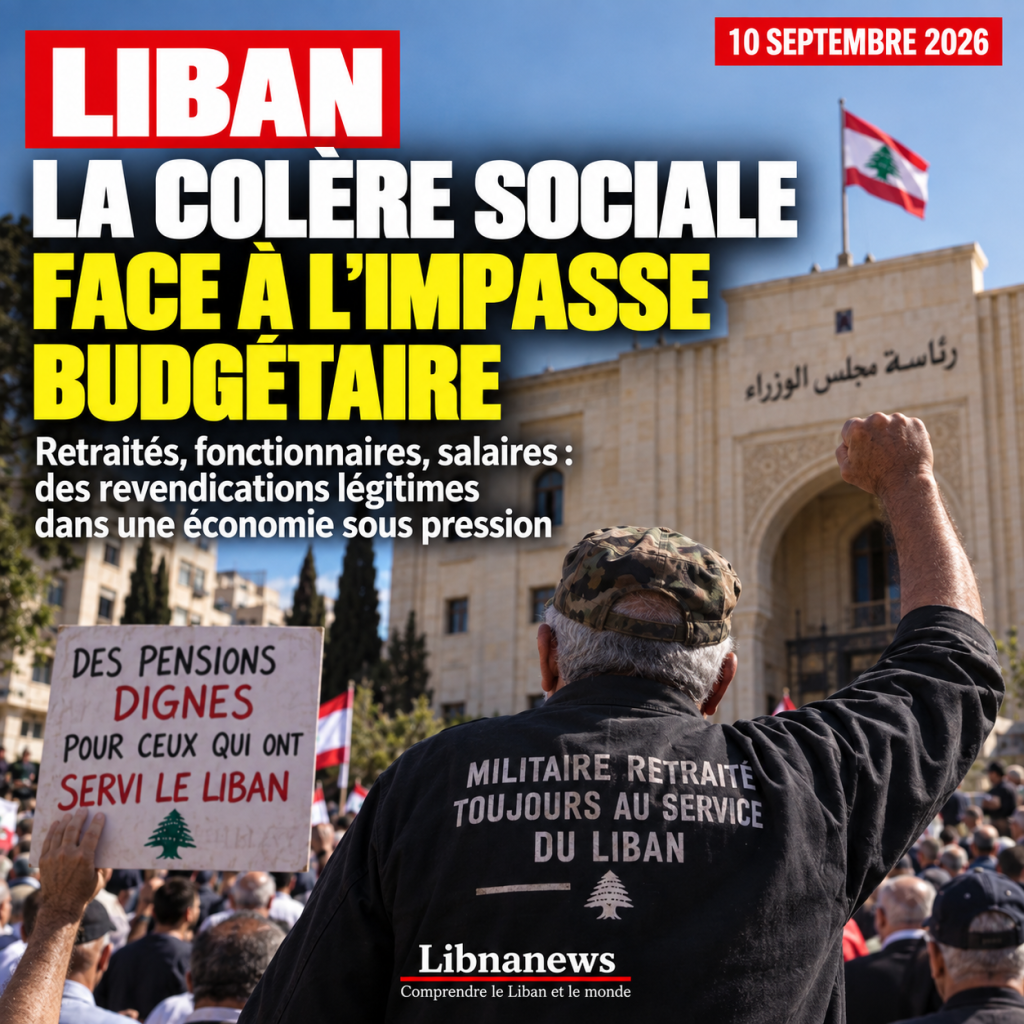
The social challenge goes back to Lebanon when the State probably has less room to respond. Retired soldiers have returned to the streets this week, while civil servants and other categories of the public sector are demanding a further correction of salaries and pensions. The movement accompanies the review of the 2027 budget by the government of Nawaf Salam. But behind the demands is a more difficult equation: the Lebanese economy is expected to contract by 6.4 per cent by 2026, inflation rises to 17.5 per cent and public compensation already absorbs a considerable part of the budget. Any further increase must therefore be financed from more revenue, at the risk of taxing households part of what the State would grant them through wages.
It is this paradox that explains the current tension. Pensioners have good reason to consider their pensions insufficient. The monetary collapse started in 2019 destroyed most of their purchasing power. But the state no longer has access to the mechanisms that once allowed the cost of increases to be delayed. It can no longer borrow normally from markets. It cannot ask the Bank of Lebanon to finance its deficits indefinitely without risking further destabilization of the pound. And it must simultaneously finance reconstruction, public services, the army and an economy hit by a new war.
So today the street is demanding a correction that almost everyone recognizes is necessary, but that no one has yet found a way to finance it sustainably.
Pensions still far from their value in 2019
The demonstrations of retired military personnel are not new. They have been returning for several years with a regularity that reflects the absence of a structural solution.
Prior to the crisis, public wages and pensions were paid in a pound held around £1,507.5 per dollar. The collapse of the currency made this reference disappear. Even after the multiple allowances, aids and supplements granted since then, actual remuneration remains well below its level before 2019.
The state has gradually piled up the corrections without rebuilding the salary scale.
The result is a system where the official administrative salary no longer corresponds to the actual income paid. In addition to basic salaries, there were multipliers, temporary allowances, social assistance, attendance allowances and various supplements.
In February 2026, the Salam government again awarded the equivalent of six additional salaries to public and contract employees, with the corresponding supplements for the military. The effort is between $700 million and $800 million per year according to government estimates used in the budget discussions.
This amount is considerable for the Treasury. However, it remains insufficient for the beneficiaries.
This is all the Lebanese anomaly: an expenditure of nearly $800 million can weigh heavily on public finances while leaving the recipient with an income deemed too low to live normally.
The problem comes from the scale of the collapse since 2019. Real GDP lost a considerable share of its value during the crisis. Prices have been gradually dollarized. The public wage did not follow the same path.
Retired military personnel are in a particularly difficult position. Unlike some employees, they have fewer possibilities to supplement their pension with another activity. However, they bear the same health, food, electricity, transport and housing costs as the rest of the population.
Their anger, therefore, does not only reflect a categorical claim. It shows the limitations of the five-year model: gradually compensate for the collapse of incomes without being able to restore their previous value.
Lebanon entered recession again
The difficulty is compounded this year by the sudden reversal of the economy.
Lebanon had recorded its first real recovery since the beginning of the crisis in 2025. The World Bank now estimates real growth in that year at 4.2 per cent. Consumption, tourism, investment and some monetary stabilization had led to hope for the start of normalisation.
The war started in March 2026 interrupted this dynamic.
In its latest economic report on Lebanon, published on 21 August, the World Bank now plans toreal GDP contraction by 6.4% in 2026.
The gap with the war-free scenario reached 10.4 growth points.
This means that the budgetary problem is not just military spending or destruction. The conflict also reduces the size of the economy from which the State can derive its revenues.
Tourism was hit. Consumption has declined. People have been displaced. Housing, businesses and infrastructure were destroyed. Supply chains are disrupted and part of the investment is postponed.
This recession adds a rise in prices. The World Bank plans17.5% inflation in 2026in particular due to logistical disruptions, the cost of transport and the increase in oil.
For retirees and civil servants, this inflation further reduces the value of increases obtained a few months earlier.
For the government, it makes a new wage correction politically more necessary while making it economically more dangerous.
It’s the heart of the dead end.
Increasing wages is possible, financing them long-term much less
To say that the state absolutely cannot raise wages would be incorrect. He did it in February.
The real problem is elsewhere:it cannot increase them sustainably to match the demands without finding several hundred million dollars of additional permanent revenue.
A salary increase is not an exceptional expense. She comes back every month, then every year. When it also changes pensions, its cost extends over several decades.
Draft budget 2027 illustrates this constraint.
Planned spending is about$6.9 billion, almost 15% more than in the 2026 budget. Similar remuneration and expenditure would already represent more than half of the total.
Finance Minister Yassine Jaber said the already decided increases added about700 to 800 million dollarsexpenditure.
A new general revalorisation would therefore quickly change the fiscal balance if no additional revenue were created.
However, the government is seeking to present a deficit-free budget.
This discipline is not only intended to satisfy the International Monetary Fund. She’s responding to the trauma of the crisis.
For years, the Lebanese State has financed structural deficits through debt. The banks have placed a large part of the deposits with the State and the Bank of Lebanon. When the system collapsed in 2019, losses were eventually carried over to depositors, currency and the economy as a whole.
Returning today to deficits financed directly or indirectly by the Bank of Lebanon would risk recreating part of this mechanism.
The current stability of the pound is based, inter alia, on a restrictive monetary policy and on the absence of massive Treasury financing through monetary creation.
The government is therefore caught between two constraints: increasing revenues to preserve the public sector, without reopening the mechanism that had contributed to the collapse.
By February, the state had already had to tax to be able to increase
The decision taken at the beginning of the year shows how narrow the margin is.
When the government accepted the six additional salaries in February, it simultaneously sought new revenues.
It decided on an additional tax on300,000 pounds on 20 litres of gasolineand proposed to transfer VAT from11% to 12%. Additional duties on containers were also envisaged.
The message was clear: a permanent increase in remuneration should be accompanied by permanent revenues.
On paper, the logic is budgetary.
Socially, it becomes much more problematic.
VAT is a tax on consumption. It affects households when they spend. A gas tax does not only affect motorists. It is transmitted to transport, distribution and, gradually, at the price of a large part of the goods.
The State can therefore give an additional $100 to a staff member while increasing his/her monthly expenses.
It was precisely this mechanism that provoked the February protests in Beirut and Tripoli.
The problem remains today.
The more public servants get a wage adjustment financed by consumer taxes, the more likely a part of this correction is to be absorbed by the rising cost of living. And private sector households, which do not necessarily benefit from the increase, also support new taxes.
A measure designed to solve a social crisis can therefore create another.
Public revenues up, but not a cash pool available
The situation is all the more difficult for protesters to understand as the state’s revenues have grown considerably.
They went from about$3.9 billion in 2024 to almost $6 billion in 2025According to the data analysed this summer. At first glance, this increase may suggest that the government now has the means to restore wages.
That would be too fast.
Part of this progress comes from better collection. Another is the revalorisation of taxes, duties and tax bases after several years during which part of the levies had become almost symbolic as a result of the depreciation of the pound.
These additional revenues are not all reproducible at the same rate.
Above all, the State has to face new expenditures: war, aid to displaced persons, reconstruction, administration, military needs and infrastructure rehabilitation.
The World Bank also warns that the improvement in public finances in 2025 and the first half of 2026 is expected to be subject to increasing pressure in the second half of the year. The recession slows down revenue as needs increase.
The budgetary surplus recorded in 2025, estimated at3.9% of GDPTherefore, does not mean that the State can safely create several hundred million dollars of additional permanent expenditure.
An exceptional revenue can fund an exceptional expense. It should not be used to create a wage obligation that will still have to be paid in 2028, 2029 or 2030.
Depositors, Bank of Lebanon and Taxation: the second front
Another element feeds the feeling of injustice: the banking record.
Since 2019, depositors have been deprived of much of their savings. The Bank of Lebanon is gradually funding certain withdrawals under the mechanisms established since the crisis.
We must avoid confusion here.
VAT revenues or gas tax are not legally paid into a fund to reimburse depositors. To argue that wage taxes would be directly diverted to bank withdrawals would therefore be inaccurate.
But the consolidated economy tells a more complex story.
The state must balance its budget because it can no longer rely on monetary financing. At the same time, the Bank of Lebanon must preserve its currencies, stabilize the pound and finance mechanisms for depositors to gradually recover part of their funds.
Both institutions therefore draw their margins from the same impoverished economy.
The more resources the Bank of Lebanon mobilizes to secure withdrawals without destabilizing the exchange rate, the more critical monetary discipline becomes. The more the state increases its spending, the more tax revenues it has to raise to avoid asking again for monetary financing.
Taxation, public wages and repayment of deposits are therefore not linked by direct accounting. They are under the same constraint of resources.
It is this reality that fuels a politically explosive frustration: households pay more taxes and taxes while public servants feel that they are not regaining their purchasing power and that depositors continue to recover only a fraction of their savings.
The 2027 budget actually puts the problem ahead
The current draft budget does not address this contradiction.
It incorporates the cost of the measures already granted, but does not provide, in its original version, for a major additional reconstruction of the salary scale.
According to the medium-term budgetary framework elements reported in the press, no comparable increase would be planned for several years.
This is precisely what worries the unions.
For them, to accept the 2027 budget in the state would be to freeze already insufficient remuneration while inflation continues to rise.
For the Ministry of Finance, promising further increases without identified revenues would be tantamount to putting in future budgets a burden that the State cannot finance.
Both sides can therefore defend economically coherent arguments while leading to incompatible positions.
Civil servants cannot live on amputated incomes for long.
The State cannot pay for what it does not collect.
And increasing taxes on a recession economy can further reduce the activity on which future revenues depend.
A social challenge that now exceeds military pensioners
It is this lock that gives the current manifestations a wider reach.
Retired members are the most visible. Their organization allows them to block axes and quickly concentrate pressure around the Grand Serail. However, the same difficulties affect civil servants, public education, the Lebanese University, the judiciary and many administrations.
The risk to the government is not only a proliferation of demonstrations.
It is to see a coalition of categories that no longer demand a one-off premium, but challenge the whole model of exit from crisis.
Since 2019, the state has essentially managed public revenues by successive corrections. This method avoided a complete rupture of administration. She never solved the question of real wages.
The recession of 2026 now reduces the possibility of continuing this way.
The Salam government must simultaneously avoid a new monetary crisis, maintain fiscal balance, finance the consequences of the war, support the army, advance in bank restructuring and prevent the collapse of its own public services.
Pensioners demand that the State first comply with a much more immediate obligation: to allow those who have worked for it to live from their pension.
The discussions opened this week must now translate this contradiction into figures. The Ministry of Finance was responsible for evaluating the cost of proposals discussed with the representatives of retirees prior to the further consideration of the 2027 budget. It is this calculation, more than political declarations, that will determine whether the government still has room for compromise or whether the social challenge will enter a new phase.




