For many Lebanese from the diaspora who returned to the country this summer, the observation is insistent: some prices now appear to be comparable to those of Paris, Dubai or other major cities, while local incomes remain much lower. Restaurants, imported products, services, leisure or travel sometimes give the image of an economy that is returned at international prices without having regained wages, productivity and the corresponding infrastructure. This perception does not mean that the cost of living in Lebanon generally exceeds that of these metropolises. However, it reflects a very real economic phenomenon: the dollarization of prices was done much faster than the reconstruction of incomes.
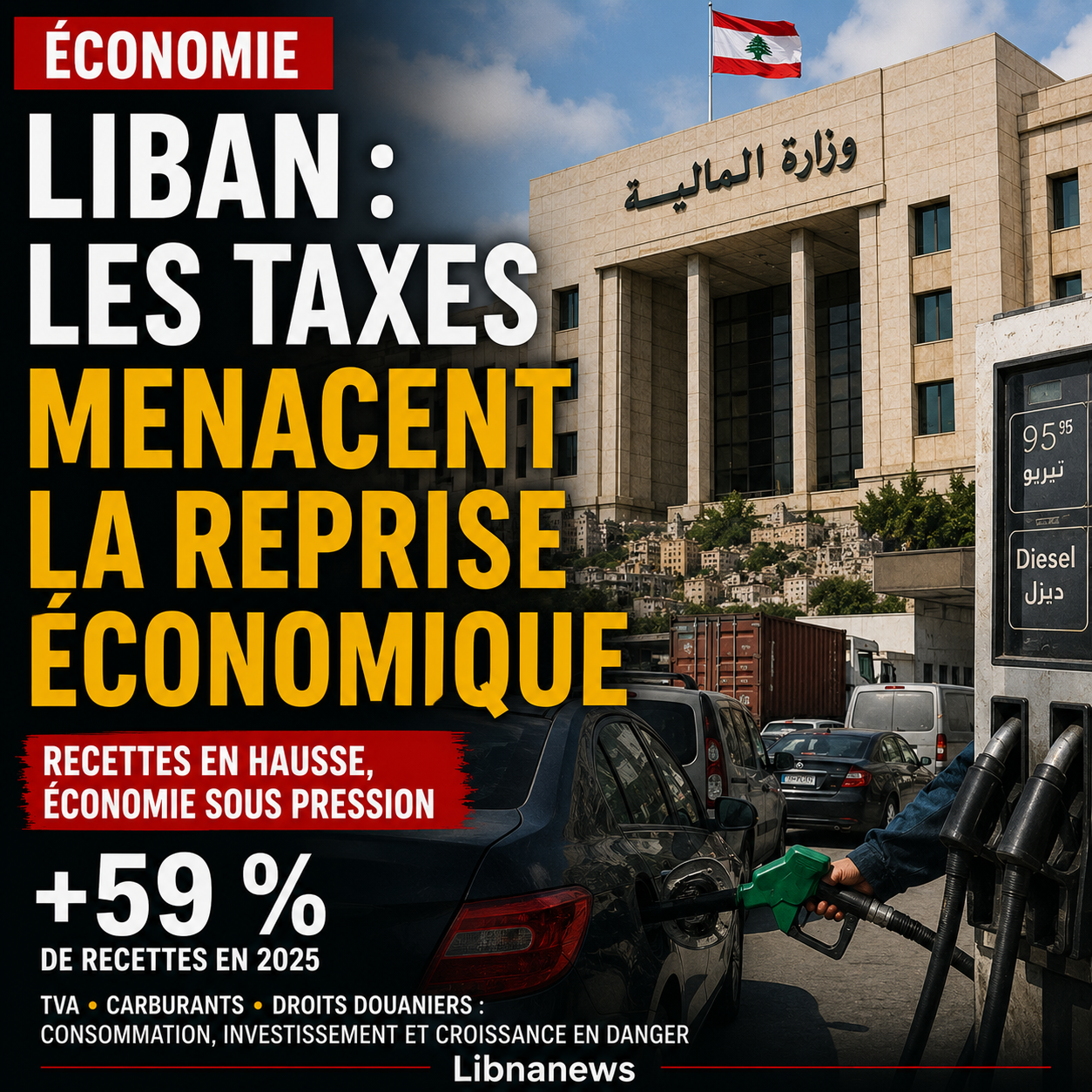
In this context, rising tax pressure is becoming a growth issue. The Lebanese State needs revenue to restore its administrations, raise public salaries and finance long-compressed services. It has already managed to increase its receipts sharply, from about $3.9 billion in 2024 to over $6 billion in 2025. But this recovery is partly based on the revalorisation of taxes, duties and tax bases. It also depends heavily on VAT, customs and other levies applied to consumption.
The equation is delicate. An economy emerging from several years of contraction can hardly withstand a succession of tax increases without reaction. Households reduce their purchases when their disposable income declines. Companies defer investment when their costs increase. The most fragile actors can switch to informal. In the short term, the state collects more. In the medium term, it risks reducing itself the economic base on which its future revenues will depend.
An economy in recovery, but still far from its pre-crisis level
The first element to consider is the starting point. The return of positive growth does not mean that the Lebanese economy has erased the crisis that began in 2019. The cumulative contraction in real gross domestic product remains close to 40% compared to the levels preceding the collapse.
An annual growth of a few points is thus a catch-up, not a phase of expansion comparable to that of an economy that has regained its normal capacity. Tourism, diaspora transfers, consumption and the return of monetary stability have improved. But the banking system remains deeply disrupted, credit remains scarce and infrastructure continues to suffer from several years of underinvestment.
Before the new shocks of 2026, real growth of around 4% had been envisaged for the year under several conditions. This forecast included sufficient stability, reforms and a gradual improvement in investment. It therefore remained surrounded by significant risks.
In an economy that has lost nearly two-fifths of its real activity since 2019, a growth point counts a lot. A fiscal policy that removes one or two points from consumption or investment does not only produce a slight statistical slowdown. It delays the return to the pre-crisis economic level.
This distinguishes the Lebanese situation from that of an overheated economy. The country does not seek to curb excessive demand. It is still seeking to rebuild solvent demand, productive capacity and investment.
Revenue surge does not match the economy’s surge
However, the public accounts show a dramatic increase. Revenues increased from about $3.9 billion in 2024 to about $6 billion, or slightly more depending on the accounting entity in 2025. The increase is approaching 60% in one year.
Real activity clearly did not increase by 60%. The difference is essential to understand the nature of the fiscal recovery.
Some of the additional revenue comes from improved economic activity. When firms sell more, imports increase or transactions resume, the tax base naturally expands. Another part is better collection and recovery of amounts previously outstanding from the Consolidated Revenue Fund.
But an important component also comes from fiscal catching up. After the collapse of the pound, several taxes, duties and charges remained fixed for a time at values that became very low in real terms. The review was necessary to avoid the disappearance of State revenue.
The consequence is clear. A 60% increase in receipts does not mean an equivalent increase in the wealth produced. It also reflects an increase in the amount actually charged on each consumption unit or on certain transactions.
For the Treasury, both phenomena increase revenues. For the economy, they do not have the same effect at all.
Four effects behind increased revenue
An economist would break this up into four components. The first is real growth. More production and income create more taxable material without changing the tax rules.
The second is the nominal effect. The increase in prices and the dollarization of many amounts increase the value of transactions. Even when the volume sold does not change, the tax collected in face value may increase.
The third is recovery. An administration that better controls returns, imports or payments recovers a larger share of the tax due legally. This increase is particularly interesting because it does not necessarily require higher rates for taxpayers already in good standing.
The fourth component is the tax burden itself. It consists of rate increases, duty revisions and the adjustment of the bases used to calculate tax.
These distinctions should be at the centre of the budgetary debate. An increase in revenue from growth is sustainable as the economy progresses. Improved recovery can also produce lasting gains. However, an increase obtained by catching up rates or bases produces a one-time jump which cannot be repeated every year.
Therefore, the 2025 peak should not be mechanically extrapolated. Once tax values have been realigned, the state cannot expect a further increase of close to 60% without widening the economy, further improvement in recovery or further tax increases.
VAT places consumption at the heart of state financing
The revenue structure further complicates the equation. Budget 2026 remains heavily tax dependent. Tax revenues represent about four-fifths of the planned budget.
VAT is central. It alone accounts for about one third of the planned budget revenue, according to public budget documents. Customs duties represent around an additional one tenth. This means that a considerable proportion of resources depends directly on consumption and imports.
This structure presents an administrative logic. VAT is much easier to collect than an income tax that is difficult to identify. Imported goods go through customs and can be checked at a few entry points. In a highly informative economy, these levies are therefore effective instruments.
But their economic impact is different from that of better distributed direct taxation.
When a household consumes almost all its income, higher VAT immediately reduces its purchasing power. When a better-off household has a large saving capacity, it can more easily absorb an increase in prices without reducing consumption as much.
The relative weight of an indirect tax is therefore generally heavier for low and intermediate incomes.
A VAT point is not only a VAT point
The proposal for a VAT reduction from 11% to 12% illustrates this problem. Presented in isolation, the increase appears to be low. It corresponds to an additional point.
But households do not live in an economic model where only one variable changes at a time. They simultaneously support energy, fuel, housing, imported products, insurance and many services.
An additional VAT point is therefore added to an already high price structure.
Its effect also depends on the propensity to consume. For a household spending almost all of its income, the tax increase directly reduces the quantities it can buy or obliges to abandon certain expenses.
This behaviour ultimately affects businesses. A restaurant, store or provider does not reason in terms of national tax revenues. He simply sees a slightly lower attendance, a reduced average basket or customers delaying their purchases.
A few percent of lost consumption may be sufficient to change the decision to hire, invest or open a new point of sale.
Fuel has a multiplier effect on prices
Fuel taxation is even more sensitive. It does not stop at the pump.
Lebanon depends almost entirely on road transport for people and goods. Public transport alternatives remain limited. The price of fuel therefore falls into a wide variety of production costs.
A wholesaler pays for the transport of his goods. A farmer must bring his production. A restaurant receives daily or regular deliveries. A service company pays for the travel of its employees. Households use their vehicles to reach their workplace.
When a tax increases fuel, several actors try to pass on the cost. A game ends in prices. Another is absorbed by the margins. A third reduces household disposable income.
This is why a gas or diesel tax has a macroeconomic effect higher than the amount paid directly by motorists.
It acts as a small cost shock applied to a large part of the economy.
The risk of a loop between public wages, taxes and inflation
The financing of new public remuneration is a particularly good example of this mechanism. Civil servants, military personnel and retirees have suffered a considerable collapse of their purchasing power since 2019. An upgrade had become necessary to maintain the functioning of administrations.
An additional appropriation of £56,500 billion represents approximately $630 million. The full-year total cost of the various wage support measures can be close to 800 million depending on the arrangements taken into account.
The figure of 630 million must be reconciled with the government revenue of 2025. It represents about 10 per cent of an annual revenue level close to $6 billion.
Expenditure is therefore far from marginal.
If financed by additional indirect levies, the government creates a loop. It increases the nominal income of public officials and then recovers part of this increase through taxes paid by these same households and the rest of the economy.
At the same time, fuel and consumption taxes can fuel price increases. The nominal wage gain is therefore not entirely transformed into a purchasing power gain.
For employees in the private sector who do not receive any revalorisation linked to public decision, the effect is even more direct: they support the levies without benefiting from the expenditure which justifies them.
Tax impact matters more than the official taxpayer
This is another economic principle often absent from public debate. The person or company that legally pays a tax to the State is not necessarily the person who actually bears the cost.
This difference is called tax impact.
An importer pays a customs duty, but can pass it on to its selling price. The consumer then bears part of the tax. A company faced with an additional tax can reduce its margin, increase its prices or reduce its wage costs.
The final distribution depends on the competition and the ability of each actor to change their behaviour.
In a market where competition is weak, a company can more easily pass the levy on to the customer. In a highly competitive sector, it may be forced to absorb part of it in its margin.
In both situations, an economic actor pays. The tax does not disappear.
This analysis is particularly important in Lebanon, where certain sectors have limited competition and where market concentration can facilitate the transmission of increases to consumers.
Companies already bear a high cost of capital
At the same time, Lebanese companies face a constraint that their competitors in many economies do not share: a deeply damaged credit system.
Since the banking crisis, conventional investment financing has remained limited. Many entrepreneurs use their own funds, family financing or resources from abroad.
This increases the implicit cost of capital.
This constraint adds energy, transportation, insurance, security risk, legal uncertainty and the cost of many private services.
A new tax is therefore imposed on a company which already bears several risk premiums.
Under these conditions, an increase of a few points over the total cost of an investment may be sufficient to move from a profitable to unprofitable project.
However, lost investment never appears in tax revenues. The Treasury sees the additional customs duty collected today. He does not see the machine that will eventually not be purchased.
Static tax returns can be misleading
This difference between the short and long term constitutes one of the main risks of fiscal policy.
When a department estimates that an additional tax will raise $100 million, it typically uses an existing taxable base and applies the new levy.
It’s the static yield.
But households and businesses change their behaviour when prices change. The volume consumed may decrease. Official imports can slow down. Some investments may be postponed.
The actual yield then becomes less than the initial calculation.
In the medium term, the difference can be even greater. Cancelled investment reduces future production. Lower output generates less wages, less profits and less consumption.
The state can earn a tax today and lose several tax flows tomorrow.
It is this dynamic that must be measured before each major new increase.
Customs pay more, but they also tax production tools
Customs revenues are often presented as one of the successes of the financial recovery. Their progress effectively reflects better valuation of goods and, in some cases, improved controls.
But imports do not concern only luxury cars or final consumer products.
Lebanon also imports machinery, industrial equipment, spare parts, agricultural inputs and a multitude of components needed for local production.
Taxing these imports indiscriminately can therefore increase the cost of Lebanese production.
The economic effect depends on the nature of the product. High taxation of a luxury product consumed may have little effect on productive capacity. A tax on a machine or strategic input directly affects investment.
Thus, growth-friendly taxation should further differentiate between the two categories.
The aim should not be simply to maximize revenues at the border. Imports that increase future production capacity must be preserved.
Low public investment makes new taxes more difficult to justify
The debate becomes more sensitive when the expenditure structure is observed. Available budget documents show that current expenditure remains largely dominant, while capital spending remains low.
Capital spending is around 2% of GDP in the budget projections, compared with a much higher share for current expenditure. Remuneration, pensions and benefits represent a significant part of these.
This composition is very important.
A tax used to build productive infrastructure can have a positive economic return over time. A road reduces transport costs. A more reliable power supply reduces private energy expenditure. An efficient digital network increases productivity.
The taxpayer pays more but receives an asset or service that can reduce other costs.
When most of the tax increase finances current expenditure, this return is much less direct.
Salary costs remain necessary. But they do not automatically offset the economic cost of a tax on businesses and households.
Lebanon remains a relatively weak tax state
However, an overly simple conclusion should be avoided. The Lebanese problem is not that of a State that already takes an exceptionally high share of national wealth.
Prior to the crisis, government revenues accounted for around 20% of GDP. They then collapsed. By 2022, they had fallen around 5.6% of GDP before rising sharply.
This drop shows why tax catching was essential. At 5% or 6% of GDP, the State could no longer finance its core functions.
The return to ratios closer to those before the crisis is therefore normal.
But the overall ratio does not say everything. A country may have moderate tax revenues while imposing very strongly certain categories.
If a large part of the economy escapes the system, while registered employees, formal enterprises and consumers bear the bulk of the collection, the actual pressure becomes very uneven.
The real Lebanese problem is therefore as much that of the base as of the rates.
Those who already pay may pay more and more
A fragile tax administration naturally tends to tax what it sees.
She sees the employees declared. She sees the formal importers. It sees consumption subject to VAT. She sees the fuels sold in the official circuits.
It sees less easily some professional income, some informal activities or assets difficult to identify.
The risk is then that each additional budget requirement will lead to an increase in levies on the same easily controlled basis.
This strategy can work in the short term. But it gradually creates a gap between formal and informal economies.
The company that meets all its obligations becomes more expensive. Its competitor who underestimates part of its sales retains an advantage.
From a point on, rising rates can itself encourage more informality.
Broadening the base can bring more than raising rates
Therefore, the economic priority should be the actual collection rate rather than the only legal rate.
Let us take a simplified example. A tax with a rate of 10% but with a State which actually covers only 60% of the theoretical basis produces much less than an identical tax properly administered.
Raising the rate to 11% is asking taxpayers who already pay more. Increasing compliance from 60% to 70% increases revenue while reducing the advantage of fraudsters.
Both solutions can produce a comparable amount for the Consolidated Revenue Fund. Their economic effect is very different.
The second is generally more conducive to competition and fairness.
Lebanon still has important opportunities in this area: digitization, data cross-checking, tracking of importers, invoicing control and improved recovery.
These reforms are more difficult than adding a VAT point. But they directly attack one of the structural weaknesses of the system.
Taxation can speed up the transition to informal
The risk of informality must be taken seriously because it can become self-reliant.
The higher the rates, the greater the financial benefit of fraud. The more fraud develops, the smaller the tax base. The smaller the base, the more the state is tempted to raise the rates on the remaining taxpayers.
The result is a vicious circle.
Formal enterprises bear more costs. Some reduce their activity or seek to circumvent obligations themselves. Revenues become increasingly dependent on taxes that are difficult to avoid, such as consumer or border taxes.
The tax system is even more concentrated.
Breaking this circle implies reducing the cost of compliance and increasing the risk of escape, rather than relying primarily on higher rates.
Tourism can lose its price advantage
The diaspora is another channel through which high prices can affect recovery.
The Lebanese stay abroad brings currencies directly into the economy. Restaurants, hotels, rentals, beaches, shops, transport and services benefit from these expenses.
During the early years of the crisis, visitors with dollar revenues enjoyed a considerable purchasing power advantage.
This advantage was greatly reduced with dollarization.
When a meal, service or leisure approaches the prices of Paris or Dubai, the visitor starts to compare the value received for his money more closely.
The family bond with Lebanon protects the country from pure tourism competition. An expatriate does not choose Beirut only because it is cheaper than another destination.
But he can reduce his spending, shorten his stay or share his holidays between several countries.
For a foreign visitor without family ties, the choice is even more sensitive to the relationship between price, quality and safety.
A tax increase that is passed on to prices can therefore decrease one of the foreign exchange flows on which the recovery depends.
Paris prices without Paris salaries
It is here that the Diaspora’s assessment takes on a broader economic dimension.
A high price is not in itself a problem if productivity and incomes are high. Paris and Dubai are expensive cities, but their income, service and infrastructure structures differ significantly from those of Lebanon.
The problem arises when prices grow faster than incomes.
A dollar billing restaurant itself pays part of its inputs in dollars. An owner sometimes tries to adjust his rent to international references. A company imports its digital equipment and services.
The Lebanese economy thus undergoes an internationalisation of its costs without having yet regained international productivity.
Indirect taxation overlaps with this gap.
For residents paid in pounds or with partially adjusted incomes, weight becomes particularly important.
The smallest households have a higher propensity to consume
The macroeconomic effect also depends on who pays.
Smaller households generally consume a larger share of their income. Their marginal propensity to consume is therefore high.
When a tax removes $100 from their disposable income, much of this money disappears directly from consumption.
On the contrary, an easy household can absorb part of the levy by reducing its savings.
This means that the same tax dollar does not have the same effect on GDP depending on the taxpayer who supports it.
A tax that is highly dependent on consumption can therefore have a greater negative multiplier than a more targeted levy on high incomes or wealth.
The question of tax fairness is directly linked here to the question of growth.
Taxation of formal enterprises can hinder declared employment
The labour market is another channel.
A company that officially hires an employee supports not only its salary, but also the social and tax obligations related to formal employment.
If the total cost increases faster than the worker’s productivity, the employer can change his behaviour.
It can delay recruitment, propose a more informal status or use more outsourcing.
The expected increase in tax revenues related to wages should therefore be analysed with caution.
An increase in revenues may mean that incomes are rising and more wages are reported. That would be positive.
It may also reflect higher pressure on a relatively easy-to-control basis.
In this case, the State must ensure that the cost of formal employment does not become an additional barrier to job creation.
Tax deferrals already signal the fragility of private cash flow
Tax deferrals decided in 2026 offer another indicator. A deferral is not a tax reduction, but it implicitly recognizes that some taxpayers need more time to pay.
This distinction is important.
A company can be profitable over the year while facing a cash flow problem at a given time. If taxes are to be paid before commercial receivables are received, there may be a lack of liquidity.
In a normal banking system, it could obtain short-term credit.
In Lebanon, this solution remains much more difficult.
Tax deferrals thus become a cash management instrument for the economy itself.
The fact that the State must use them shows that private sector capacity to pay cannot be considered unlimited.
Fiscal recovery cannot be based solely on the private sector
Finally, there is a risk of imbalance in the distribution of the adjustment.
The State has reduced its expenditure for several years. It is now seeking to restore wages and certain services. That is necessary.
But if this restoration is financed mainly by taxes applied to the private sector, it bears an increasing part of the cost of rebuilding the administration.
This transfer can work if the improvement of public services reduces the costs of businesses.
More efficient justice, better organized customs, better electricity or digital administrations are economic gains.
On the other hand, if the tax burden increases without sufficient improvement in these services, the private sector pays more without increasing productivity.
It is then that taxation becomes a net obstacle to growth.
The choice is not just to tax or not to tax
Lebanon cannot return to the situation in which the State no longer collects anything. This model has contributed to the collapse of administrations, wages and services.
The problem is therefore not the tax itself.
It lies in the composition, rhythm and use of the recipes.
Further taxing an existing base is administratively easy. Expanding the base requires institutional investment.
The first solution produces immediate revenues. The second builds a more sustainable system.
For an economy that returns from afar, the difference is fundamental.
The priority should be revenue growth without rising rates
The best test of Lebanese tax health will therefore be that in the coming years.
If revenues continue to increase sharply without further significant tax increases, this will mean that the economy is growing, formalisation is advancing or recovery is improving.
That would be the most favorable scenario.
If, on the contrary, revenue growth slows as rates cease to rise, the 2025 peak will appear more like a one-time tax catch-up.
The state will then face a difficult alternative: to increase further levies or to accept a slowdown in revenue.
It is precisely this situation that must be avoided by developing the tax base right now.
Revenue growth is sustainable only if taxable GDP increases
In the long term, the fiscal equation is simpler than it looks.
Government revenues can grow sustainably if the tax rate increases, if more activities are actually taxed or if the economy becomes larger.
The first solution has an economic and political limit.
The second is still widely available in Lebanon due to informality and weaknesses in recovery.
The third is the most important.
An additional company creates VAT, wages, profits and potentially customs duties. Additional employment creates income and consumption. Investment increases future production.
The best tax base is therefore a growing economy.
A policy that maximizes year-round revenues by reducing this growth can be accountingly effective and economically poor.
The danger is a gradually stifled recovery
Taxes alone will not cause a new economic crisis. Lebanon continues to face much more serious challenges: security, banking, debt, reconstruction, institutional functioning and investor confidence.
But taxation can amplify or alleviate these constraints.
A lost point of consumption, deferred investment or cancelled hiring seem insignificant when considered separately. Their addition, however, produces national growth.
It is precisely in this way that a recovery can be stifled. Not by a sudden collapse, but by an accumulation of individual decisions to spend less, to wait before investing or staying in the informal.
The increase in revenues in 2025 shows that the Lebanese State has regained part of its fiscal capacity. The next step must show that it is able to consolidate it without constantly asking the same taxpayers for more.
Therefore, the real objective should not be to maximize the tax revenue of 2026. The size of the formal and taxable economy should be maximized over several years. In a country where prices in dollars have already recovered levels sometimes comparable to those observed abroad, while revenues remain very late, the fiscal mix becomes a condition of recovery itself.