





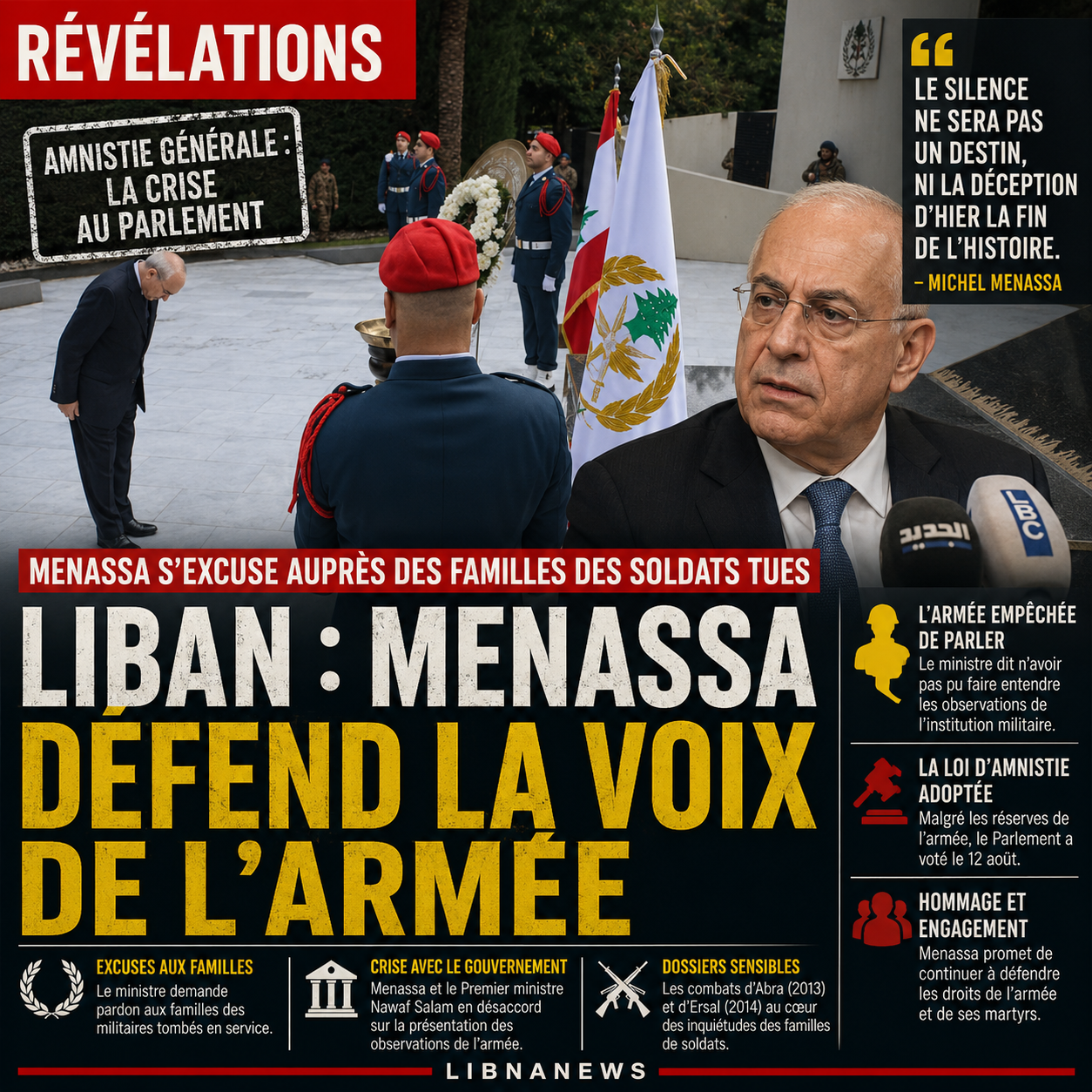
On Thursday 13 August 2026, the Lebanese Minister of Defence, Michel Menassa, apologized to the families of the soldiers who had fallen into service two days after leaving the parliamentary session without being able to explain the Lebanese Army’s observations on the general amnesty law. In an unusually personal statement, he claims to have failed to « make the voice of the army heard » and promises that « silence will not be a destiny » or « the disappointment of yesterday the end of history ».
The text comes after the adoption by Parliament of the General Amnesty Act and the exceptional reduction of certain penalties. The vote on 12 August did not close the open crisis between Menassa and Prime Minister Nawaf Salam. Their confrontation relates as much to the content of the text as to the right of the Minister of Defence to present directly to Members the observations prepared by the military institution.
Michel Menassa apologizes to the families of the killed soldiers
Michel Menassa first addresses the families of the soldiers who died in the course of their duties. He says that he did not find words in the face of their pain to match their sacrifices and considers the blood of their children as a responsibility that directly engages the State. The minister acknowledges above all that he was unable to publicly defend their right « as they deserve » at the time when Parliament was considering a law that could benefit some detainees prosecuted or convicted in cases involving the army.
The minister goes further than a mere protocol regret. He claims to feel personally at fault, whatever his rank, because he was unable to speak when the army felt it necessary to expose his reservations. However, it promises to continue to take the position of the military institution and defend its right to express itself, directly linking this responsibility to the sacrifice of the fallen soldiers for Lebanon.
This wording gives the communiqué immediate political significance. Menassa does not present the parliamentary incident as a personal quarrel with Nawaf Salam. He described it as a time when the army’s voice would have been prevented, while the text discussed directly affected the files of soldiers killed in clashes and the rights of their families.
» The army was prevented from speaking »
The most political passage in the communiqué concerns the parliamentary sitting. Menassa claims to have seen « voices gathering against the voice of the army » and positions converge while, according to him, the military institution should be protected rather than contained. He also denounces those who would treat the word of the army as a burden and sacrifice of his dead as a secondary element in political calculations.
The minister summarized his grievance in a direct formula: « Yesterday the army was prevented from speaking ». He adds, however, that the blood of his martyrs cannot be silenced in his conscience. For him, the army should not be seen as a party to a political conflict, nor should it be used as an instrument that is mobilized and then discarded depending on the circumstances.
Menassa also insists on the special place of the military institution in a country crossed by political and denominational divisions. It presents it as one of the last institutions still enjoying national confidence and recalls that the soldiers who died in service did not choose their mission according to their community affiliation. His message thus aims to place the dispute with the head of government on institutional rather than religious ground.
The conflict arose from the general amnesty law
The crisis dates back to Tuesday 11 August. Michel Menassa had come to Parliament with written comments from the Lebanese Army on the amendments to the proposed general amnesty law. These remarks had been forwarded the day before to the House Vice-President, Elias Bou Saab, and the minister wished to present them to the deputies.
Nawaf Salam s The Prime Minister considered that the political position of the government should be expressed by the head of government and not presented separately as that of the army. The exchange between the two men became inflamed, Menassa left the Chamber without speaking out and the incident caused a crisis within the government majority.
The army command would then have insisted that the minister should be able to make his observations. Several deputies also defended his right to be heard, while the Speaker of the Chamber, Nabih Berri, tried mediation. The disagreement then exceeded the content of the amnesty: it asked whether an institution directly concerned by a law could publicly send its assessment to the deputies through its minister.
Military families at the heart of disagreement
The sensitivity of the case lies in the categories of prisoners eligible for amnesty. Discussions included persons prosecuted or convicted in terrorist cases and in clashes between armed groups and the Lebanese Army. The fighting of Abra in 2013 and Ersal in 2014 remains particularly present in the memory of the institution and the families of killed soldiers.
The Ministry of Defence and the army did not necessarily oppose any amnesty mechanism. Their concern was about exclusions and the risk that a mechanism to correct excessively long detentions or old judicial situations would also benefit those involved in the death of military personnel. This is what Menassa wanted to defend before the House before the vote.
Parliament finally adopted the text on Wednesday 12 August. Among other things, the law provides for the release of dozens of detainees qualified as Islamists and amends the rules applicable to certain long detentions without trial. Its adoption responds to an old demand from families denouncing years of imprisonment without final conviction, but it has revived the opposition of relatives of killed soldiers who fear that legislative leniency will erase the gravity of crimes committed against the army.
Menassa turns his departure from Parliament into a commitment
Thursday’s communiqué thus appears as Michel Menassa’s political response after two days during which he had remained relatively silent on the background of his confrontation with Nawaf Salam. Rather than detailing the discussions with the Prime Minister, he chose to address directly the families of the killed soldiers and to present his inability to speak to the MPs as a personal failure to do so.
This choice also allows him to avoid, at this stage, an additional frontal confrontation with the head of government. Menassa does not quote Nawaf Salam in his statement. However, it clearly targets those who, in his view, have contributed to preventing the army from expressing its position and affirms that what happened in Parliament should not become a lasting rule.
The final formula is both a promise to families and an institutional warning. In claiming that « silence will not be a destiny » and that « the disappointment of yesterday will not be the end of history », Menassa suggests that he intends to return to the place of the army in the debate about amnesty and publicly defend the rights of the institution and its dead.
The law is now passed, but the political dispute it has provoked remains open. The Minister of Defence has not yet made public the full content of the observations that the army wished to make to the MPs, and his communiqué of 13 August shows that the parliamentary episode continues to be considered by the Ministry of Defence as an unresolved issue.