






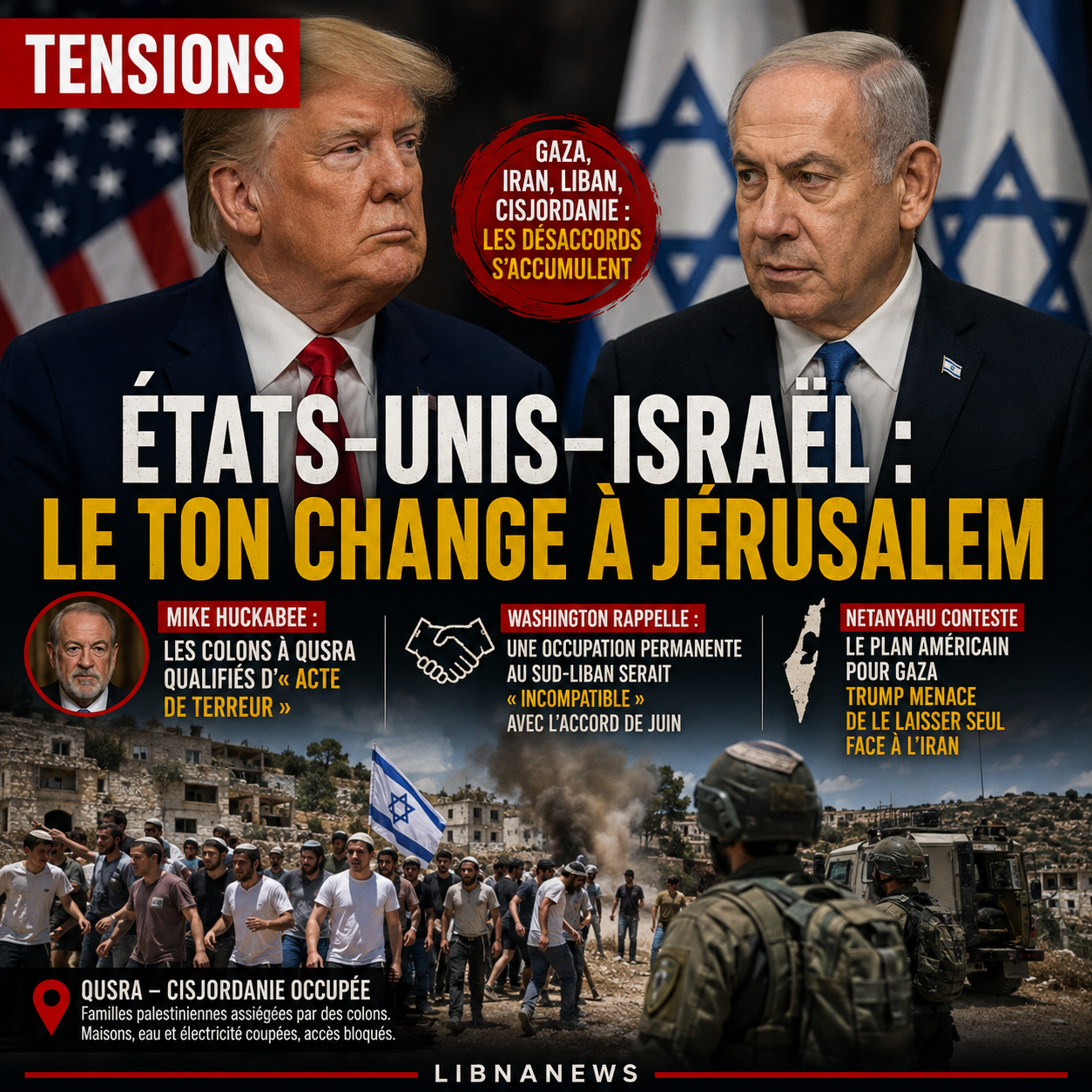
The American tone towards Israel was further tightened on Thursday, August 13. Mike Huckabee, United States Ambassador to Israel and historical support for settlement, described the siege of Palestinian homes by Israeli settlers in Qusra, the occupied West Bank, as an « act of terror ». The formula is remarkable from a diplomat who had previously defended some of the most contested Israeli positions. It comes especially after several weeks of disagreement between Donald Trump and Benjamin Netanyahu over Iran, Gaza and Lebanon. These episodes do not yet constitute a break in the American-Israeli alliance, but they are creating an increasingly difficult political crisis to hide.
The fact of the day is all the more significant as it comes from Mike Huckabee. Former Republican governor of Arkansas, Baptist pastor and figure of the American evangelical right, the ambassador has for decades belonged to the American political current most favorable to Israel. He defended the settlements in the West Bank, challenged the prospect of a Palestinian state in that territory and repeatedly used the biblical terminology of Judea and Samaria preferred by the Israeli right.
On Thursday, however, the diplomat used a vocabulary usually reserved for Palestinian attacks or armed groups. After several days of siege of Palestinian families by settlers in Qusra, near Nablus, Huckabee spoke of a « horrible act of terror » and called for the perpetrators to be treated as criminals. One family also holds American nationality, which placed the embassy directly in the file.
This statement does not mean that the Trump administration has changed its doctrine on the West Bank. However, it takes on a particular dimension because it adds to a very rapid succession of American warnings to Israel. In less than three months, Donald Trump threatened Benjamin Netanyahu to let him face Iran alone, Washington challenged some Israeli operations in Lebanon, the Israeli Prime Minister publicly rejected an American plan for Gaza and the State Department just recalled that a permanent occupation of southern Lebanon would be incompatible with Israel’s commitments.
Mike Huckabee now speaks of « terrorism »
The Qusra incidents started over the weekend. Dozens of Israeli settlers settled around several Palestinian houses, preventing their occupants from moving normally. Access to water and electricity was interrupted in some homes, while families reported stone-throwing, degradation and inability to receive normal food or medicine.
One of the houses belongs to Lou Ridi, a Palestinian American living in the United States. Members of his family remained blocked several days before an Israeli intervention. The involvement of an American citizen gave the case a diplomatic dimension that other episodes of settler violence did not necessarily have in Washington.
The American embassy asked the Israeli authorities to intervene. The army then increased its strength in the sector, dismantled settler-built facilities and announced disciplinary measures against military personnel seen alongside the groups involved. At least one Israeli was arrested.
It is in this context that Huckabee used the term « terror ». The condemnation is therefore not limited to denouncing « violence », « extremist » or « unacceptable acts ». Donald Trump’s personal representative in Israel used a particularly heavy political and moral qualification about Israeli citizens attacking Palestinians.
A spectacular change from Huckabee
The ambassador’s personality explains why this statement receives so much attention. Mike Huckabee was never seen as a diplomat likely to systematically seek a balance between Israeli and Palestinian positions. When he was confirmed in the Senate in April 2025, on the contrary, he was presented as one of the most ideologically close American ambassadors to the Israeli right in several decades.
In June 2025, he had publicly questioned the traditional goal of a Palestinian state in the West Bank and Gaza. He had even suggested that, if a Palestinian State were to be established, a territory could possibly be found in another Muslim country rather than on the land claimed by the Palestinians. With regard to Israeli policies in the West Bank, he had also adopted very little interventionist attitude.
This orientation was again manifested in February 2026. In an interview that had resulted in convictions in several Arab capitals, Huckabee had defended a biblical view of Israel’s territorial rights and had made statements particularly favourable to extending its territorial control.
The ambassador is therefore not becoming an opponent of Israel or a classic defender of Palestinian diplomacy. His reaction to Qusra is more interesting precisely because it does not correspond to his journey. When such an ideologically close official of Israel calls the actions of settlers « terrorism », the message to the Israeli government takes on a different weight.
United States-Israel Tensions Accumulate
However, Huckabee’s statement would be excessive to interpret in isolation as evidence of a diplomatic crisis. It becomes much more significant when it is placed in the succession of incidents that have deteriorated since spring the relations between Donald Trump and Benjamin Netanyahu.
The strategic alliance between the United States and Israel remains extremely strong. Washington continues to guarantee much of Israel’s external security, provide weapons and coordinate its regional operations closely with the Hebrew State. Both countries fought together against Iran in 2026 and still share the objective of reducing the military capabilities of Tehran, Hezbollah and Hamas.
What is changing is the political objectives that must follow military operations. Donald Trump is increasingly clearly seeking to transform the benefits obtained by force into agreements to reduce American engagement. Benjamin Netanyahu believes that too fast a withdrawal or insufficient compromises can allow Israel’s opponents to rebuild their capabilities.
This strategic difference was still manageable as long as it remained private. It is now publicly exposed on several fronts.
Iran: Trump threatened Netanyahu to leave him alone
The most spectacular tone rupture occurred in early June about Iran. After months of war, Trump sought to stabilize a ceasefire and negotiate with Tehran. Benjamin Netanyahu wanted to retain his freedom of military action against an opponent whom Israel considers an existential threat.
The US President then revealed that he had sent a direct warning to the Israeli Prime Minister. If Netanyahu got off the war against Iran in defiance of the American strategy, he could, according to Trump, find himself « alone » to lead it.
Such a threat is exceptional in the American-Israeli relationship. It stated that United States military support should no longer necessarily be considered automatic for any new operation decided by Jerusalem.
The disagreement included the consequences of the Israeli attacks on Lebanon. Washington was trying to prevent a further escalation involving Iran, while some Israeli operations against Hezbollah threatened to provoke precisely that reaction. Trump had publicly held that an Israeli strike in Lebanon should not have taken place and asked Netanyahu for further restraint.
The personal relationship between the two leaders, long presented as particularly close, then entered a more confrontational phase. Trump continued to call Netanyahu allied, but he no longer hid his irritation when an Israeli operation threatened to compromise his own negotiations.
American services even monitored Israeli intentions
The deterioration became more significant when the US services began to examine not only Iranian intentions, but also the risk that the Israeli government would defeat Washington’s diplomatic efforts.
In June, U.S. assessments found that Israel could take measures that could undermine the agreement Donald Trump then attempted to consolidate with Tehran. The question was no longer just what Iran would do, but how far Netanyahu was prepared to go to prevent a compromise that he thought was too favourable to the Islamic Republic.
This mistrust does not mean that Washington considered Israel an adversary. However, it shows that the interests of the two allies no longer coincided fully. The United States wanted to limit a war that had become costly and politically difficult. Israel wanted to exploit as much as possible the Iranian weakening before giving up the military option.
This disagreement remains unresolved today. Negotiations between Washington and Tehran are again blocked, while confrontation around the Strait of Ormuz continues. The possibility of a further escalation keeps Israel and the United States in mutual military dependence, without removing their differences on how to end the conflict.
Gaza: Netanyahu Openly Rejects Trump Plan · Global Voices
A new episode occurred on Sunday, August 9. Benjamin Netanyahu publicly rejected Donald Trump’s 15-point new plan for Gaza. The US project includes the disarmament of Hamas and the gradual withdrawal of Israeli forces, accompanied by an international mechanism to stabilize the territory.
Hamas has accepted the principle of the document, while maintaining its own conditions on how its disarmament should take place. Israel refuses the proposed sequence. Netanyahu demands that disarmament be truly completed before Israeli forces withdraw.
The dispute therefore concerns the sequence of stages. For Washington, withdrawal and disarmament must progress in a coordinated mechanism. For Israel, leaving military positions before having verified the complete disappearance of Hamas’ armed capabilities would risk Hamas reorganizing itself.
The divergence would already be significant if it remained a technical negotiation. Netanyahu chose to make it public by stating that the American document was unacceptable to Israel. The gesture directly affects Donald Trump, who seeks to present his peace apparatus as a regional solution after several years of war.
The White House did not withdraw its project. On the contrary, American officials claimed that it remained in force and that discussions with Israel were continuing. The message is clear: Washington does not regard Israeli refusal as the end of negotiations.
In Lebanon, Washington contradicts Israel Katz
The third issue of tension concerns Lebanon directly. On Wednesday, 12 August, Israeli Defense Minister Israel Katz visited the southern part of the country and announced that the Israeli army would continue to maintain a « security zone ». It also assumed the destruction of underground infrastructure and housing in areas controlled by Israeli forces.
The American response was unusually clear. The State Department recalled that Israel had claimed no territorial ambition in Lebanon and that a permanent military presence in the south would not correspond to the commitments made in the June Framework Agreement or the long-term security sought for both countries.
This position comes as Washington plays the main role in the negotiations between Israel and Lebanon. The agreement reached at the end of June is based on a logic of reciprocity: the progressive disarmament of Hezbollah, the deployment of the Lebanese Army, the verification mechanism and the Israeli withdrawal from the occupied territories.
If Israel turns the currently controlled area in the south into a permanent presence, American architecture is directly challenged. The problem would therefore no longer concern only Beirut and Jerusalem, but the credibility of United States mediation.
The Trump administration did not content itself with a general formula calling the parties to the restraint. It explicitly stated that a permanent settlement would be incompatible with the agreed framework. This position is now added to the US plan for Gaza’s rejection and the differences over Iran.
Huckabee now brings West Bank to the list
With Qusra, the West Bank in turn becomes a visible frictional terrain. This is important because the Trump administration has so far adopted a policy that is extremely favourable to Israeli positions in this territory. In particular, at the beginning of Trump’s second term, it had abolished sanctions imposed under the previous administration on certain settlers accused of violence.
For several weeks, democratic elected officials have criticized Washington for sending a message of impunity by abolishing these measures. Violence continued in 2026, while settlements and outposts are increasing in several areas of the West Bank.
Huckabee had long resisted the idea that Washington should impose a clear settlement policy on Israel. He had also refused to place the establishment of a Palestinian State at the heart of his mandate. His condemnation of Qusra therefore does not correspond to a mere return to traditional American diplomacy.
Rather, it marks the appearance of a limit. Political proximity to Israel no longer prevents the ambassador from directly calling certain Israelis terrorists when their actions target Palestinian families, especially when an American citizen is concerned and the Israeli security forces seem unable to quickly stop the violence.
A crisis with Netanyahu more than with Israel
However, these episodes must be interpreted accurately. Talking about a breakup between the United States and Israel would be premature. The military, security, economic and political ties between the two countries remain too deep for some, even important, disagreements to reverse the alliance.
The crisis seems to be more in opposition to the Trump administration’s current strategy of Benjamin Netanyahu. The United States continues to support Israel’s overall security objectives, but increasingly challenges the methods, duration of military occupation and sequence of withdrawals.
On Iran, Washington wants to retain control of the war schedule and negotiations. In Gaza, Trump wants to turn the ceasefire into a political agreement including a withdrawal. In Lebanon, he hoped that the disarmament of Hezbollah would lead to the planned Israeli withdrawal. In the West Bank, his own ambassador now called for prosecution of violent settlers.
Netanyahu faces a different logic. His coalition and right-wing electorate demanded maximum security guarantees and refused to allow territorial concessions to precede the effective disarmament of Israel’s opponents. The Israeli elections scheduled for 27 October further reinforce this constraint.
The Prime Minister therefore has little political space to appear as assigning to American injunctions. Donald Trump, as he approaches the November US mid-term elections, is looking for visible results after a year of costly wars.
Trump doesn’t necessarily want to follow Netanyahu to the end
The current dynamics thus reveal an important transformation of the relationship. During the first few months of the mandate, the Israeli government could hope that Donald Trump’s return would offer him almost unlimited regional freedom of action. The ambassador appointed to Jerusalem himself seemed to symbolize this exceptional ideological proximity.
The situation of summer 2026 is different. Trump continues to defend Israel but shows a growing willingness to determine himself when a military operation must stop. Above all, it refuses that Israeli objectives automatically prolong the engagement of US forces or undermine the agreements it seeks to conclude.
This development had already raised serious concern in Israel in June. The President’s relatives had to publicly defend his policy with an Israeli public concerned about his negotiations with Iran. Mike Huckabee himself recognized the existence of significant anxiety about the state of the bilateral relationship.
His intervention of 13 August thus takes on additional relief. Two months after trying to reassure the Israelis of Trump’s support, the ambassador found himself asking the Israeli authorities to act against settlers whom he described as terrorists.
The Israeli right could become a problem for Trump
The main risk for Washington now comes from the political forces to the right of Netanyahu. The nationalist and religious parties of its coalition defend a policy of annexation in the West Bank, oppose territorial withdrawals and wish to maintain maximum military freedom in Gaza, Lebanon and Iran.
Several US objectives require exactly the opposite: verifiable withdrawals, negotiated compromises and a gradual limitation of military operations. The more Trump seeks to close the various regional conflicts, the more this contradiction will appear.
The Qusra case also shows that settler violence can become a direct bilateral problem. When Palestinians of American nationality are targeted, the administration can no longer treat incidents solely as an Israeli-Palestinian domestic matter. The embassy must protect its citizens and hold the Israeli authorities accountable.
The wording used by Huckabee could therefore constitute a precedent. If the attacks continue and Washington believes that the Israeli police or army do not respond adequately, the question of American measures against the perpetrators may again arise.
A strong alliance, but a more visible American discipline
Caution remains essential before talking about a real strategic crisis between the two countries. The United States has not suspended its military support for Israel. Donald Trump did not question the alliance and publicly reiterated that his relationship with Netanyahu remains good, including after the Israeli rejection of his plan for Gaza.
But the multiplication of disagreements alters the nature of this relationship. Washington no longer seeks only to protect Israel or to facilitate its operations. It now demands more clearly that Jerusalem respect the diplomatic frameworks that the United States itself has negotiated and the limits set by the United States President.
Iran was the first major test, when Trump threatened Netanyahu to let him fight alone. Gaza is the second, with Israel refusing a presidential plan that Washington continues to defend. Lebanon adds a third dispute over the duration of the Israeli occupation. Huckabee’s condemnation in the West Bank now creates a fourth political front.
Taken separately, each of these files could be presented as a normal disagreement between allies. Their concentration over a few weeks, however, shows a more difficult tendency to rule out: the US and Israeli goals for the post-war period are no longer fully aligned.
The next indication will come from the Israeli government’s reaction to Mike Huckabee’s comments and how the authorities will treat the settlers involved in Qusra. It will also come from the negotiations on Gaza and Lebanon, where Washington is now asking for withdrawals that the Netanyahu government still refuses to consider as acquired.