

The Ministry of Agriculture calls on the country’s establishments to buy Lebanese olives and oil regularly. Nawaf Salam estimates that approximately 254,000 olive trees have been affected in the fire areas, without specifying how many were destroyed.
The Lebanese Ministry of Agriculture asks hotels, restaurants and other tourist establishments to make regular use of the olives and oil produced in Lebanon in their supplies. The campaign, announced on 23 November, aims in particular to open up opportunities for producers in the South during the marketing of their harvest. The call concerns the day-to-day purchases of establishments, and not just the promotion of the product during a show or tasting.
The sector grouping has opened its memberships
On 14 November, at the HORECA trade fair in Beirut, the Lebanese Olive and Olive Oil Group opened its membership and signed a Memorandum of Understanding with HORECA. In particular, producers, mill operators, processors, catering professionals and marketers may join. The group also intends to develop regular laboratory checks and better organize marketing. Its creation is part of a work initiated in 2018 under the OLIO III project, financed by Italy.
The Protocol establishes a framework for cooperation with the trade fair. The ministry announcement does not, however, designate any hotel or restaurant that has already committed to ordering a specific volume. It does not publish any purchase budget or prices agreed with producers. It is the actual orders placed, their frequency and the prices paid to suppliers that will measure the effect of the campaign on sales.
Approximately 254,000 trees affected, according to the Prime Minister
On 26 November, on World Olive Day, Nawaf Salam stated that approximately 254,000 trees had been affected in areas where fires had occurred as a result of Israeli attacks, he said. The Grand Serail has published no method of counting or ventilation between destroyed and damaged trees. This figure therefore does not allow a loss of production or income to be calculated.
The department also highlights the source of products and quality analyses. The 20 samples of oil controlled in the Nabatiyé area, whose compliance the ministry has announced, provide information on the lots examined. They do not establish a condition of affected orchards and do not replace controls on other lots. For southern olive growers, the number of buyers and quantities ordered remain to be documented.
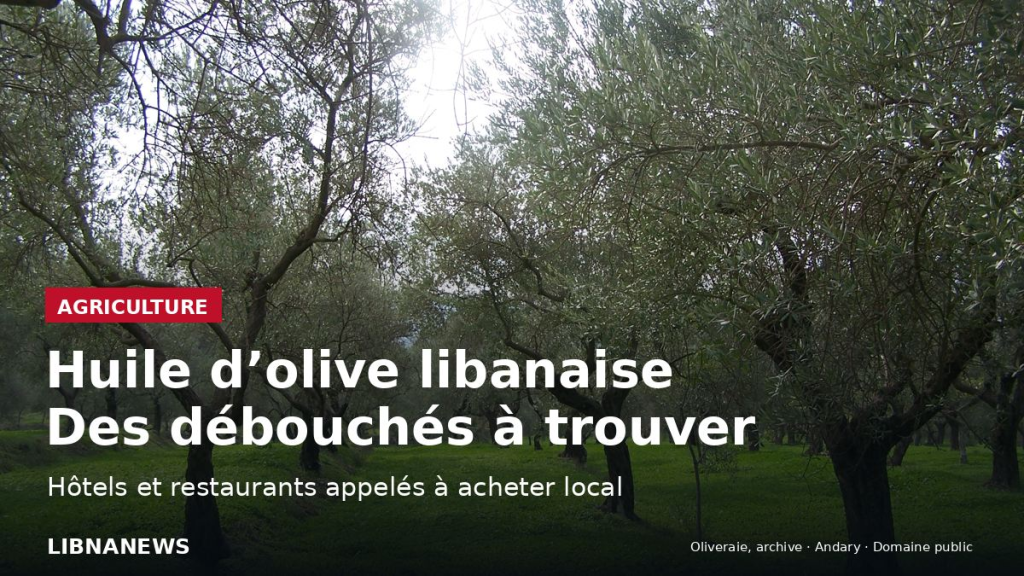
Cover: olive grove in Lebanon. Archive photograph released in 2008, unrelated to the damage of 2026. Andary / Wikimedia Commons, public domain; cropping and titration Libnanews.





Comments