

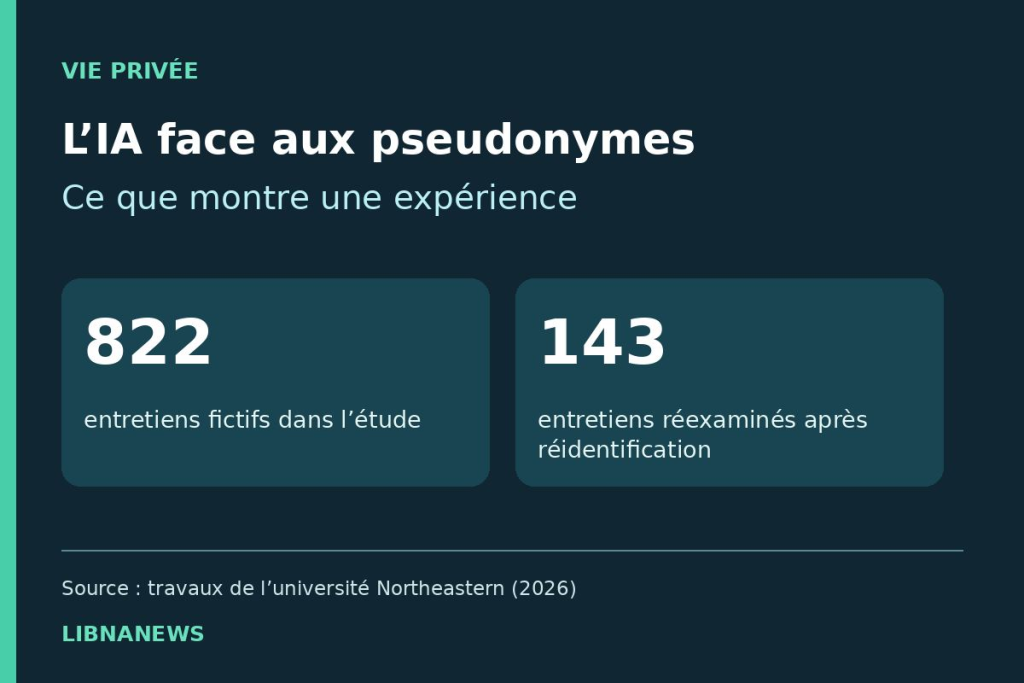
Removing the names of an interview is not always enough to protect the speaker. A work by Northeastern University, which was pre-published on 4 October and presented by the University on 24 November, measured 822 fictitious interviews. It reveals flaws in the anonymization of texts, but does not allow to calculate the risk for any account under pseudonym.
A test on interviews built for the experiment
The 822 interviews were based on already public information about people known to researchers. The interviews were simulated: they were not private testimony or a representative sample of anonymous Internet users. The team compared fifteen configurations. The most efficient systems identified the speaker in about 400 interviews. Without access to Internet search, three models have still correctly identified between 15% and 28% of people in this corpus.
Approximately nine out of ten responses were accurate among those with high or very high confidence in the systems. This proportion does not apply to all responses or systems. A confident answer is not proof of identity; false reconciliation may also expose a person to suspicion or harassment.
What the rereading of a testimony can change
In a second test, out of 143 interviews selected from among those whose speakers had already been identified, the team evaluated a more conservative writing of the transcripts. The average proportion of identifications declined from 75.1% to 35.1% on this subset. The risk has not disappeared and these two rates do not describe all 822 texts.
For an editorial that promises to protect a witness, it is not enough to replace his name. A review must evaluate the entire narrative and its publishing context, including the pieces and their metadata. A team can reformulate or remove unnecessary details in agreement with the witness, limit the circulation of the original document and avoid sending it to a third party service to test it. If the revelation of identity would have serious consequences, it is necessary to re-evaluate with the person what can be published and what it is best to remember.





Comments