

Canadian support for the army is on the agenda with Youssef Raji’s visit to Ottawa. His meeting with Anita Anand, announced on Friday 6 November, should focus on Lebanese institutions. Prior to this interview, public documents distinguish between a Canadian financial balance sheet, equipment actually delivered and commitments that remain to be specified. They do not mention a new military envelope granted during the visit.
The most recent figure published by Ottawa is C$6 million for the Lebanese Armed Forces since May 2025. Global affairs Canada reported on November 4, in the announcement of the ministerial visit. This includes a capacity-building programme to combat terrorism. It must not be presented as a new aid of six million decided this week.
Canadian military support has a logistical component
A material example is documented in Kfarchima. On 4 February 2026, the Lebanese Army announced a ceremony marking the end of the rehabilitation of a warehouse of its logistics brigade. Canadian Ambassador Gregory Galligan and representatives of the Army and UNOPS participated.
The UNOPS report, published the following day, outlines the scope of the project: three rehabilitated warehouses, a new basement, an improved operating system and essential equipment. Funding came from the Canadian government. The facilities are designed to accommodate, retain and distribute brigade resources.
This example is more specific than a statement of support. It includes a place, a beneficiary, a partner responsible for implementation and a completed surrender. It also shows that military aid can take the form of storage infrastructure. It is not limited to deliveries of weapons or vehicles.
The documents consulted do not provide the detailed cost of each warehouse. Nor do they allow each invoice to be linked to the six million envelope announced in the November balance sheet. Adding an assumed cost of this work to the Canadian balance sheet could therefore result in twice the same credits.
Not all capacity is measured by restored buildings
The reception of equipment is a verifiable step. Its sustainable functioning is another. For logistics facilities, utility then depends on personnel, maintenance, inventory management and unit supply.
The army presents the rehabilitation of the warehouses as a reinforcement of its logistical capabilities. UNOPS explains that these facilities need to improve the conservation and use of equipment. These are the objectives announced by the agencies concerned. The press releases do not provide a quantified, independent and subsequent assessment of their impact on operations.
This difference avoids two errors. The first would be to reduce aid to a diplomatic promise when concrete implementation is documented. The second would be to deduce a measured improvement in all military capabilities from the handover of buildings. The material balance sheet and the operational balance sheet require different indicators.
Military families report under another scheme
Canadian support is also involved in actions that do not correspond to unit equipment. On 30 June 2026, the army announced that it would receive a Canadian and Norwegian donation from UN Women. Its beneficiaries were women and girls from war-affected military families.
The ceremony was held at Kfarchima, the headquarters of the agency responsible for disaster risk and crisis management. This aid concerns the social consequences of the war for families. It cannot be described as an armament delivery or as an endowment directly usable by a combatant unit.
The public record does not provide a total value and a breakdown by lessor. Therefore, Canada should not be assigned alone a set of operations with Norway. The presence of a joint partner also makes it impossible to merge this family support with the warehouse project.
Humanitarian amounts remain separate
In its press release of November 4, Ottawa has presented several categories of support to Lebanon since May 2025. In addition to the six million for the armed forces, he mentioned more than $83 million in humanitarian aid. The balance sheet also includes nine million for development and eight million for peace and stabilization.
These amounts are expressed in the currency of the donor country. They should not be converted into US dollars without date or exchange rates. Above all, the sum of the various headings would not constitute a Lebanese army budget. Beneficiaries, objectives and implementation channels differ.
The distinction is important in the Lebanese debate on institutional capacity. Humanitarian aid can support a population affected by the fighting without financing the operation of the armed forces. A stabilization programme can accompany state action without becoming a subsidy freely available to the military command.
What the Ottawa meeting still needs to say
The programme announced for the interview between Anita Anand and Youssef Raji focuses on Lebanon’s cooperation, sovereignty and long-term stability. It includes Canadian support to the armed forces and other national institutions. At this stage, the announcement of the interview is not its result.
A possible additional commitment should be described in terms of amount, timing, beneficiary, nature of equipment or training. A promise of funding, a project agreement and a delivery do not match the same degree of execution.
Kfarchima’s documented achievements already offer a concrete starting point. The November 6 visit will see whether Ottawa and Beirut are adding new resources to this assessment, or whether they confirm the continuation of existing programs.
Credit Line
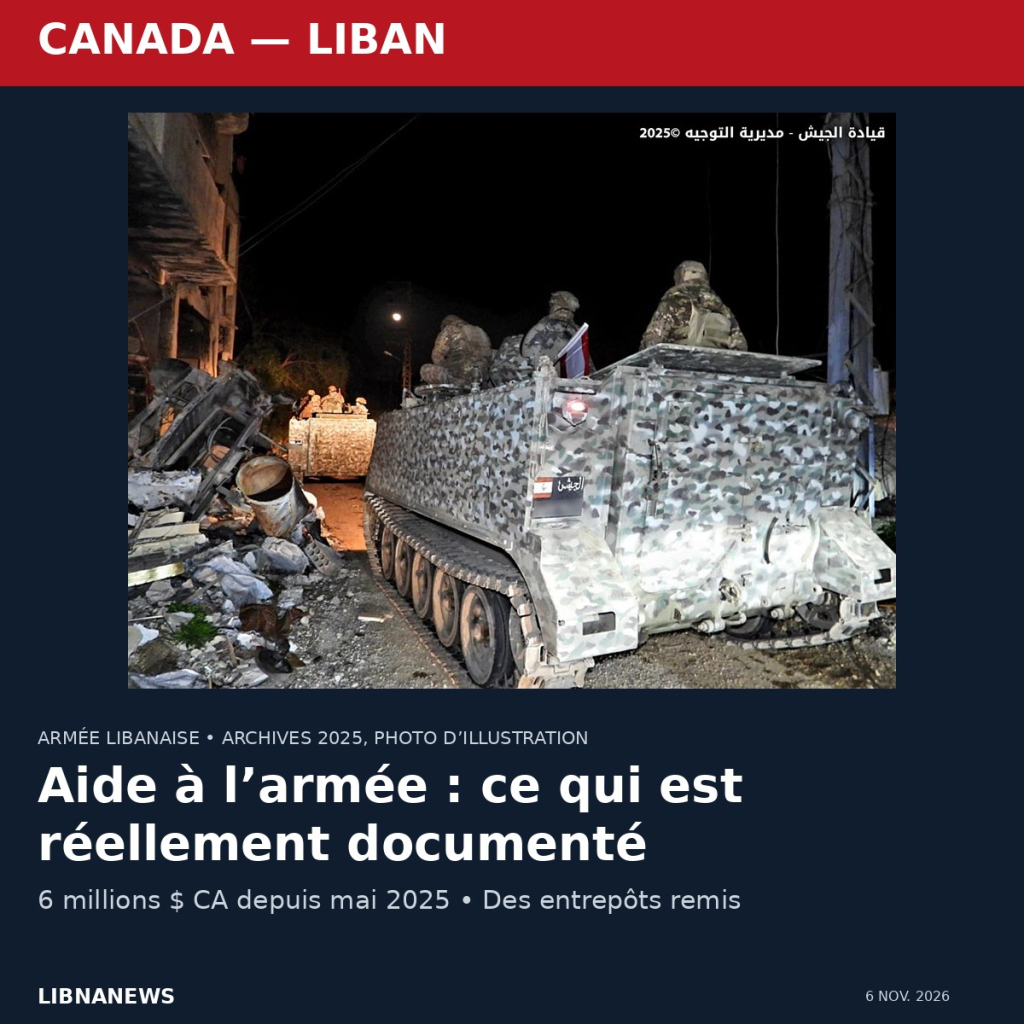
Photograph of Lebanese Army archives, published in February 2025. It does not represent Canadian delivery or Kfarchima warehouses. Libnanews coverage. Photo source Libnanews, media 259840: https://img.libnanews.com/wp-content/uploads/2025/02/armee-libanaise-18-February.jpg . Original credit from the direction of direction retained. Integral photo, without retouching or cropping, resizing and dressing off photo only.





Comments