

The powers of the outgoing Israeli government do not disappear with the elections. During the coalition negotiations, Benjamin Netanyahu and his ministers continued to perform their duties. This continuity is based on the Basic Law on Government. However, it does not give them unlimited freedom: case law requires restraint adapted to their situation, while allowing them to act when a vital public interest dictates it.
For Lebanon, distinction is essential. Negotiations opened after the Israeli election do not automatically suspend diplomatic or military decisions. Nor do they guarantee that a weakened executive can engage in any new policy without control. The question relates to the legal competence, procedures and circumstances of each decision.
The powers of the outgoing government remain legally valid
Article 30 of the Basic Law provides for the continuity of the executive. After the election of a new Knesset, the current government continues to perform its functions until the next one is established. The scheme avoids that a coalition negotiation, even if prolonged, leaves the administration without political authority.
The mandate given by the President to a candidate does not, therefore, alone lead to the departure of the outgoing Prime Minister. It opens a training attempt. The next government has yet to be formed according to the procedures laid down, and then gain the confidence of the Knesset.
These steps are not interchangeable. Recommending a candidate to the President, receiving the mission of forming a coalition and actually taking office are three different events. Nor does an agreement between party leaders replace the necessary institutional acts.
The law even provides for the possibility of replacing certain ministers who cease to be in office during that period. Article 30 allows the outgoing government to appoint a member of the Knesset in their place without seeking parliamentary approval normally necessary. This provision illustrates the priority given to administrative continuity.
A restraint obligation, rather than a list of permitted actions
The constitutional text does not reduce the executive to a list of daily tasks. The limitations also come from the jurisprudence and directives of the Government’s legal counsel. In particular, they aim to prevent the use of the election period to impose choices that are difficult to correct.
The Israeli Institute of Democracy summarizes this doctrine in an explanation published in May 2026. Transition governments have a narrower margin of appreciation. They must exercise restraint, unless there is a vital need to act. In particular, restrictions apply to higher appointments and budgetary decisions that may serve an electoral strategy.
The distinction is concrete. Ensuring the continuity of a service and choosing its new leader for several years does not raise exactly the same issues. Similarly, responding to an immediate emergency does not automatically compare to adopting a structural policy that could await the establishment of a new government.
There is therefore no universal response that an outgoing executive could do anything, or could no longer decide anything. The urgency, the scope of the act, its lasting effects and the possibility of waiting are part of the assessment. The existence of a legal power does not preclude consideration of how to exercise it.
Diplomatic negotiations are not automatically prohibited
An important precedent concerns the talks conducted by Ehud Barak with the Palestinian Authority prior to the 2001 election. Applicants asked the Supreme Court to stop these discussions on the grounds that the Prime Minister had resigned.
In the Weiss judgment of 25 January 2001, the majority did not prohibit negotiations. It distinguished the competences of the outgoing executive from the assessment of its decisions. The government had to reconcile restraint with the need for continuity and essential public interests. One judge expressed a dissenting opinion, which recalls that the application of the principle could cause debate.
This precedent does not give a blank for any future agreement. It shows that an outgoing government status alone is not enough to make negotiations illegal. The nature of the proposed undertaking and the required approvals should be considered separately.
For the discussions concerning Lebanon, it would therefore be excessive to consider the Israeli interlocutor as having no capacity to act. It would be equally excessive to announce that an agreement could be reached without any constraint because the government remains in place. The content of the text and the procedure followed remain decisive.
Military decisions are always procedural
Article 40 of the Basic Law regulates the entry into war and certain major military operations. It provides for a government decision. Under the conditions laid down by the Act, such jurisdiction may be delegated to a ministerial committee provided for by law.
The text distinguishes these decisions from other military actions necessary for State defence and public security. It also organises the information of the relevant parliamentary bodies. The status of outgoing government does not erase this architecture.
These provisions do not predict a specific operation. They indicate the authorities and procedures that Israeli law recognizes. They do not state whether a given decision complies with international law, a separate issue of internal division of powers.
A military act may thus fall within the jurisdiction of the institutions empowered under domestic law and remain contested under other obligations. For Lebanon, the analysis of the transitional period must keep these two plans separate. The continuity of the Israeli Government does not constitute a general legal justification for its operations in Lebanese territory.
Parliament retains its own role
The formation of a coalition occupies the political debate, but it does not absorb all the functions of the Knesset. The Basic Law provides for the collective responsibility of the Government before it. It also organises the transmission of information to committees, subject to the rules applicable to sensitive issues.
The report of parliamentary forces therefore remains important during the transition. A new political majority may influence the control of the executive, even before another cabinet is established. Its possibilities, however, depend on parliamentary rules and organization, not just statements by party leaders.
In order to monitor the consequences of the Israeli elections, three cases must be observed separately: the formation of the government, the Cabinet’s decisions still in office and the exercise of parliamentary control. The forthcoming appointment of a candidate to form a coalition will only respond to the first. Diplomatic and military acts should continue to be examined according to their content and procedure.
Credit Line
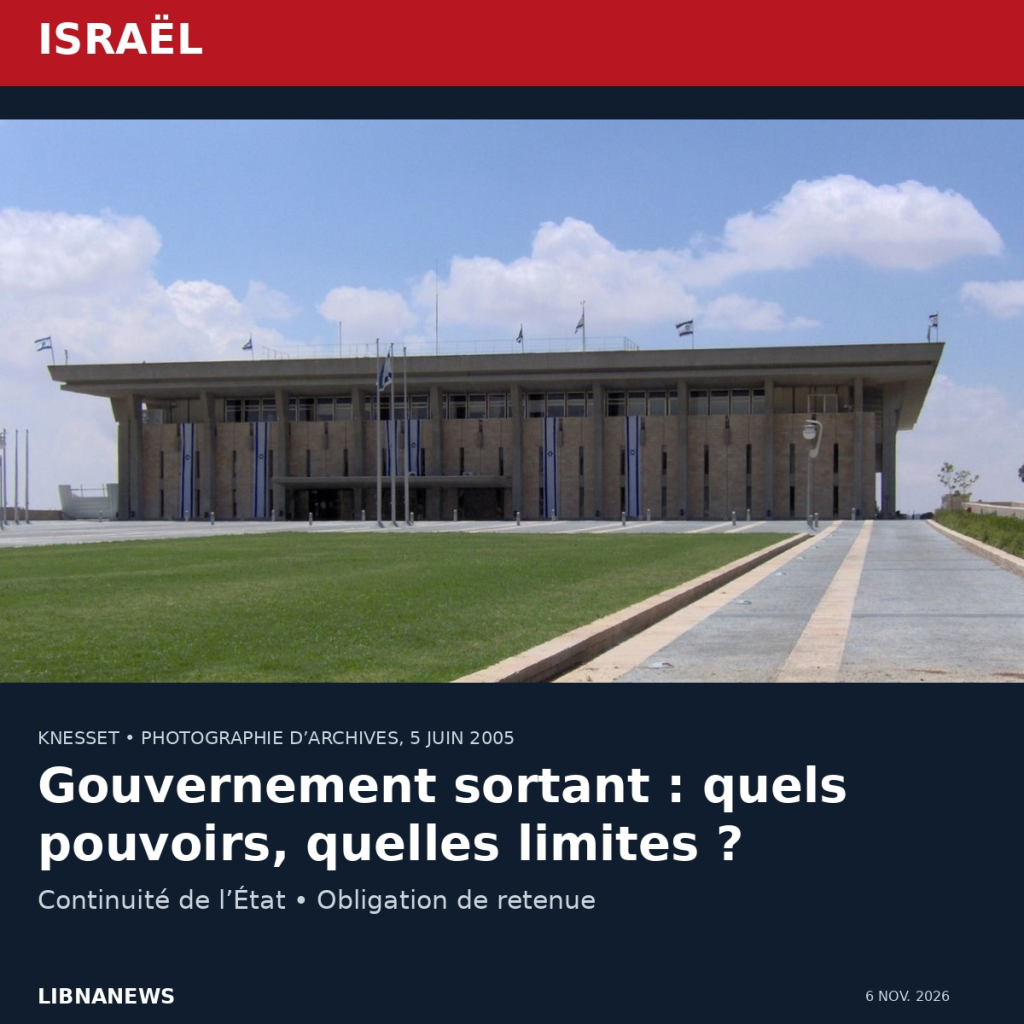
La Knesset, 5 June 2005. Photo Joshua Paquin, CC BY 2.0; perspective corrected by Berthold Werner in the source version. Illustration of archives. Dress Libnanews. Source: https://commons.wikimedia.org/wiki/File:Knesset building.jpg . License: https://creativecommons.org/licenses/by/2.0/ . Resized full picture, no new cropping or change of perspective. Texts added outside photography.





Comments